Brazil Hams, Shoulders and Cuts of Swine Market Size, Share & Growth Rate
The Brazil Hams, Shoulders and Cuts of Swine Market was estimated at USD 176 Million in 2025 and is projected to reach USD 209 Million by 2032, growing at a CAGR of 2.5% from 2026 to 2032. This steady growth trajectory reflects the market's resilience amid fluctuations in feed prices and shifting consumer preferences for high-quality processed meats. The commitment to maintaining rigorous hygiene standards and leveraging international trade agreements further bolsters Brazil's reputation in the global pork market.
Brazil Hams, Shoulders and Cuts of Swine Market Year-wise Growth Rate and Key Drivers
This graph highlights how the Brazil Hams, Shoulders and Cuts of Swine Market has steadily grown over the years, supported by major growth factors.
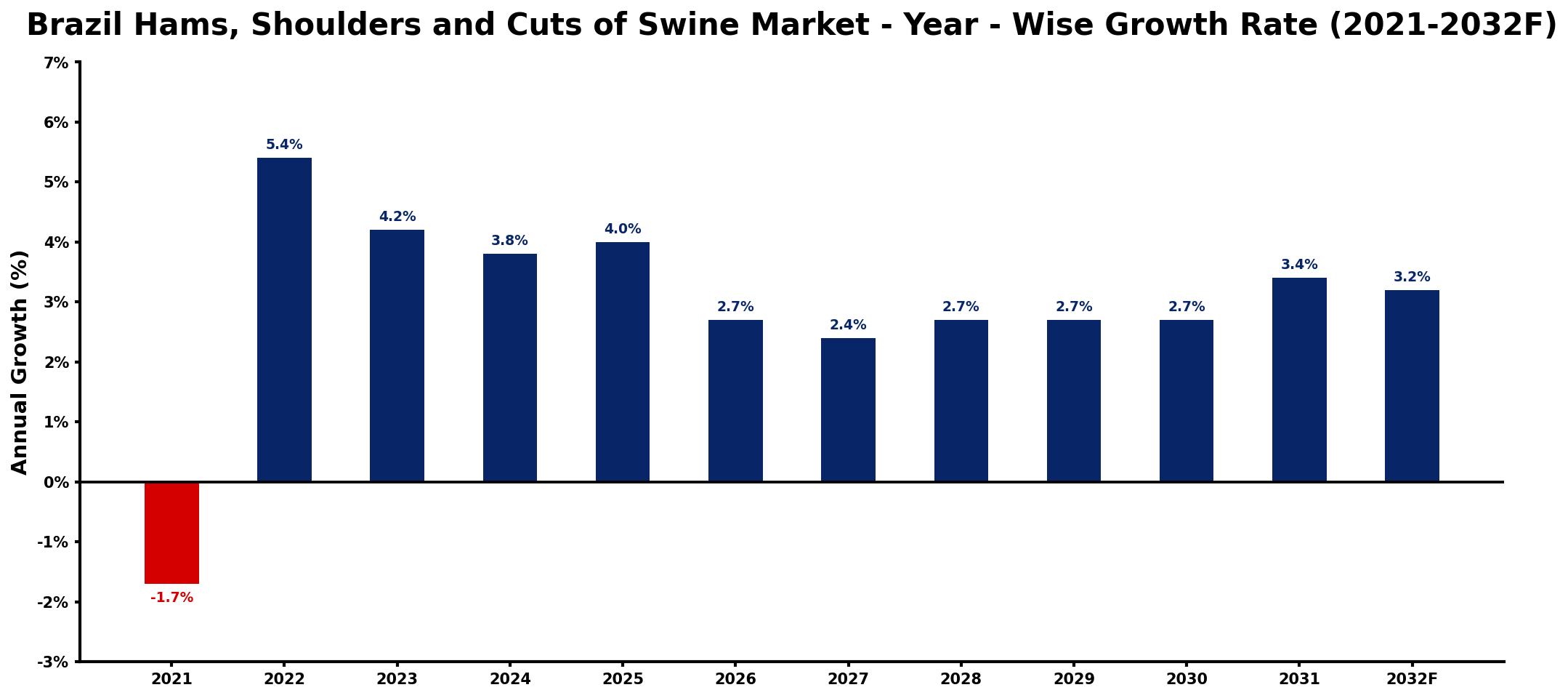
The table below presents the year‑wise growth rates along with the key drivers influencing the market
| Year | Growth Rate | Major Drivers |
| 2021 | -1.7% | Supply chain disruptions affecting availability |
| 2022 | 5.4% | Rising consumer demand for protein |
| 2023 | 4.2% | Increased export opportunities emerging |
| 2024 | 3.8% | Health trends favoring lean meats |
| 2025 | 4.0% | Investment in processing technology growth |
| 2026 | 2.7% | Expansion of retail distribution channels |
| 2027 | 2.4% | Sustainable farming practices gaining traction |
| 2028 | 2.7% | Growing popularity of gourmet products |
| 2029 | 2.7% | expanding manufacturing base activity |
| 2030 | 2.7% | Rising disposable income among consumers |
| 2031 | 3.4% | E-commerce sales driving market reach |
| 2032 | 3.2% | Innovations in product offerings advancing |
Note: Market size estimations and growth projections presented in this report are based on 6Wresearch's proprietary forecasting methodology, utilizing the latest available industry data, government publications, and primary research inputs.
Brazil Hams, Shoulders and Cuts of Swine Market Synopsis
In recent years, the Brazilian market for hams, shoulders, and cuts of swine has demonstrated a robust performance, benefiting from increasing domestic demand and a surge in exports. However, as we look ahead, the market is expected to navigate a landscape marked by evolving consumer trends and external trade dynamics.
Emerging consumer preferences for premium, traceable meat products are reshaping the competitive landscape, introducing both challenges and opportunities for producers. The focus on product differentiation, driven by a desire for quality and sustainability, will likely define the future trajectory of the Brazil Hams, Shoulders and Cuts of Swine Market.
Brazil Hams, Shoulders and Cuts of Swine Market Key Takeaways
- The market is projected to grow steadily, driven by both domestic consumption and export opportunities.
- Consumer demand is increasingly shifting towards high-quality, traceable meat products.
- Stringent hygiene standards and regulations are pivotal in maintaining market credibility.
- Market players face the dual challenge of price volatility and competition from imports.
- Government policies and international trade agreements significantly impact market dynamics.
Evaluation of Restraints in Brazil Hams, Shoulders and Cuts of Swine Market
The Brazil Hams, Shoulders and Cuts of Swine Market faces significant restraints that could hamper its growth trajectory. Chief among these are price volatility, which can severely impact profitability for producers and processors. Furthermore, stringent sanitary regulations and compliance requirements create an additional layer of complexity, particularly for smaller market players. Additionally, international trade barriers can limit market access, making it challenging for Brazilian products to compete in foreign markets. These factors necessitate a strategic approach from industry stakeholders to mitigate risks while maximizing growth opportunities.
Brazil Hams, Shoulders and Cuts of Swine Market Trends
Several key trends are emerging within the Brazil Hams, Shoulders and Cuts of Swine Market that warrant attention. First, there is a noticeable shift towards the production of organic and sustainably sourced pork, driven by consumer demand for healthier and ethically produced food options. Additionally, advancements in processing technologies are enhancing product quality and extending shelf life, thereby improving market competitiveness. Lastly, the integration of digital traceability solutions is becoming increasingly important, allowing consumers to connect with the source of their food, thus reinforcing trust and brand loyalty.
Brazil Hams, Shoulders and Cuts of Swine Market Opportunities
The Brazil Hams, Shoulders and Cuts of Swine Market presents several promising growth and investment opportunities. The expanding export markets, particularly in Asia and Europe, are ripe for exploration. Furthermore, the growing trend of online meat retailing offers producers new avenues to reach consumers directly. Investing in R&D for innovative processing methods and product differentiation can also provide a competitive edge. Lastly, aligning with governmental initiatives promoting sustainable agricultural practices could enhance brand reputation and consumer appeal.
Government Initiatives in the Brazil Hams, Shoulders and Cuts of Swine Market
The Brazilian government has instituted various policies aimed at bolstering the hams, shoulders, and cuts of swine market. These initiatives focus on improving food safety standards, enhancing export capabilities, and promoting sustainable farming practices. Public spending on agricultural research and development is aimed at fostering innovation within the sector, ensuring that Brazil remains competitive in the global pork market. Furthermore, trade agreements are being leveraged to facilitate market access for Brazilian pork products, which is essential for future growth.
Future Insights of the Brazil Hams, Shoulders and Cuts of Swine Market
Looking ahead to the period from 2026 to 2032, the Brazil Hams, Shoulders and Cuts of Swine Market is set to experience a gradual yet steady growth trajectory. Demand for high-quality and ethically produced pork is expected to rise, driven by evolving consumer preferences. As producers adapt to these changes and improve operational efficiencies, the market is likely to embrace innovations that enhance product quality and traceability. Overall, a combination of favorable trade dynamics and a focus on sustainable practices will play a pivotal role in shaping the future landscape of this market.
Brazil Hams, Shoulders and Cuts of Swine Market Latest Developments (2025 - 2026)
Recent developments in the Brazil Hams, Shoulders and Cuts of Swine Market have highlighted a concerted effort among producers to enhance sustainability and product quality. Industry stakeholders are increasingly adopting advanced processing techniques to meet the rising consumer demand for premium products. Additionally, collaborations between government and private sectors aim to improve export conditions, facilitating broader access to international markets. As the market continues to evolve, staying abreast of these trends will be crucial for participants aiming to maintain a competitive edge.
Brazil Hams, Shoulders and Cuts of Swine Market - Key Attractiveness of the Report
- 10 Years of Market Numbers
- Historical Data Starting from 2022 to 2025
- Base Year: 2025
- Forecast Data until 2032
- Key Performance Indicators Impacting the Market
- Major Upcoming Developments and Projects
Key Highlights of the Report:
- Brazil Hams, Shoulders and Cuts of Swine Market Outlook
- Market Size of Brazil Hams, Shoulders and Cuts of Swine Market, 2025
- Forecast of Brazil Hams, Shoulders and Cuts of Swine Market, 2032
- Historical Data and Forecast of Brazil Hams, Shoulders and Cuts of Swine Revenues & Volume for the Period 2022-2032F
- Brazil Hams, Shoulders and Cuts of Swine Market Trend Evolution
- Brazil Hams, Shoulders and Cuts of Swine Market Drivers and Challenges
- Brazil Hams, Shoulders and Cuts of Swine Price Trends
- Brazil Hams, Shoulders and Cuts of Swine Porter's Five Forces
- Brazil Hams, Shoulders and Cuts of Swine Industry Life Cycle
- Historical Data and Forecast of Brazil Hams, Shoulders and Cuts of Swine Market Revenues & Volume By Product Type for the Period 2022-2032F
- Historical Data and Forecast of Brazil Hams, Shoulders and Cuts of Swine Market Revenues & Volume By Processed Meat for the Period 2022-2032F
- Historical Data and Forecast of Brazil Hams, Shoulders and Cuts of Swine Market Revenues & Volume By Frozen Meat for the Period 2022-2032F
- Historical Data and Forecast of Brazil Hams, Shoulders and Cuts of Swine Market Revenues & Volume By Chilled Meat for the Period 2022-2032F
- Historical Data and Forecast of Brazil Hams, Shoulders and Cuts of Swine Market Revenues & Volume By Canned Meat for the Period 2022-2032F
- Historical Data and Forecast of Brazil Hams, Shoulders and Cuts of Swine Market Revenues & Volume By Fresh Meat for the Period 2022-2032F
- Historical Data and Forecast of Brazil Hams, Shoulders and Cuts of Swine Market Revenues & Volume By Animal Type for the Period 2022-2032F
- Historical Data and Forecast of Brazil Hams, Shoulders and Cuts of Swine Market Revenues & Volume By Cattle and Buffalo for the Period 2022-2032F
- Historical Data and Forecast of Brazil Hams, Shoulders and Cuts of Swine Market Revenues & Volume By Pig for the Period 2022-2032F
- Historical Data and Forecast of Brazil Hams, Shoulders and Cuts of Swine Market Revenues & Volume By Poultry for the Period 2022-2032F
- Historical Data and Forecast of Brazil Hams, Shoulders and Cuts of Swine Market Revenues & Volume By Sheep and Goat for the Period 2022-2032F
- Historical Data and Forecast of Brazil Hams, Shoulders and Cuts of Swine Market Revenues & Volume By Other Animals for the Period 2022-2032F
- Historical Data and Forecast of Brazil Hams, Shoulders and Cuts of Swine Market Revenues & Volume By Distribution Channel for the Period 2022-2032F
- Historical Data and Forecast of Brazil Hams, Shoulders and Cuts of Swine Market Revenues & Volume By Business to Consumers (B2C) for the Period 2022-2032F
- Historical Data and Forecast of Brazil Hams, Shoulders and Cuts of Swine Market Revenues & Volume By Modern Groceries for the Period 2022-2032F
- Historical Data and Forecast of Brazil Hams, Shoulders and Cuts of Swine Market Revenues & Volume By Wet & Butcher Shops for the Period 2022-2032F
- Historical Data and Forecast of Brazil Hams, Shoulders and Cuts of Swine Market Revenues & Volume By Convenience Stores for the Period 2022-2032F
- Historical Data and Forecast of Brazil Hams, Shoulders and Cuts of Swine Market Revenues & Volume By Business to Business (B2B) for the Period 2022-2032F
- Historical Data and Forecast of Brazil Hams, Shoulders and Cuts of Swine Market Revenues & Volume By Other Channel for the Period 2022-2032F
- Brazil Hams, Shoulders and Cuts of Swine Import Export Trade Statistics
- Market Opportunity Assessment By Product Type
- Market Opportunity Assessment By Animal Type
- Market Opportunity Assessment By Distribution Channel
- Brazil Hams, Shoulders and Cuts of Swine Top Companies Market Share
- Brazil Hams, Shoulders and Cuts of Swine Competitive Benchmarking By Technical and Operational Parameters
- Brazil Hams, Shoulders and Cuts of Swine Company Profiles
- Brazil Hams, Shoulders and Cuts of Swine Key Strategic Recommendations






































