Brazil Household Textile Market Summary
The brazil household textile market was estimated at USD 461 Million in 2025 and is projected to reach USD 553 Million by 2032, growing at a CAGR of 2.8% from 2026 to 2032.
Brazil Household Textile Market Year-wise Growth Rate and Key Drivers
This graph highlights how the Brazil Household Textile Market has steadily grown over the past five years, supported by major growth factors.
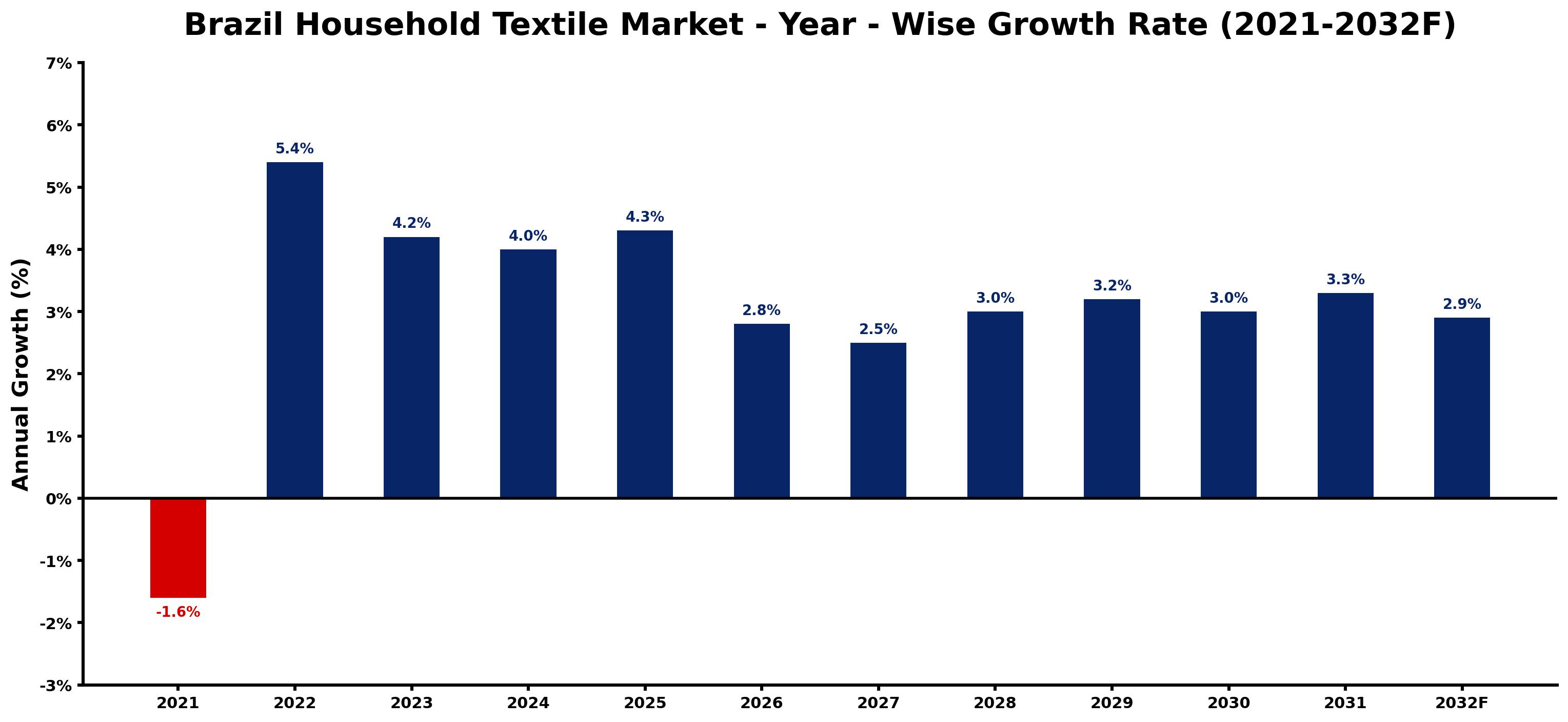
The table below presents the year wise growth rates along with the key drivers influencing the market
| Year | Growth Rate | Major Drivers |
| 2021 | -1.6% | Pandemicrelated supply chain disruptions led to increased prices and decreased availability of household textiles. |
| 2022 | 5.4% | Sustainability initiatives gained traction, influencing consumer preferences for eco-friendly textiles. |
| 2023 | 4.2% | Innovative designs became essential as millennials and Gen Z embraced home décor trends. |
| 2024 | 4.0% | E-commerce expansion allowed small textile brands to reach broader audiences effectively. |
| 2025 | 4.3% | Rising disposable incomes contributed to increased spending on premium household textiles. |
| 2026 | 2.8% | Local manufacturing initiatives emerged, enhancing product availability and reducing lead times. |
| 2027 | 2.5% | Consumer awareness of health and hygiene led to a preference for antimicrobial textiles. |
| 2028 | 3.0% | Urbanization trends drove demand for versatile and space-saving textile solutions. |
| 2029 | 3.2% | Technological integration in production boosted efficiency, impacting pricing strategies positively. |
| 2030 | 3.0% | Cultural influences from popular media stimulated interest in diverse textile patterns. |
| 2031 | 3.3% | Collaborations with international brands provided fresh perspectives and unique product offerings. |
| 2032 | 2.9% | Adoption of smart textiles began, integrating technology into everyday household items. |
Note - Market size estimations and growth projections presented in this report are based on 6Wresearch's advanced forecasting approach, validated with industry datasets as of June 2026.
Brazil Household Textile Market Synopsis
The Brazil Household Textile Market is projected to reach 2.8% and witness significant growth during the forecast period (2026-2032). The diverse landscape of this market encompasses a broad range of products, including bedding, towels, and upholstery, catering to the evolving consumer preferences for comfort and aesthetic appeal within home interiors. As sustainable and eco-friendly practices gain momentum, they are not only shaping production processes but also influencing consumer decisions across the household textile sector.
Brazil Household Textile Market Growth Drivers
Several factors are driving the growth of the Brazil Household Textile Market. Key among them are:
- The rise in disposable income levels among Brazilian consumers, leading to increased spending on home furnishings and improvements.
- Current trends in home decor, which emphasize comfort and quality, are encouraging consumers to upgrade their household textiles.
- Growing consumer awareness regarding health and well-being, which is leading to a preference for organic and sustainable textile options.
- An increase in urbanization, resulting in smaller living spaces where high-quality textiles serve both functional and decorative purposes.
- The influence of social media and interior design trends, which motivate homeowners to invest in stylish and modern household textiles.
Brazil Household Textile Market Challenges and Restraints
While the Brazil Household Textile Market shows promise, it faces several challenges that could impact its trajectory:
- Volatility in the prices of raw materials, particularly cotton and synthetic fibers, which can affect production costs and pricing strategies.
- Shifting consumer preferences towards sustainable products, which may pose barriers for manufacturers who are not yet compliant with eco-friendly practices.
- Complications in supply chain management, exacerbated by logistics challenges and fluctuating demand dynamics.
- Environmental concerns are increasing scrutiny on production processes, necessitating companies to adopt more transparent and responsible manufacturing methods.
- The competitive landscape is becoming increasingly crowded, making it more challenging for new entrants to establish a foothold without significant investment in brand differentiation.
Brazil Household Textile Market Trends and Opportunities
The Brazil Household Textile Market is witnessing several trends that herald new opportunities for stakeholders:
- The growing inclination towards e-commerce platforms for purchasing household textiles is reshaping traditional retail channels.
- Innovative textile technologies, such as antimicrobial and moisture-wicking fabrics, are being developed to meet changing consumer demands.
- Personalization in home textiles, where consumers seek unique and customized products to reflect their individual tastes.
- Increased collaboration between designers and textile manufacturers to create limited-edition collections that appeal to niche markets.
- The emphasis on wellness and ergonomics in textile design is driving demand for textiles that enhance comfort and promote better sleep.
Brazil Household Textile Market Government Investment and Initiatives
Government policies significantly influence the Brazil Household Textile Market, providing various initiatives and regulatory frameworks aimed at promoting sustainable practices and consumer safety:
- The Brazilian government is focused on establishing high product standards and safety regulations within the textile industry to protect consumers.
- Incentives for using eco-friendly materials are being introduced, encouraging manufacturers to embrace sustainable materials in their production processes.
- Labeling requirements have been put in place to ensure transparency regarding the materials used, helping consumers make informed purchasing decisions.
- Public spending on research and development in the textile sector aims to innovate and improve the quality of household textiles available in the market.
- Efforts are being made to address environmental concerns, with policies promoting responsible manufacturing to ensure minimal ecological impact.
Brazil Household Textile Market Latest Developments (May 2025 - June 2026)
In the period from May 2025 to June 2026, the Brazil Household Textile Market has experienced noteworthy developments that indicate a shift towards sustainability and innovation:
- Increased investment in sustainable textile manufacturing technologies is being observed, aimed at minimizing waste and enhancing production efficiency.
- The emergence of new players in the online retail space is facilitating easier access to a wider range of household textile products for consumers.
- Brands are increasingly adopting circular economy principles, focusing on product lifecycle management and recyclability to appeal to eco-conscious consumers.
- Collaborations with local artisans are becoming more common, blending traditional craftsmanship with modern designs to enhance product appeal.
- Consumer education campaigns on the benefits of sustainable textiles are gaining traction, driving higher awareness and demand for eco-friendly products.
Brazil Household Textile Market - Key Attractiveness of the Report
- 10 Years of Market Numbers
- Historical Data Starting from 2022 to 2025
- Base Year: 2025
- Forecast Data until 2032
- Key Performance Indicators Impacting the Market
- Major Upcoming Developments and Projects
Key Highlights of the Report:
- Brazil Household Textile Market Outlook
- Market Size of Brazil Household Textile Market, 2025
- Forecast of Brazil Household Textile Market, 2032
- Historical Data and Forecast of Brazil Household Textile Revenues & Volume for the Period 2022-2032F
- Brazil Household Textile Market Trend Evolution
- Brazil Household Textile Market Drivers and Challenges
- Brazil Household Textile Price Trends
- Brazil Household Textile Porter's Five Forces
- Brazil Household Textile Industry Life Cycle
- Historical Data and Forecast of Brazil Household Textile Market Revenues & Volume By Type for the Period 2022-2032F
- Historical Data and Forecast of Brazil Household Textile Market Revenues & Volume By Non-woven Textile for the Period 2022-2032F
- Historical Data and Forecast of Brazil Household Textile Market Revenues & Volume By Woven Textile for the Period 2022-2032F
- Historical Data and Forecast of Brazil Household Textile Market Revenues & Volume By Application for the Period 2022-2032F
- Historical Data and Forecast of Brazil Household Textile Market Revenues & Volume By Bed for the Period 2022-2032F
- Historical Data and Forecast of Brazil Household Textile Market Revenues & Volume By Furniture for the Period 2022-2032F
- Historical Data and Forecast of Brazil Household Textile Market Revenues & Volume By Door & Window for the Period 2022-2032F
- Historical Data and Forecast of Brazil Household Textile Market Revenues & Volume By Dining & Wash for the Period 2022-2032F
- Historical Data and Forecast of Brazil Household Textile Market Revenues & Volume By Ground for the Period 2022-2032F
- Brazil Household Textile Import Export Trade Statistics
- Market Opportunity Assessment By Type
- Market Opportunity Assessment By Application
- Brazil Household Textile Top Companies Market Share
- Brazil Household Textile Competitive Benchmarking By Technical and Operational Parameters
- Brazil Household Textile Company Profiles
- Brazil Household Textile Key Strategic Recommendations






































