Brazil Industrial Computers Market Summary
The brazil industrial computers market was estimated at USD 128 Million in 2025 and is projected to reach USD 152 Million by 2032, growing at a CAGR of 3.0% from 2026 to 2032.
Brazil Industrial Computers Market Year-wise Growth Rate and Key Drivers
This graph highlights how the Brazil Industrial Computers Market has steadily grown over the past five years, supported by major growth factors.
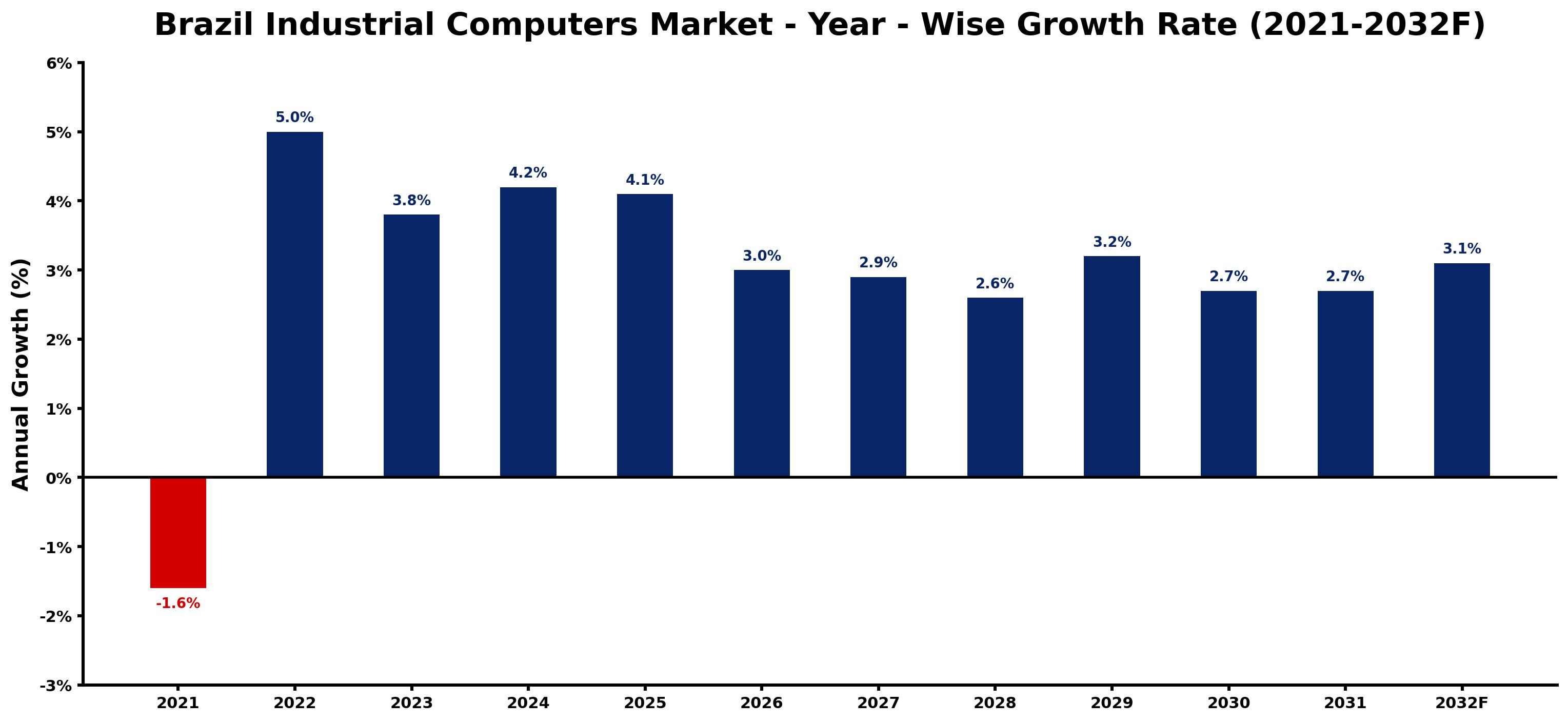
The table below presents the year wise growth rates along with the key drivers influencing the market
| Year | Growth Rate | Major Drivers |
| 2021 | -1.6% | Supply chain disruptions led to prolonged delivery delays, hampering production and increasing operational costs for manufacturers. |
| 2022 | 5.0% | Manufacturers began embracing smart factory concepts to enhance operational efficiencies. |
| 2023 | 3.8% | Supply chain disruptions prompted businesses to invest in resilient computing solutions. |
| 2024 | 4.2% | Emerging technologies such as AI and IoT gained traction in industrial settings. |
| 2025 | 4.1% | Local production of industrial computers reduced import dependencies and costs significantly. |
| 2026 | 3.0% | Increased focus on energy efficiency made industrial computing essential for compliance. |
| 2027 | 2.9% | Partnerships between tech firms and industries fostered innovation in software solutions. |
| 2028 | 2.6% | Sustainability initiatives spurred demand for eco-friendly industrial computing options. |
| 2029 | 3.2% | Investment in infrastructure improvements created opportunities for advanced computing applications. |
| 2030 | 2.7% | Heightened cybersecurity concerns prompted industries to upgrade their computing systems. |
| 2031 | 2.7% | Integration of cloud technologies transformed traditional industrial computing landscapes. |
| 2032 | 3.1% | Competitive market dynamics encouraged ongoing innovation in industrial computing solutions. |
Note - Market size estimations and growth projections presented in this report are based on 6Wresearch's advanced forecasting approach, validated with industry datasets as of June 2026.
Brazil Industrial Computers Market Synopsis
The Brazil Industrial Computers Market is projected to reach 3.0% and witness significant growth during the forecast period (2026-2032). The increasing integration of automation and digital technologies across various sectors drives this expansion. Manufacturers and process control industries are increasingly seeking specialized computing solutions to enhance efficiency, reliability, and performance. This burgeoning demand presents both opportunities and challenges within the market.
Brazil Industrial Computers Market Growth Drivers
The key drivers behind the Brazil Industrial Computers Market include:
- The heightened need for automation in industrial processes is a major factor. Manufacturers are adopting advanced technologies to streamline operations, thus requiring robust computing solutions.
- Smart manufacturing and the embrace of Industry 4.0 practices are accelerating demand for industrial computers, as companies strive for enhanced productivity and operational efficiency.
- The growing emphasis on data analytics and real-time monitoring capabilities necessitates powerful computing hardware capable of processing large volumes of data seamlessly.
- As industries evolve, there is an increasing focus on integrating IoT devices, further driving the need for specialized industrial computing systems that can handle diverse input sources.
- The push for sustainability and energy efficiency in manufacturing processes incentivizes the adoption of advanced computing technologies that optimize resource usage.
Brazil Industrial Computers Market Challenges and Restraints
Despite the promising growth trajectory, the Brazil Industrial Computers Market faces several challenges:
- Technological obsolescence is a significant concern, as rapid advancements in technology require continuous upgrades to maintain competitive advantage.
- Businesses often struggle with ensuring cybersecurity, particularly as industrial computers become more interconnected and susceptible to cyber threats.
- The high costs associated with adopting cutting-edge computing technologies can be a barrier for smaller enterprises, limiting their ability to compete effectively in the market.
- Compatibility with evolving industrial processes presents a challenge, as companies must ensure that their computing solutions can adapt to new methodologies and technological advancements.
- Supply chain disruptions may affect the availability of key components, thereby impacting the timely rollout of new computing solutions in various industries.
Brazil Industrial Computers Market Government Investment and Initiatives
Government policies in Brazil play a crucial role in shaping the landscape of the industrial computers market. The Brazilian government has implemented various supportive measures aimed at fostering technology adoption within the manufacturing sector. Key initiatives include:
- Tax incentives designed to encourage companies to invest in advanced computing technology have been introduced, aiming to boost productivity and efficiency across industries.
- Subsidies for research and development in industrial automation technologies are offered, supporting innovation and technological advancements.
- Government policies emphasize the importance of cybersecurity frameworks to protect critical industrial systems, ensuring that companies prioritize data security during technology implementation.
- Investment in infrastructure development, particularly in technology parks and innovation hubs, facilitates collaboration between businesses and research institutions.
- Public-private partnerships are being promoted to enhance technology transfer and local production capabilities, ultimately strengthening the domestic industrial computing landscape.
Brazil Industrial Computers Market Trends and Opportunities
As the Brazil Industrial Computers Market continues to evolve, several key trends are emerging:
- The integration of AI and machine learning capabilities into industrial computers is expected to enhance operational efficiency and predictive maintenance capabilities across various sectors.
- Increased adoption of cloud computing solutions presents opportunities for industrial computers to offer enhanced scalability, flexibility, and data accessibility.
- Demand for ruggedized and specialized computing solutions is growing, particularly in sectors such as mining and oil & gas, where environmental conditions pose additional challenges.
- Customization of industrial computing solutions to meet specific industry needs allows for greater adaptation and efficiency, creating opportunities for innovation.
- The rise of edge computing is likely to influence the development of industrial computers, enabling real-time data processing closer to the source of information and enhancing decision-making processes.
Brazil Industrial Computers Market Latest Developments (May 2025 - June 2026)
During the period from May 2025 to June 2026, the Brazil Industrial Computers Market has seen significant developments. Industry stakeholders have increasingly focused on enhancing the interoperability of industrial computers with IoT devices, enabling seamless data exchange and smarter operational capabilities. The emphasis on sustainability has led companies to explore energy-efficient solutions, promoting green computing technologies within the industrial landscape. Furthermore, regional partnerships have been fostered to advance research and development initiatives, enabling local businesses to innovate and compete more effectively in the global market. The shift towards hybrid computing models has also gained traction, allowing industries to combine on-premise computing with cloud-based solutions to optimize their operations.
Brazil Industrial Computers Market - Key Attractiveness of the Report
- 10 Years of Market Numbers
- Historical Data Starting from 2022 to 2025
- Base Year: 2025
- Forecast Data until 2032
- Key Performance Indicators Impacting the Market
- Major Upcoming Developments and Projects
Key Highlights of the Report:
- Brazil Industrial Computers Market Outlook
- Market Size of Brazil Industrial Computers Market, 2025
- Forecast of Brazil Industrial Computers Market, 2032
- Historical Data and Forecast of Brazil Industrial Computers Revenues & Volume for the Period 2022-2032F
- Brazil Industrial Computers Market Trend Evolution
- Brazil Industrial Computers Market Drivers and Challenges
- Brazil Industrial Computers Price Trends
- Brazil Industrial Computers Porter's Five Forces
- Brazil Industrial Computers Industry Life Cycle
- Historical Data and Forecast of Brazil Industrial Computers Market Revenues & Volume By Type for the Period 2022-2032F
- Historical Data and Forecast of Brazil Industrial Computers Market Revenues & Volume By Panel for the Period 2022-2032F
- Historical Data and Forecast of Brazil Industrial Computers Market Revenues & Volume By Box for the Period 2022-2032F
- Historical Data and Forecast of Brazil Industrial Computers Market Revenues & Volume By Embedded for the Period 2022-2032F
- Historical Data and Forecast of Brazil Industrial Computers Market Revenues & Volume By Din Rail for the Period 2022-2032F
- Historical Data and Forecast of Brazil Industrial Computers Market Revenues & Volume By Rack Mount for the Period 2022-2032F
- Historical Data and Forecast of Brazil Industrial Computers Market Revenues & Volume By Thin Client for the Period 2022-2032F
- Historical Data and Forecast of Brazil Industrial Computers Market Revenues & Volume By Technology for the Period 2022-2032F
- Historical Data and Forecast of Brazil Industrial Computers Market Revenues & Volume By Resistive for the Period 2022-2032F
- Historical Data and Forecast of Brazil Industrial Computers Market Revenues & Volume By Capacitive for the Period 2022-2032F
- Historical Data and Forecast of Brazil Industrial Computers Market Revenues & Volume By Others for the Period 2022-2032F
- Historical Data and Forecast of Brazil Industrial Computers Market Revenues & Volume By ?End Use for the Period 2022-2032F
- Historical Data and Forecast of Brazil Industrial Computers Market Revenues & Volume By Automotive for the Period 2022-2032F
- Historical Data and Forecast of Brazil Industrial Computers Market Revenues & Volume By Chemicals for the Period 2022-2032F
- Historical Data and Forecast of Brazil Industrial Computers Market Revenues & Volume By Electronics for the Period 2022-2032F
- Historical Data and Forecast of Brazil Industrial Computers Market Revenues & Volume By Oil & Gas for the Period 2022-2032F
- Historical Data and Forecast of Brazil Industrial Computers Market Revenues & Volume By Food & Beverages for the Period 2022-2032F
- Historical Data and Forecast of Brazil Industrial Computers Market Revenues & Volume By Pharmaceuticals for the Period 2022-2032F
- Historical Data and Forecast of Brazil Industrial Computers Market Revenues & Volume By Others for the Period 2022-2032F
- Brazil Industrial Computers Import Export Trade Statistics
- Market Opportunity Assessment By Type
- Market Opportunity Assessment By Technology
- Market Opportunity Assessment By ?End Use
- Brazil Industrial Computers Top Companies Market Share
- Brazil Industrial Computers Competitive Benchmarking By Technical and Operational Parameters
- Brazil Industrial Computers Company Profiles
- Brazil Industrial Computers Key Strategic Recommendations






































