Brazil LED Professional Lighting Market Summary
The brazil led professional lighting market was estimated at USD 368 Million in 2025 and is projected to reach USD 439 Million by 2032, growing at a CAGR of 2.9% from 2026 to 2032.
Brazil LED Professional Lighting Market Year-wise Growth Rate and Key Drivers
This graph highlights how the Brazil LED Professional Lighting Market has steadily grown over the past five years, supported by major growth factors.
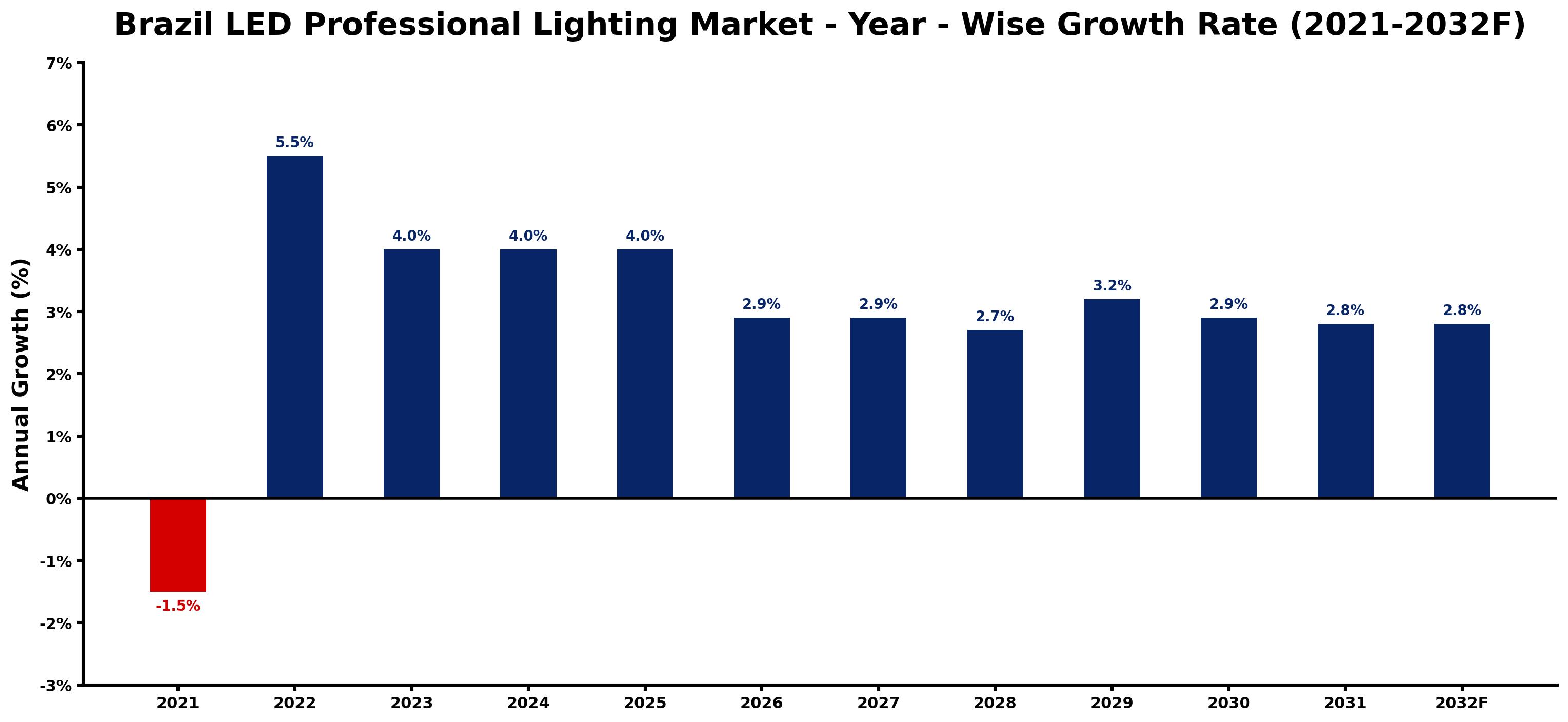
The table below presents the year wise growth rates along with the key drivers influencing the market
| Year | Growth Rate | Major Drivers |
| 2021 | -1.5% | Supply chain disruptions significantly hindered project completions and delayed new installations in the commercial sector. |
| 2022 | 5.5% | Local manufacturers began to innovate, producing cost-effective LED options for consumers. |
| 2023 | 4.0% | Sustainability-focused businesses embraced LED lighting to enhance green building certifications. |
| 2024 | 4.0% | Retail environments increasingly utilized dynamic LED displays to boost customer engagement. |
| 2025 | 4.0% | Corporate responsibility programs prioritized reducing energy costs through LED installations. |
| 2026 | 2.9% | High energy prices compelled residential consumers to seek LED lighting alternatives. |
| 2027 | 2.9% | Technological advancements in smart lighting systems captured attention of urban developers. |
| 2028 | 2.7% | Integration of IoT functionalities in LEDs appealed to tech-savvy Brazilian consumers. |
| 2029 | 3.2% | Public transport infrastructure investments emphasized the need for efficient lighting solutions. |
| 2030 | 2.9% | Growing awareness of health benefits stimulated interest in human-centric LED applications. |
| 2031 | 2.8% | Tourism sector expansion led to increased demand for well-lit public spaces. |
| 2032 | 2.8% | Collaborations between tech firms and lighting manufacturers fostered innovative product offerings. |
Note - Market size estimations and growth projections presented in this report are based on 6Wresearch's advanced forecasting approach, validated with industry datasets as of June 2026.
Brazil LED Professional Lighting Market Synopsis
The Brazil LED Professional Lighting Market is projected to reach 2.9% and witness significant growth during the forecast period (2026-2032). This market has experienced consistent expansion, propelled by the escalating need for high-quality lighting solutions across diverse sectors. Brazil has emerged as a leader in the professional LED lighting segment within Latin America, thanks largely to its robust economic performance and an increasing number of public infrastructure initiatives. These projects necessitate the deployment of modern lighting systems, including those for street lighting, office buildings, and commercial spaces, ensuring efficient and sustainable illumination.
Brazil LED Professional Lighting Market Growth Drivers
Several factors are driving the growth of the Brazil LED Professional Lighting Market. Notably, the trend towards energy-efficient technologies is gaining traction among businesses and governments alike. The benefits of LED lighting, such as lower energy consumption and longer lifespans compared to traditional incandescent and halogen lighting, are becoming increasingly recognized.
- A significant increase in urbanization is leading to heightened demand for efficient lighting solutions in public spaces. As cities expand, the requirement for reliable, durable, and effective lighting systems rises proportionately.
- Government initiatives aimed at reducing carbon emissions and promoting sustainable practices are catalyzing the adoption of LED lighting. Regulatory frameworks are being established to phase out inefficient lighting technologies.
- Technological advancements in LED manufacturing are resulting in the production of more affordable and higher-performing lighting solutions. These innovations contribute to the overall attractiveness of LED options in professional settings.
- The growing focus on infrastructure development, particularly in transportation and public amenities, is driving the demand for modernized lighting systems. Efficient lighting is essential for enhancing safety and visibility.
- Rising awareness among consumers and businesses regarding the long-term cost benefits of LED technology is further fueling market growth. The shift towards sustainable lighting solutions is becoming a priority across various industries.
Brazil LED Professional Lighting Market Trends and Opportunities
The Brazil LED Professional Lighting Market is currently witnessing distinct trends that present ample opportunities for growth. As the market evolves, several key developments are emerging.
- The integration of smart technology into lighting systems is becoming prevalent as cities embrace the Internet of Things (IoT) paradigm. Smart lighting solutions promote enhanced energy management and operational efficiency.
- There is a notable shift toward sustainable and environmentally friendly products, aligning with global efforts to combat climate change. The inclination towards eco-friendly lighting options is expected to broaden market prospects.
- As Brazil continues to invest in infrastructure, including public transportation and urban development, opportunities for LED lighting applications are poised to expand significantly.
- The growth of the commercial sector, including retail and hospitality, is driving demand for aesthetically appealing lighting solutions that enhance customer experience and ambiance.
- Increased collaboration between manufacturers and technology providers is leading to innovative LED solutions tailored to specific industry needs, facilitating broader market penetration.
Brazil LED Professional Lighting Market Government Investment and Initiatives
The Brazilian government is actively investing in initiatives that promote the adoption of LED technology across various public sectors. Strategic policies are being implemented to enhance the energy efficiency standards of lighting, with a focus on sustainability. Additionally, public spending on infrastructure projects is being directed toward incorporating modern lighting solutions that minimize energy consumption and carbon emissions.
- Government-led campaigns to phase out traditional lighting technologies are encouraging municipalities to upgrade to LED systems, particularly in public lighting applications.
- Subsidies and incentives for energy-efficient upgrades are being introduced to stimulate market growth and reduce the overall energy burden on local governments.
- There is a concerted effort towards establishing regulations that mandate the use of energy-efficient lighting solutions in public spaces, thereby driving the demand for LED technology.
- Investment in smart city projects is also influencing the adoption of connected lighting solutions, enhancing urban management and service delivery.
- Collaboration between government entities and private stakeholders is fostering innovation in LED lighting solutions that cater to local needs and preferences.
Brazil LED Professional Lighting Market Latest Developments (May 2025 - June 2026)
Recent developments in the Brazil LED Professional Lighting Market indicate a robust trajectory towards modernization and sustainability. Key industry trends include a surge in public-private partnerships aimed at developing advanced LED solutions tailored for critical infrastructure projects. Notably, municipalities are increasingly adopting smart lighting systems that provide improved control and energy management.
- Legislative measures supporting energy-efficient lighting technologies are being reinforced, fostering an environment conducive to market expansion.
- The emergence of competitive pricing strategies among lighting manufacturers is making LED solutions more accessible to a broader range of end-users.
- Technological innovations continue to enhance the performance and functionality of LED products, ensuring that they meet the evolving demands of various sectors.
- Increased focus on user experience in commercial applications is driving the adoption of aesthetic and customizable lighting solutions.
- Lastly, environmental sustainability initiatives are propelling the demand for eco-friendly LED solutions, aligning with global sustainability goals.
Brazil LED Professional Lighting Market - Key Attractiveness of the Report
- 10 Years of Market Numbers
- Historical Data Starting from 2022 to 2025
- Base Year: 2025
- Forecast Data until 2032
- Key Performance Indicators Impacting the Market
- Major Upcoming Developments and Projects
Key Highlights of the Report:
- Brazil LED Professional Lighting Market Outlook
- Market Size of Brazil LED Professional Lighting Market, 2025
- Forecast of Brazil LED Professional Lighting Market, 2032
- Historical Data and Forecast of Brazil LED Professional Lighting Revenues & Volume for the Period 2022-2032
- Brazil LED Professional Lighting Market Trend Evolution
- Brazil LED Professional Lighting Market Drivers and Challenges
- Brazil LED Professional Lighting Price Trends
- Brazil LED Professional Lighting Porter's Five Forces
- Brazil LED Professional Lighting Industry Life Cycle
- Historical Data and Forecast of Brazil LED Professional Lighting Market Revenues & Volume By Product Type for the Period 2022-2032
- Historical Data and Forecast of Brazil LED Professional Lighting Market Revenues & Volume By LED Bulbs for the Period 2022-2032
- Historical Data and Forecast of Brazil LED Professional Lighting Market Revenues & Volume By LED Fixtures for the Period 2022-2032
- Historical Data and Forecast of Brazil LED Professional Lighting Market Revenues & Volume By Bare LED Tubes for the Period 2022-2032
- Historical Data and Forecast of Brazil LED Professional Lighting Market Revenues & Volume By LED Down lights for the Period 2022-2032
- Historical Data and Forecast of Brazil LED Professional Lighting Market Revenues & Volume By Applications for the Period 2022-2032
- Historical Data and Forecast of Brazil LED Professional Lighting Market Revenues & Volume By Indoor for the Period 2022-2032
- Historical Data and Forecast of Brazil LED Professional Lighting Market Revenues & Volume By Outdoor for the Period 2022-2032
- Historical Data and Forecast of Brazil LED Professional Lighting Market Revenues & Volume By Automotive for the Period 2022-2032
- Historical Data and Forecast of Brazil LED Professional Lighting Market Revenues & Volume By Backlighting for the Period 2022-2032
- Brazil LED Professional Lighting Import Export Trade Statistics
- Market Opportunity Assessment By Product Type
- Market Opportunity Assessment By Applications
- Brazil LED Professional Lighting Top Companies Market Share
- Brazil LED Professional Lighting Competitive Benchmarking By Technical and Operational Parameters
- Brazil LED Professional Lighting Company Profiles
- Brazil LED Professional Lighting Key Strategic Recommendations
Market Covered
This report offers a comprehensive study of the subsequent market segments:
By Product Type
- LED Bulbs
- LED Fixtures
- Bare LED Tubes
- LED Down lights
By Applications
- Indoor, Outdoor
- Automotive
- Backlighting
- Competitive Landscape






































