Mexico LED Professional Lighting Market Summary
The mexico led professional lighting market was estimated at USD 249 Million in 2025 and is projected to reach USD 289 Million by 2032, growing at a CAGR of 1.2% from 2026 to 2032.
Mexico LED Professional Lighting Market Year-wise Growth Rate and Key Drivers
This graph highlights how the Mexico LED Professional Lighting Market has steadily grown over the past five years, supported by major growth factors.
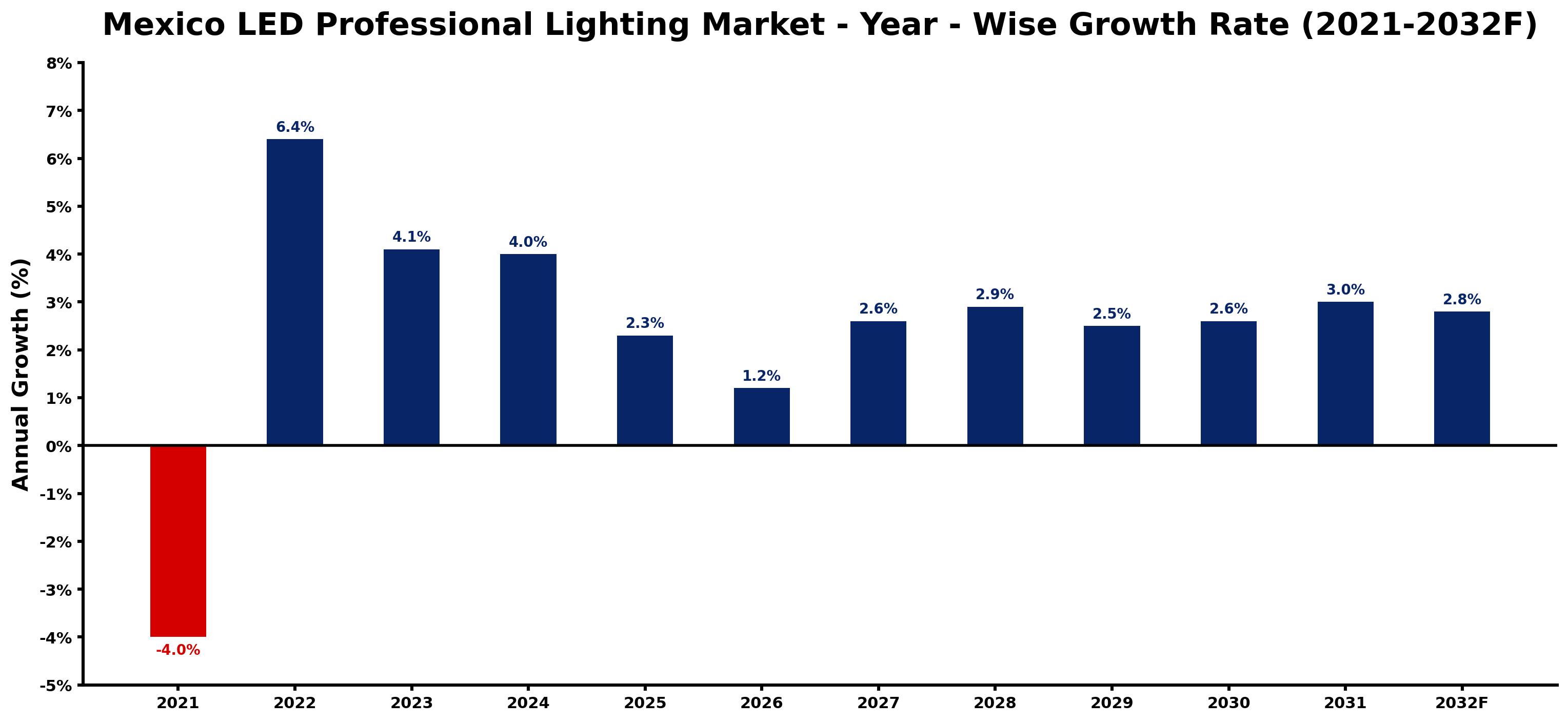
The table below presents the year wise growth rates along with the key drivers influencing the market
| Year | Growth Rate | Major Drivers |
| 2021 | -4.0% | Increased competition from inexpensive alternatives eroded market share and diminished profit margins for LED manufacturers. |
| 2022 | 6.4% | Emerging local manufacturing capabilities reduced import dependency and improved supply chains. |
| 2023 | 4.1% | Consumer awareness campaigns highlighted the long-term cost benefits of LED products. |
| 2024 | 4.0% | Major construction projects in urban areas spurred demand for modern lighting installations. |
| 2025 | 2.3% | Technological innovations enhanced LED efficiency, attracting commercial and residential sectors. |
| 2026 | 1.2% | Corporate sustainability commitments encouraged companies to shift towards energy-efficient lighting. |
| 2027 | 2.6% | Smart city initiatives integrated advanced lighting systems into urban infrastructure planning. |
| 2028 | 2.9% | Rising electricity costs prompted homeowners to seek more energy-efficient lighting alternatives. |
| 2029 | 2.5% | Universities and public institutions adopted LED solutions to enhance campus sustainability practices. |
| 2030 | 2.6% | Investment in renewable energy infrastructure complemented LED adoption in various sectors. |
| 2031 | 3.0% | Global supply chain stabilization led to more competitive pricing in the LED market. |
| 2032 | 2.8% | Technological integration with IoT devices made LED systems more appealing for consumers. |
Note - Market size estimations and growth projections presented in this report are based on 6Wresearch's advanced forecasting approach, validated with industry datasets as of June 2026.
Mexico LED Professional Lighting Market Synopsis
The Mexico LED Professional Lighting Market is projected to reach 1.2% and witness significant growth during the forecast period (2026-2032). This market is being propelled by several factors, including increasing investments in infrastructure projects, a significant rise in the adoption of energy-efficient lighting solutions, and a heightened emphasis on sustainable building practices. The expansion of commercial and industrial spaces, encompassing various sectors such as offices, retail centers, and hospitality establishments, is further contributing to the surging demand for LED professional lighting systems. In addition, government initiatives aimed at promoting energy conservation and the rapid advancement of technologies related to smart lighting, automation, and connected solutions are creating a conducive environment for market growth across Mexico.
Mexico LED Professional Lighting Market Growth Drivers
Multiple factors are driving the expansion of the Mexico LED Professional Lighting Market. Firstly, the ongoing infrastructure development projects across the nation necessitate the incorporation of advanced lighting solutions, which supports market uptake. Secondly, the rising demand for energy-efficient lighting solutions is steering consumers and businesses towards LEDs, given their cost-effective and environmentally friendly attributes. Thirdly, regulatory frameworks encouraging energy-saving technologies and practices are motivating industries to replace traditional lighting sources with modern LED solutions. Furthermore, increasing urbanization and the corresponding growth in commercial and residential developments are enhancing the need for effective lighting systems. Lastly, the burgeoning interest in smart lighting and automation technologies is opening new avenues of growth within the sector.
Mexico LED Professional Lighting Market Trends and Opportunities
The Mexico LED Professional Lighting Market is witnessing several emerging trends that present unique opportunities for stakeholders. One notable trend is the integration of smart technologies into lighting solutions, allowing for enhanced control and energy management. This trend aligns with the growing emphasis on sustainability and energy conservation. Additionally, the market is observing an upsurge in the adoption of connected lighting systems, which facilitate remote monitoring and control, proving advantageous for facility managers and end-users. Furthermore, the increasing focus on health and wellness in workspaces is propelling demand for lighting solutions that improve the overall quality of indoor environments. Lastly, government incentives aimed at promoting LED adoption are creating an encouraging landscape for investments in energy-efficient technologies.
Mexico LED Professional Lighting Market Challenges and Restraints
Despite the positive growth outlook, the Mexico LED Professional Lighting Market faces several challenges that could impede its progress. One significant challenge is the high initial investment associated with upgrading existing lighting systems to advanced LED technologies. This financial barrier can deter small and medium-sized enterprises from making the switch. In addition, the lack of awareness regarding the long-term benefits and cost savings associated with LED lighting may hinder adoption rates among less informed consumers. Furthermore, infrastructural limitations in certain regions may pose logistical challenges for delivering and installing advanced lighting solutions. Lastly, the volatility of raw material prices can affect production costs and pricing strategies within the sector, potentially impacting overall market growth.
Mexico LED Professional Lighting Market Government Investment and Initiatives
The Mexican government is actively engaged in promoting energy-efficient lighting solutions as part of its broader sustainability agenda. Various initiatives have been introduced to encourage the adoption of LED technologies, including subsidies, tax incentives, and public awareness campaigns aimed at highlighting the benefits of energy conservation. Additionally, government funding for infrastructure projects has increasingly prioritized the use of LED lighting systems to enhance energy efficiency in public spaces. These policies not only support the transition to more sustainable lighting solutions but also foster a collaborative environment for private sector investment in advanced technologies. Furthermore, ongoing partnerships between government bodies and industry stakeholders are expected to catalyze innovation and drive further advancements in the LED professional lighting market.
Mexico LED Professional Lighting Market Latest Developments (May 2025 - June 2026)
Recent developments within the Mexico LED Professional Lighting Market indicate a robust direction towards technological innovation and increased market penetration. There has been a noticeable uptick in the launch of new products featuring smart lighting capabilities that integrate IoT technology, enabling more efficient operation. Additionally, key stakeholders are focusing on enhancing the performance and affordability of LED products to meet the growing consumer demand. There is also a trend of collaborations and partnerships forming between technology providers and construction firms to ensure that newly developed infrastructures incorporate cutting-edge lighting solutions. Moreover, public-private partnerships have been increasingly utilized to drive the transition to LED systems in governmental facilities and public spaces. These developments not only signify a shift towards greater efficiency but also highlight the market's commitment to sustainability and innovation.
Mexico LED Professional Lighting Market - Key Attractiveness of the Report
- 10 Years of Market Numbers
- Historical Data Starting from 2022 to 2025
- Base Year: 2025
- Forecast Data until 2032
- Key Performance Indicators Impacting the Market
- Major Upcoming Developments and Projects
Key Highlights of the Report:
- Mexico LED Professional Lighting Market Outlook
- Market Size of Mexico LED Professional Lighting Market, 2025
- Forecast of Mexico LED Professional Lighting Market, 2032
- Historical Data and Forecast of Mexico LED Professional Lighting Revenues & Volume for the Period 2022-2032
- Mexico LED Professional Lighting Market Trend Evolution
- Mexico LED Professional Lighting Market Drivers and Challenges
- Mexico LED Professional Lighting Price Trends
- Mexico LED Professional Lighting Porter's Five Forces
- Mexico LED Professional Lighting Industry Life Cycle
- Historical Data and Forecast of Mexico LED Professional Lighting Market Revenues & Volume By Product Type for the Period 2022-2032
- Historical Data and Forecast of Mexico LED Professional Lighting Market Revenues & Volume By LED Bulbs for the Period 2022-2032
- Historical Data and Forecast of Mexico LED Professional Lighting Market Revenues & Volume By LED Fixtures for the Period 2022-2032
- Historical Data and Forecast of Mexico LED Professional Lighting Market Revenues & Volume By Bare LED Tubes for the Period 2022-2032
- Historical Data and Forecast of Mexico LED Professional Lighting Market Revenues & Volume By LED Down lights for the Period 2022-2032
- Historical Data and Forecast of Mexico LED Professional Lighting Market Revenues & Volume By Applications for the Period 2022-2032
- Historical Data and Forecast of Mexico LED Professional Lighting Market Revenues & Volume By Indoor for the Period 2022-2032
- Historical Data and Forecast of Mexico LED Professional Lighting Market Revenues & Volume By Outdoor for the Period 2022-2032
- Historical Data and Forecast of Mexico LED Professional Lighting Market Revenues & Volume By Automotive for the Period 2022-2032
- Historical Data and Forecast of Mexico LED Professional Lighting Market Revenues & Volume By Backlighting for the Period 2022-2032
- Mexico LED Professional Lighting Import Export Trade Statistics
- Market Opportunity Assessment By Product Type
- Market Opportunity Assessment By Applications
- Mexico LED Professional Lighting Top Companies Market Share
- Mexico LED Professional Lighting Competitive Benchmarking By Technical and Operational Parameters
- Mexico LED Professional Lighting Company Profiles
- Mexico LED Professional Lighting Key Strategic Recommendations
Market Covered
This report offers a comprehensive study of the subsequent market segments:
By Product Type
- LED Bulbs
- LED Fixtures
- Bare LED Tubes
- LED Down lights
By Applications
- Indoor, Outdoor
- Automotive
- Backlighting
- Competitive Landscape






































