United Kingdom (UK) LED Professional Lighting Market Summary
The united kingdom (uk) led professional lighting market was estimated at USD 296 Million in 2025 and is projected to reach USD 369 Million by 2032, growing at a CAGR of 2.5% from 2026 to 2032.
United Kingdom (UK) LED Professional Lighting Market Year-wise Growth Rate and Key Drivers
This graph highlights how the United Kingdom (UK) LED Professional Lighting Market has steadily grown over the past five years, supported by major growth factors.
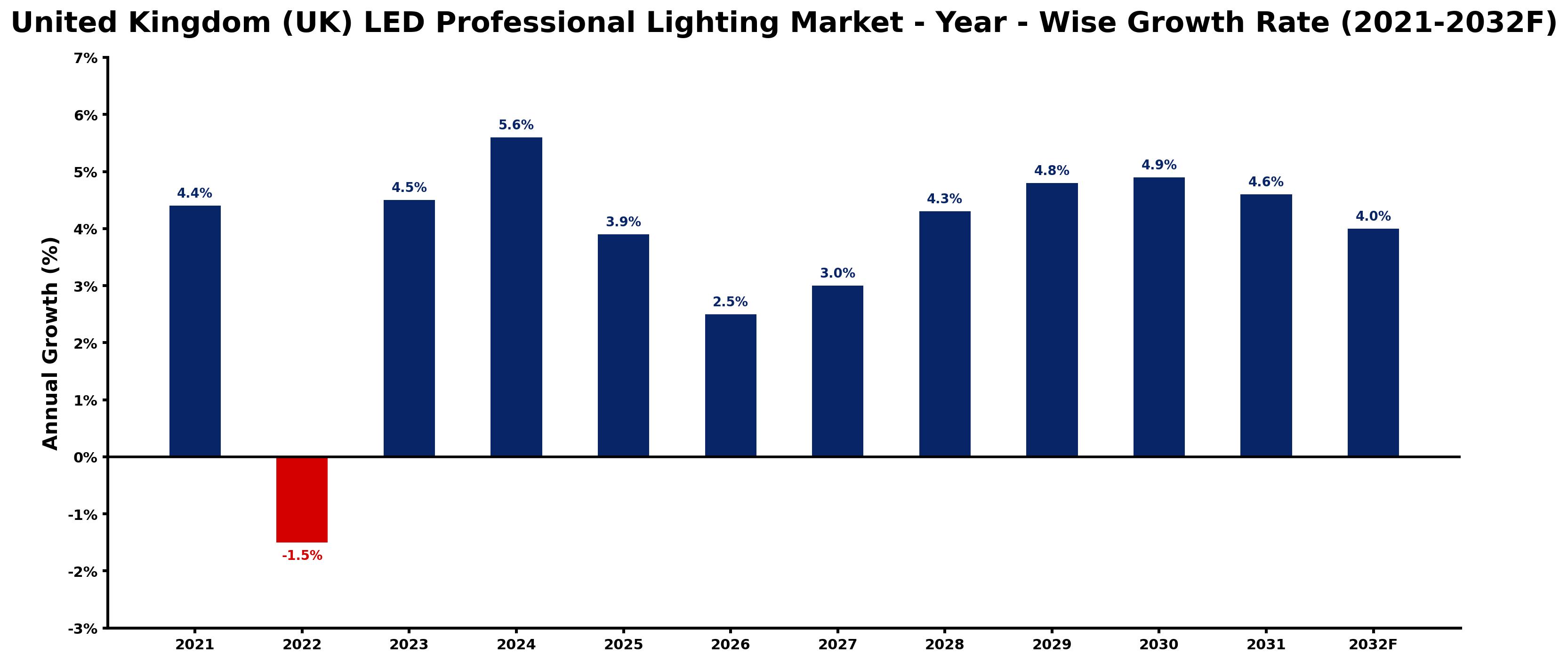
The table below presents the year wise growth rates along with the key drivers influencing the market
| Year | Growth Rate | Major Drivers |
| 2021 | 4.4% | Post-lockdown retail projects necessitate efficient, sustainable lighting solutions across sectors. |
| 2022 | -1.5% | Increased competition from emerging technologies led to market share erosion for traditional LED lighting solutions. |
| 2023 | 4.5% | Investments in smart city infrastructure enhance the demand for adaptive lighting systems. |
| 2024 | 5.6% | Emerging trends in IoT integration are reshaping the commercial lighting landscape significantly. |
| 2025 | 3.9% | Sustainability commitments from businesses are driving LED adoption in their operations. |
| 2026 | 2.5% | High utility costs compel consumers to seek alternatives like LED for savings. |
| 2027 | 3.0% | Innovations in LED technology encourage applications in previously untapped markets. |
| 2028 | 4.3% | The expansion of the construction sector includes extensive use of LED for efficiency. |
| 2029 | 4.8% | Consumer preferences are shifting towards aesthetic and functional lighting solutions. |
| 2030 | 4.9% | Evolving standards in energy efficiency ratings influence purchasing decisions widely. |
| 2031 | 4.6% | Technological advancements minimize production costs, making LEDs more accessible to consumers. |
| 2032 | 4.0% | Increased awareness of environmental impacts drives competitive pricing of energy-efficient products. |
Note - Market size estimations and growth projections presented in this report are based on 6Wresearch's advanced forecasting approach, validated with industry datasets as of June 2026.
United Kingdom (UK) LED Professional Lighting Market Synopsis
The United Kingdom (UK) LED Professional Lighting Market is projected to reach 2.5% and witness significant growth during the forecast period (2026-2032). This growth is predominantly driven by the increasing emphasis on energy efficiency, sustainability, and the modernization of lighting infrastructure across the country. Renovation activities in commercial buildings, the expansion of smart city initiatives, and a growing preference for intelligent lighting systems in various sectors are crucial factors propelling market advancement.
United Kingdom (UK) LED Professional Lighting Market Growth Drivers
Several compelling growth drivers are influencing the United Kingdom (UK) LED Professional Lighting Market. The demand for energy-efficient lighting solutions continues to surge due to escalating energy costs and environmental concerns. Furthermore, the push towards smart city projects across urban areas is fostering the adoption of advanced lighting technologies that integrate seamlessly with digital infrastructure.
- Heightened awareness regarding energy conservation among consumers and businesses is leading to an increased adoption of LED lighting systems as a viable alternative to traditional lighting options.
- The ongoing trend of smart technology integration in workplaces and public spaces is driving the demand for intelligent lighting solutions that enhance user experience while optimizing energy consumption.
- Government regulations aimed at minimizing carbon emissions and reducing overall energy consumption are catalyzing the transition towards LED professional lighting products.
- Technological advancements, such as improved heat management and control features in LED products, are making them more appealing to a broader range of applications.
- Lastly, the renovation of outdated lighting infrastructure in commercial and industrial sectors presents significant opportunities for market growth as organizations seek cost-effective solutions.
United Kingdom (UK) LED Professional Lighting Market Trends and Opportunities
The United Kingdom (UK) LED Professional Lighting Market is currently experiencing transformative trends that present numerous opportunities for growth. The incorporation of smart lighting systems, utilizing Internet of Things (IoT) technologies, is a key trend reshaping the industry landscape.
- The rise of smart homes and automated offices is driving demand for connected lighting solutions that can be controlled remotely, offering enhanced convenience and energy savings.
- Architectural LED lighting is gaining traction as aesthetics become increasingly important in urban design, leading to innovative lighting applications in public spaces and buildings.
- Energy-efficient retrofitting is becoming a common practice as businesses seek to modernize their facilities, presenting a substantial market opportunity for LED lighting solutions.
- The integration of human-centric lighting designs, which prioritize the well-being of occupants by mimicking natural light patterns, is emerging as a significant trend among commercial and residential sectors.
- Additionally, collaborations between technology firms and lighting manufacturers are facilitating the development of next-generation lighting products, opening up new avenues for market expansion.
United Kingdom (UK) LED Professional Lighting Market Challenges and Restraints
Despite the promising outlook for the United Kingdom (UK) LED Professional Lighting Market, several challenges and restraints could impede growth. High initial costs associated with advanced LED installations may deter some businesses from transitioning to these solutions. Moreover, the presence of established traditional lighting technologies poses competitive challenges.
- The rapid pace of technological advancement can lead to product obsolescence, compelling manufacturers to continuously innovate to stay competitive.
- Fluctuations in raw material prices may impact the production costs of LED products, potentially affecting profit margins for manufacturers and pricing strategies.
- Inadequate awareness and education regarding the benefits of LED technology among end-users may hinder market penetration, particularly in less urbanized areas.
- Compliance with stringent regulatory standards and certifications in the lighting industry could present challenges for new entrants and smaller firms.
- Lastly, the variability in energy policies across regions may create a complex regulatory environment, complicating market dynamics.
United Kingdom (UK) LED Professional Lighting Market Government Investment and Initiatives
The government of the United Kingdom is proactively investing in initiatives aimed at boosting the LED Professional Lighting Market. Various policies and public spending initiatives are designed to foster energy efficiency and sustainability.
- The UK government has introduced various tax incentives to encourage businesses to adopt energy-saving lighting technologies, effectively reducing the financial burden associated with upgrading to LED solutions.
- National programs targeting urban development emphasize smart city frameworks that prioritize sustainable lighting solutions, aligning with broader environmental goals.
- Public funding for research and development in lighting technologies fosters innovation, ensuring that the UK remains competitive in the global lighting market.
- Regulatory frameworks mandating reductions in carbon emissions are pushing industries to adopt LED technologies as a standard practice, further driving market demand.
- The promotion of energy-efficient public infrastructure projects has created a conducive environment for the proliferation of LED professional lighting solutions across various sectors.
United Kingdom (UK) LED Professional Lighting Market Latest Developments (May 2025 - June 2026)
Recent developments in the United Kingdom (UK) LED Professional Lighting Market from May 2025 to June 2026 indicate a dynamic progression in technology and adoption patterns. The market is witnessing a robust increase in investments directed towards R&D, particularly for smart lighting solutions that incorporate IoT capabilities.
- Significant advancements in LED technology have been reported, focusing on improving energy efficiency and product lifespans, which are crucial for commercial applications.
- The trend towards urbanization has led to an increased number of smart city projects, enhancing the integration of LED lighting within urban planning frameworks.
- The growing popularity of human-centric lighting designs has prompted manufacturers to focus on developing products that align with consumer health and wellness trends.
- Public-private partnerships are becoming more prevalent, facilitating the implementation of large-scale lighting projects that leverage both government support and private sector expertise.
- Moreover, discussions surrounding regulatory updates concerning energy efficiency standards are expected to shape the landscape of the LED professional lighting market moving forward.
United Kingdom (UK) LED Professional Lighting Market - Key Attractiveness of the Report
- 10 Years of Market Numbers
- Historical Data Starting from 2022 to 2025
- Base Year: 2025
- Forecast Data until 2032
- Key Performance Indicators Impacting the Market
- Major Upcoming Developments and Projects
Key Highlights of the Report:
- United Kingdom (UK) LED Professional Lighting Market Outlook
- Market Size of United Kingdom (UK) LED Professional Lighting Market, 2025
- Forecast of United Kingdom (UK) LED Professional Lighting Market, 2032
- Historical Data and Forecast of United Kingdom (UK) LED Professional Lighting Revenues & Volume for the Period 2022-2032
- United Kingdom (UK) LED Professional Lighting Market Trend Evolution
- United Kingdom (UK) LED Professional Lighting Market Drivers and Challenges
- United Kingdom (UK) LED Professional Lighting Price Trends
- United Kingdom (UK) LED Professional Lighting Porter's Five Forces
- United Kingdom (UK) LED Professional Lighting Industry Life Cycle
- Historical Data and Forecast of United Kingdom (UK) LED Professional Lighting Market Revenues & Volume By Product Type for the Period 2022-2032
- Historical Data and Forecast of United Kingdom (UK) LED Professional Lighting Market Revenues & Volume By LED Bulbs for the Period 2022-2032
- Historical Data and Forecast of United Kingdom (UK) LED Professional Lighting Market Revenues & Volume By LED Fixtures for the Period 2022-2032
- Historical Data and Forecast of United Kingdom (UK) LED Professional Lighting Market Revenues & Volume By Bare LED Tubes for the Period 2022-2032
- Historical Data and Forecast of United Kingdom (UK) LED Professional Lighting Market Revenues & Volume By LED Down lights for the Period 2022-2032
- Historical Data and Forecast of United Kingdom (UK) LED Professional Lighting Market Revenues & Volume By Applications for the Period 2022-2032
- Historical Data and Forecast of United Kingdom (UK) LED Professional Lighting Market Revenues & Volume By Indoor for the Period 2022-2032
- Historical Data and Forecast of United Kingdom (UK) LED Professional Lighting Market Revenues & Volume By Outdoor for the Period 2022-2032
- Historical Data and Forecast of United Kingdom (UK) LED Professional Lighting Market Revenues & Volume By Automotive for the Period 2022-2032
- Historical Data and Forecast of United Kingdom (UK) LED Professional Lighting Market Revenues & Volume By Backlighting for the Period 2022-2032
- United Kingdom (UK) LED Professional Lighting Import Export Trade Statistics
- Market Opportunity Assessment By Product Type
- Market Opportunity Assessment By Applications
- United Kingdom (UK) LED Professional Lighting Top Companies Market Share
- United Kingdom (UK) LED Professional Lighting Competitive Benchmarking By Technical and Operational Parameters
- United Kingdom (UK) LED Professional Lighting Company Profiles
- United Kingdom (UK) LED Professional Lighting Key Strategic Recommendations
Market Covered
This report offers a comprehensive study of the subsequent market segments:
By Product Type
- LED Bulbs
- LED Fixtures
- Bare LED Tubes
- LED Down lights
By Applications
- Indoor, Outdoor
- Automotive
- Backlighting
- Competitive Landscape






































