Qatar LED Professional Lighting Market Summary
The qatar led professional lighting market was estimated at USD 222 Million in 2025 and is projected to reach USD 310 Million by 2032, growing at a CAGR of 5.8% from 2026 to 2032.
Qatar LED Professional Lighting Market Year-wise Growth Rate and Key Drivers
This graph highlights how the Qatar LED Professional Lighting Market has steadily grown over the past five years, supported by major growth factors.
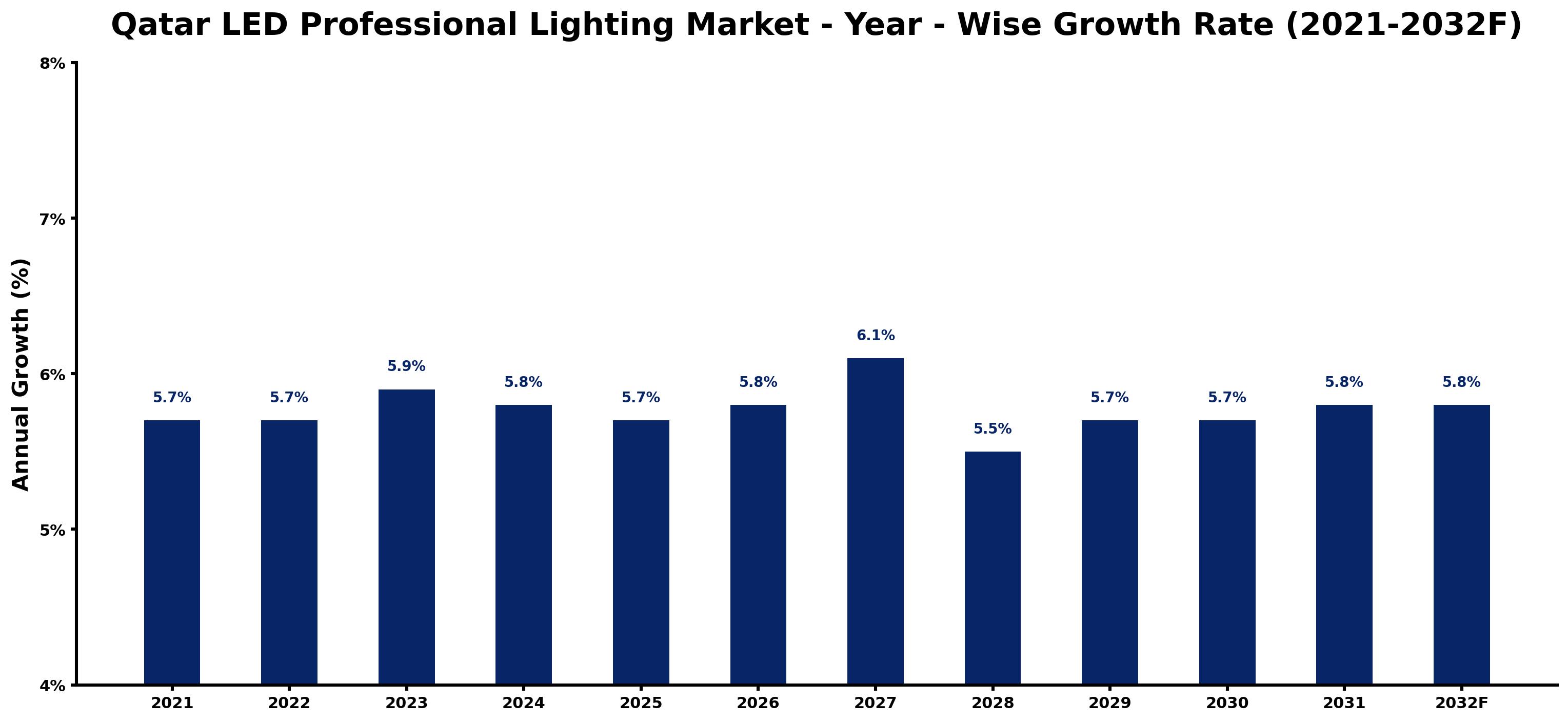
The table below presents the year wise growth rates along with the key drivers influencing the market
| Year | Growth Rate | Major Drivers |
| 2021 | 5.7% | Major construction projects in Qatar necessitate efficient lighting solutions for sustainability. |
| 2022 | 5.7% | Local manufacturers begin offering competitive LED products, enhancing the market's diversity. |
| 2023 | 5.9% | Smart city initiatives gain traction, increasing the need for integrated lighting systems. |
| 2024 | 5.8% | Incorporating energy efficiency becomes crucial as Qatar hosts significant international events. |
| 2025 | 5.7% | Research indicates strong consumer preference for eco-friendly and cost-effective lighting options. |
| 2026 | 5.8% | Innovations in LED technology allow for longer lifespan and reduced maintenance costs. |
| 2027 | 6.1% | Urbanization trends prompt a shift towards smart infrastructure and adaptive lighting solutions. |
| 2028 | 5.5% | Growing awareness of energy consumption leads businesses to invest in LED installations. |
| 2029 | 5.7% | Smart home trends gain momentum, driving demand for advanced LED lighting solutions. |
| 2030 | 5.7% | Sustainability reporting becomes standard, influencing corporate purchasing decisions for lighting. |
| 2031 | 5.8% | Regional collaborations focus on developing innovative LED solutions tailored for climate challenges. |
| 2032 | 5.8% | Complete integration of IoT in lighting systems enhances operational efficiencies and user experience. |
Note - Market size estimations and growth projections presented in this report are based on 6Wresearch's advanced forecasting approach, validated with industry datasets as of June 2026.
Qatar LED Professional Lighting Market Synopsis
The Qatar LED Professional Lighting Market is projected to reach 5.8% and witness significant growth during the forecast period (2026-2032). The market is poised for expansion due to the increasing adoption of LED technologies across various sectors, driven by their efficiency, longevity, and superior illumination qualities compared to conventional light sources. In residential, commercial, and industrial applications, LEDs are being recognized for their ability to significantly reduce energy consumption and maintenance costs, fostering a robust market landscape.
Qatar LED Professional Lighting Market Growth Drivers
Several factors are contributing to the growth of the Qatar LED Professional Lighting Market. Key drivers include:
- The escalating demand for energy-efficient lighting solutions across diverse applications is a primary driver for the market. Businesses and homeowners increasingly opt for LEDs to lower energy costs while improving lighting quality.
- Government initiatives aimed at promoting sustainable practices are crucial for market growth. Policies and incentives encouraging the switch to LED technology contribute significantly to investment in this sector.
- Technological advancements, focusing on enhancing the performance of LED products, are fostering innovation. The introduction of smart lighting solutions integrated with IoT technology is driving interest and adoption among consumers.
- The growing emphasis on smart city initiatives further propels the demand for LED professional lighting solutions. Urban developments in Qatar are increasingly incorporating LED systems as part of their infrastructure planning.
- The rising trend of environmental consciousness among consumers and industries is pushing businesses to adopt greener alternatives. LEDs' lower carbon footprint compared to traditional lighting solutions makes them an attractive option.
Qatar LED Professional Lighting Market Challenges and Restraints
Despite the positive growth outlook, the Qatar LED Professional Lighting Market faces several challenges. Notable restraints include:
- The presence of counterfeit LED products in the market poses significant risks. These inferior products can deter consumers from investing in LEDs, undermining market growth.
- Regulatory hurdles related to product certification can create obstacles for manufacturers. Complying with local regulations not only increases operational costs but can also delay product launches.
- Market saturation in certain segments may lead to intense price competition, negatively impacting profitability for companies operating within the sector.
- Lack of awareness regarding the benefits of LED technology among some consumer segments could hinder adoption rates, particularly in less urbanized areas.
- The reliance on specific supply chains for raw materials needed to manufacture LEDs makes the market susceptible to fluctuations, potentially affecting product availability and pricing.
Qatar LED Professional Lighting Market Government Investment and Initiatives
The Qatari government plays a critical role in fostering the growth of the LED professional lighting market through various initiatives. Noteworthy aspects include:
- Tax incentives provided by the Qatar Financial Centre Authority (QFCA) encourage businesses to invest in energy-efficient lighting solutions, thereby boosting the market.
- Public spending on infrastructure projects that incorporate LED lighting systems is on the rise, aligning with national strategies aimed at sustainability and modernization.
- Government policies promoting sustainable development stimulate demand for energy-efficient technologies across all sectors, including residential, commercial, and industrial lighting applications.
- Collaboration with international organizations to enhance research and development activities contributes to innovation in the LED sector, paving the way for new technologies and products.
- Initiatives aimed at increasing public awareness of energy conservation methods and the benefits of LED lighting support market penetration and consumer education.
Qatar LED Professional Lighting Market Latest Developments (May 2025 - June 2026)
Recent developments in the Qatar LED Professional Lighting Market reflect a dynamic and rapidly evolving landscape. Over this period, there has been a notable increase in smart lighting projects, particularly within urban developments, which integrate advanced technologies for improved energy efficiency. Additionally, local authorities have intensified efforts to implement regulations that ensure product quality and safety, aiming to combat the presence of counterfeit products in the market. Manufacturers are expanding their R&D activities, focusing on developing innovative solutions that cater to emerging consumer preferences for energy-saving products. The sector is also witnessing strategic partnerships aimed at enhancing distribution networks, which is expected to facilitate broader market access for high-quality LED lighting solutions.
Qatar LED Professional Lighting Market - Key Attractiveness of the Report
- 10 Years of Market Numbers
- Historical Data Starting from 2022 to 2025
- Base Year: 2025
- Forecast Data until 2032
- Key Performance Indicators Impacting the Market
- Major Upcoming Developments and Projects
Key Highlights of the Report:
- Qatar LED Professional Lighting Market Outlook
- Market Size of Qatar LED Professional Lighting Market, 2025
- Forecast of Qatar LED Professional Lighting Market, 2032
- Historical Data and Forecast of Qatar LED Professional Lighting Revenues & Volume for the Period 2022-2032
- Qatar LED Professional Lighting Market Trend Evolution
- Qatar LED Professional Lighting Market Drivers and Challenges
- Qatar LED Professional Lighting Price Trends
- Qatar LED Professional Lighting Porter's Five Forces
- Qatar LED Professional Lighting Industry Life Cycle
- Historical Data and Forecast of Qatar LED Professional Lighting Market Revenues & Volume By Product Type for the Period 2022-2032
- Historical Data and Forecast of Qatar LED Professional Lighting Market Revenues & Volume By LED Bulbs for the Period 2022-2032
- Historical Data and Forecast of Qatar LED Professional Lighting Market Revenues & Volume By LED Fixtures for the Period 2022-2032
- Historical Data and Forecast of Qatar LED Professional Lighting Market Revenues & Volume By Bare LED Tubes for the Period 2022-2032
- Historical Data and Forecast of Qatar LED Professional Lighting Market Revenues & Volume By LED Down lights for the Period 2022-2032
- Historical Data and Forecast of Qatar LED Professional Lighting Market Revenues & Volume By Applications for the Period 2022-2032
- Historical Data and Forecast of Qatar LED Professional Lighting Market Revenues & Volume By Indoor for the Period 2022-2032
- Historical Data and Forecast of Qatar LED Professional Lighting Market Revenues & Volume By Outdoor for the Period 2022-2032
- Historical Data and Forecast of Qatar LED Professional Lighting Market Revenues & Volume By Automotive for the Period 2022-2032
- Historical Data and Forecast of Qatar LED Professional Lighting Market Revenues & Volume By Backlighting for the Period 2022-2032
- Qatar LED Professional Lighting Import Export Trade Statistics
- Market Opportunity Assessment By Product Type
- Market Opportunity Assessment By Applications
- Qatar LED Professional Lighting Top Companies Market Share
- Qatar LED Professional Lighting Competitive Benchmarking By Technical and Operational Parameters
- Qatar LED Professional Lighting Company Profiles
- Qatar LED Professional Lighting Key Strategic Recommendations
Market Covered
This report offers a comprehensive study of the subsequent market segments:
By Product Type
- LED Bulbs
- LED Fixtures
- Bare LED Tubes
- LED Down lights
By Applications
- Indoor, Outdoor
- Automotive
- Backlighting






































