Brazil Licensed Merchandise Market Size, Share & Growth Rate
The Brazil Licensed Merchandise Market was estimated at USD 216 Million in 2025 and is projected to reach USD 256 Million by 2032, growing at a CAGR of 2.5% from 2026 to 2032. This growth trajectory is fueled primarily by the dynamic interplay between Brazil's vibrant retail landscape and the booming entertainment sector. The increasing appetite for branded products, driven by popular culture and a surge in online shopping, contributes significantly to market expansion.
Brazil Licensed Merchandise Market Year-wise Growth Rate and Key Drivers
This graph highlights how the Brazil Licensed Merchandise Market has steadily grown over the years, supported by major growth factors.
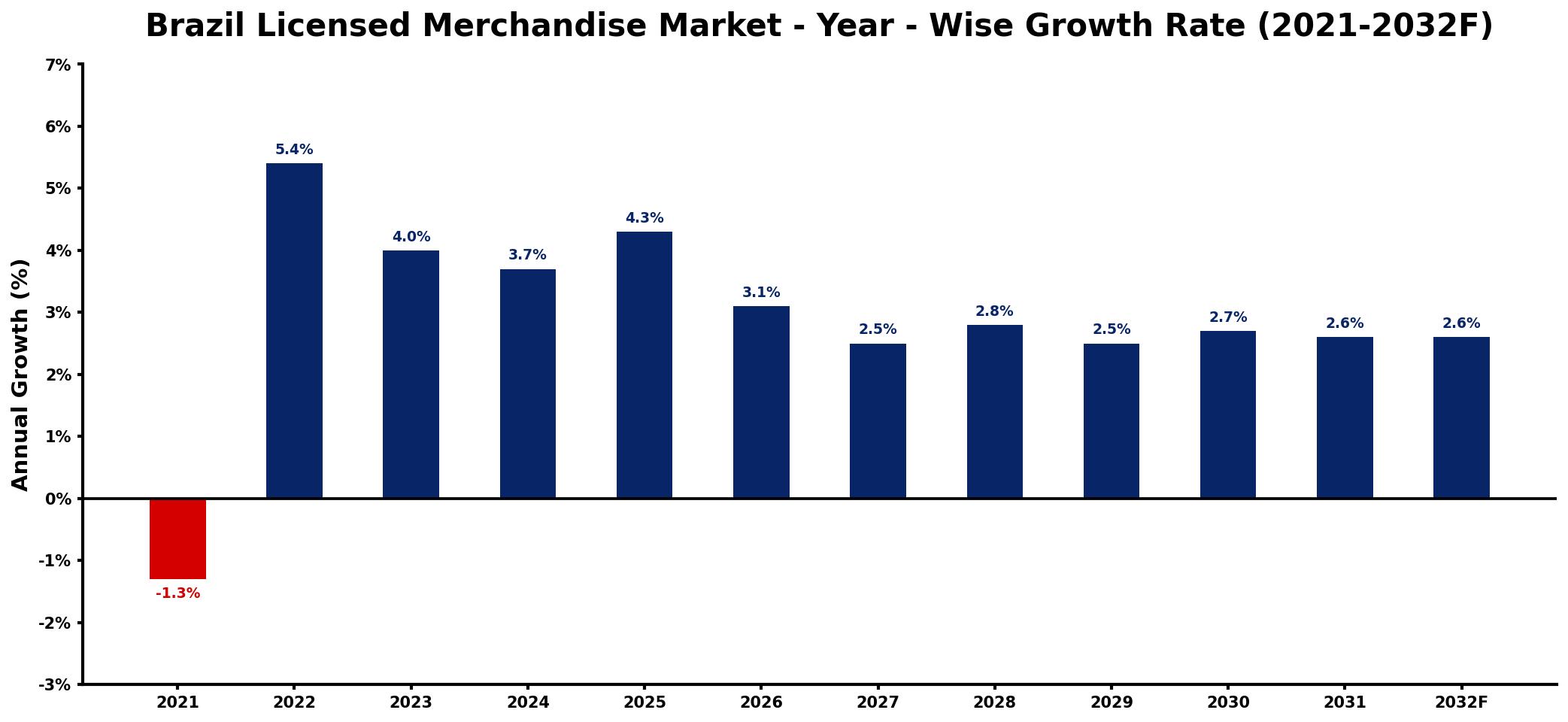
The table below presents the year‑wise growth rates along with the key drivers influencing the market
| Year | Growth Rate | Major Drivers |
| 2021 | -1.3% | decrease in consumer spending power |
| 2022 | 5.4% | increase in brand collaborations |
| 2023 | 4.0% | growth in online retail platforms |
| 2024 | 3.7% | expansion of entertainment franchises |
| 2025 | 4.3% | rise in youth culture trends |
| 2026 | 3.1% | enhanced marketing strategies adopted |
| 2027 | 2.5% | diversification of product offerings |
| 2028 | 2.8% | increased international market interest |
| 2029 | 2.5% | strengthened licensing agreements established |
| 2030 | 2.7% | growing influence of social media |
| 2031 | 2.6% | emergence of sustainable practices |
| 2032 | 2.6% | development of immersive experiences |
Note: Market size estimations and growth projections presented in this report are based on 6Wresearch's proprietary forecasting methodology, utilizing the latest available industry data, government publications, and primary research inputs.
Brazil Licensed Merchandise Market Synopsis
The most powerful force shaping the Brazil Licensed Merchandise Market today is the intertwining of entertainment and retail dynamics. Consumers are increasingly seeking authentic connections with their favorite brands, characters, and franchises, leading to a robust demand for licensed products across various categories.
This surge is further amplified by strategic partnerships between licensors and manufacturers, resulting in innovative products that resonate with diverse consumer demographics. In Brazil, where fandoms are deeply entrenched in popular culture, licensed merchandise has emerged as a significant driver of retail sales.
Brazil Licensed Merchandise Market Key Takeaways
- Retail and entertainment sectors are pivotal in propelling market growth.
- Consumer preferences increasingly favor authentic and recognizable brands.
- Licensing agreements are crucial for ensuring compliance with intellectual property rights.
- Diverse product categories present unique challenges in market segmentation and distribution.
- Strategic collaborations are fostering innovation in product offerings.
Evaluation of Restraints in Brazil Licensed Merchandise Market
Despite its promising growth, the Brazil Licensed Merchandise Market faces notable restraints primarily due to intellectual property rights challenges. The prevalence of piracy poses a significant threat to brand integrity, complicating the enforcement of licensing agreements. Ensuring that products remain genuine and legally compliant is crucial for manufacturers and licensors. Additionally, effectively reaching diverse consumer segments across various product categories presents ongoing challenges in terms of distribution and marketing strategies.
Brazil Licensed Merchandise Market Trends
Current trends indicate a significant increase in e-commerce engagement among consumers seeking licensed merchandise. The use of social media for brand promotion has also surged, allowing brands to connect directly with their audiences. Furthermore, there is a growing inclination towards sustainability, prompting manufacturers to explore eco-friendly licensed products that appeal to environmentally conscious consumers.
Brazil Licensed Merchandise Market Opportunities
The Brazil Licensed Merchandise Market presents lucrative opportunities for growth, particularly in niche product segments such as collectibles and sustainable merchandise. As partnerships between brands and local artisans gain traction, there is potential for unique, culturally relevant licensed products that resonate with Brazilian consumers. Additionally, tapping into emerging digital platforms and leveraging technology for personalized shopping experiences can further enhance market reach.
Government Initiatives in the Brazil Licensed Merchandise Market
Government policies play a crucial role in shaping the Brazil Licensed Merchandise Market through the enforcement of intellectual property rights and the promotion of creative industries. Initiatives aimed at fostering brand licensing and merchandising partnerships encourage investment in licensed products, enhancing brand value and consumer engagement. Furthermore, compliance with regulations regarding copyright protection ensures a level playing field for both licensors and manufacturers.
Future Insights of the Brazil Licensed Merchandise Market
Looking ahead to 2026-2032, the Brazil Licensed Merchandise Market is poised for steady growth, driven by the continuous evolution of consumer preferences and the integration of technology in retail. The market is likely to see an increased emphasis on authentic brand experiences and sustainable practices, aligning with global trends. Additionally, as more consumers embrace online shopping, the market is expected to adapt, focusing on innovative distribution strategies to meet diverse consumer needs.
Brazil Licensed Merchandise Market Latest Developments (2025 - 2026)
In recent months, the Brazil Licensed Merchandise Market has witnessed a notable uptick in collaboration initiatives between entertainment franchises and local manufacturers, sparking interest in culturally inspired licensed products. Additionally, there has been a shift towards the integration of technology in retail, with brands experimenting with augmented reality and personalized online shopping experiences to engage consumers more effectively. The market dynamics continue to evolve, reflecting broader trends in consumer behavior and technological advancement.
Brazil Licensed Merchandise Market - Key Attractiveness of the Report
- 10 Years of Market Numbers
- Historical Data Starting from 2022 to 2025
- Base Year: 2025
- Forecast Data until 2032
- Key Performance Indicators Impacting the Market
- Major Upcoming Developments and Projects
Key Highlights of the Report:
- Brazil Licensed Merchandise Market Outlook
- Market Size of Brazil Licensed Merchandise Market, 2025
- Forecast of Brazil Licensed Merchandise Market, 2032
- Historical Data and Forecast of Brazil Licensed Merchandise Revenues & Volume for the Period 2022-2032F
- Brazil Licensed Merchandise Market Trend Evolution
- Brazil Licensed Merchandise Market Drivers and Challenges
- Brazil Licensed Merchandise Price Trends
- Brazil Licensed Merchandise Porter's Five Forces
- Brazil Licensed Merchandise Industry Life Cycle
- Historical Data and Forecast of Brazil Licensed Merchandise Market Revenues & Volume By Product Type for the Period 2022-2032F
- Historical Data and Forecast of Brazil Licensed Merchandise Market Revenues & Volume By Apparel and Footwear for the Period 2022-2032F
- Historical Data and Forecast of Brazil Licensed Merchandise Market Revenues & Volume By Accessories and Gifts for the Period 2022-2032F
- Historical Data and Forecast of Brazil Licensed Merchandise Market Revenues & Volume By Toys and Games for the Period 2022-2032F
- Historical Data and Forecast of Brazil Licensed Merchandise Market Revenues & Volume By Others for the Period 2022-2032F
- Historical Data and Forecast of Brazil Licensed Merchandise Market Revenues & Volume By for the Period 2022-2032F
- Historical Data and Forecast of Brazil Licensed Merchandise Market Revenues & Volume By Distribution Channel for the Period 2022-2032F
- Historical Data and Forecast of Brazil Licensed Merchandise Market Revenues & Volume By Online Stores for the Period 2022-2032F
- Historical Data and Forecast of Brazil Licensed Merchandise Market Revenues & Volume By Supermarkets and Hypermarkets for the Period 2022-2032F
- Historical Data and Forecast of Brazil Licensed Merchandise Market Revenues & Volume By Departmental Stores for the Period 2022-2032F
- Historical Data and Forecast of Brazil Licensed Merchandise Market Revenues & Volume By Specialty Stores for the Period 2022-2032F
- Historical Data and Forecast of Brazil Licensed Merchandise Market Revenues & Volume By Others for the Period 2022-2032F
- Historical Data and Forecast of Brazil Licensed Merchandise Market Revenues & Volume By for the Period 2022-2032F
- Historical Data and Forecast of Brazil Licensed Merchandise Market Revenues & Volume By Price Range for the Period 2022-2032F
- Historical Data and Forecast of Brazil Licensed Merchandise Market Revenues & Volume By Premium for the Period 2022-2032F
- Historical Data and Forecast of Brazil Licensed Merchandise Market Revenues & Volume By Economic for the Period 2022-2032F
- Historical Data and Forecast of Brazil Licensed Merchandise Market Revenues & Volume By for the Period 2022-2032F
- Historical Data and Forecast of Brazil Licensed Merchandise Market Revenues & Volume By End-User for the Period 2022-2032F
- Historical Data and Forecast of Brazil Licensed Merchandise Market Revenues & Volume By Men for the Period 2022-2032F
- Historical Data and Forecast of Brazil Licensed Merchandise Market Revenues & Volume By Women for the Period 2022-2032F
- Historical Data and Forecast of Brazil Licensed Merchandise Market Revenues & Volume By Children for the Period 2022-2032F
- Brazil Licensed Merchandise Import Export Trade Statistics
- Market Opportunity Assessment By Product Type
- Market Opportunity Assessment By Distribution Channel
- Market Opportunity Assessment By Price Range
- Market Opportunity Assessment By End-User
- Brazil Licensed Merchandise Top Companies Market Share
- Brazil Licensed Merchandise Competitive Benchmarking By Technical and Operational Parameters
- Brazil Licensed Merchandise Company Profiles
- Brazil Licensed Merchandise Key Strategic Recommendations






































