Mexico Licensed Merchandise Market Size, Share & Growth Rate
The Mexico Licensed Merchandise Market was estimated at USD 232 Million in 2025 and is projected to reach USD 269 Million by 2032, growing at a CAGR of 2.1% from 2026 to 2032. This growth is primarily driven by the rising demand for branded products, with consumers increasingly gravitating towards licensed merchandise as a means of expressing their identities and affiliations with popular franchises. The expansion of e-commerce platforms is also a significant catalyst, providing consumers with convenient access to an array of licensed products.
Mexico Licensed Merchandise Market Year-wise Growth Rate and Key Drivers
This graph highlights how the Mexico Licensed Merchandise Market has steadily grown over the years, supported by major growth factors.
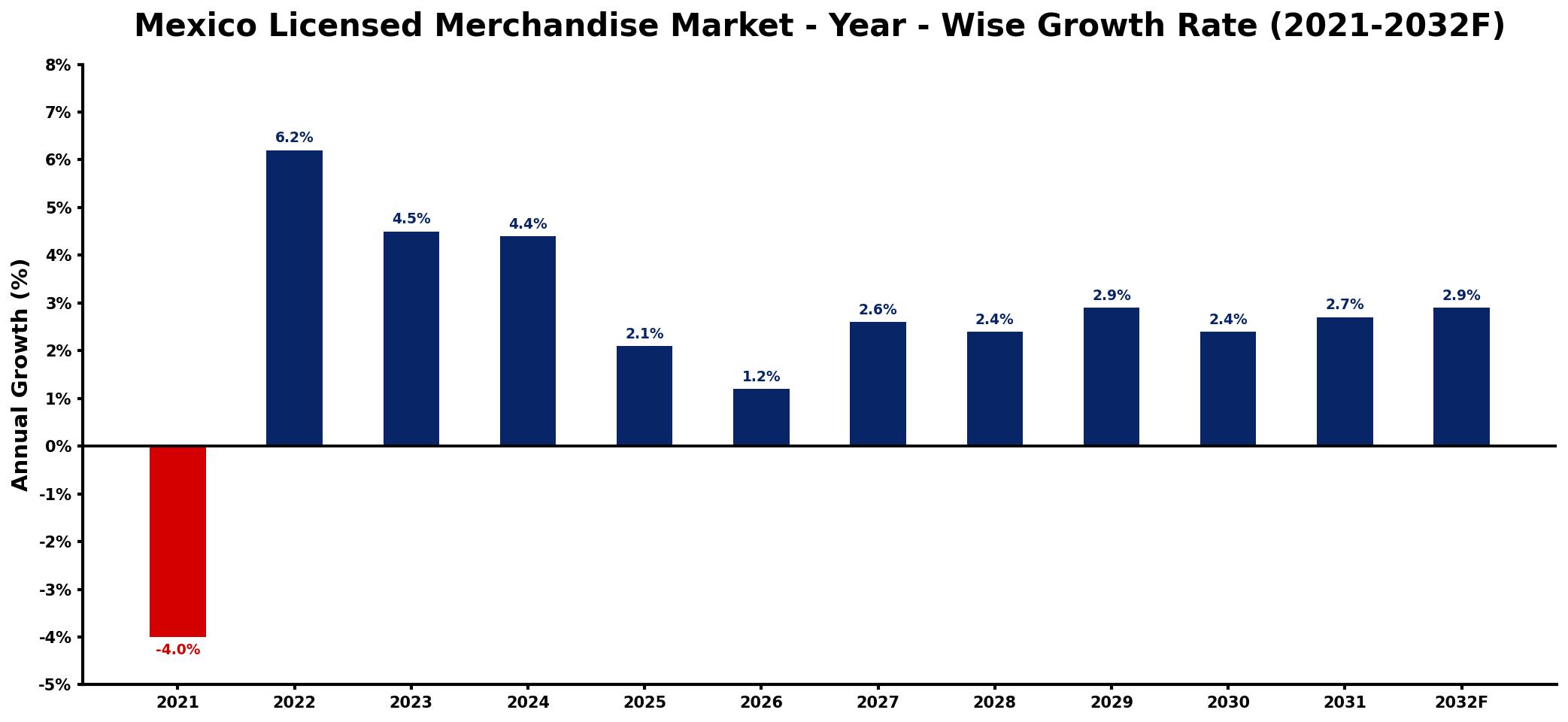
The table below presents the year‑wise growth rates along with the key drivers influencing the market
| Year | Growth Rate | Major Drivers |
| 2021 | -4.0% | decreasing consumer spending patterns |
| 2022 | 6.2% | rising popularity of collectibles |
| 2023 | 4.5% | expansion of retail partnerships |
| 2024 | 4.4% | increased demand for customization |
| 2025 | 2.1% | growing influence of social media |
| 2026 | 1.2% | emergence of new distribution channels |
| 2027 | 2.6% | enhanced brand collaboration initiatives |
| 2028 | 2.4% | surge in online shopping trends |
| 2029 | 2.9% | growth of experiential marketing strategies |
| 2030 | 2.4% | development of eco-friendly options |
| 2031 | 2.7% | increased focus on youth engagement |
| 2032 | 2.9% | expansion into emerging markets |
Note: Market size estimations and growth projections presented in this report are based on 6Wresearch's proprietary forecasting methodology, utilizing the latest available industry data, government publications, and primary research inputs.
Mexico Licensed Merchandise Market Synopsis
The most influential force currently shaping the Mexico Licensed Merchandise Market is the surge in consumer interest for licensed products across various sectors, particularly in entertainment and fashion. As disposable incomes rise, middle-class consumers are more willing to spend on branded merchandise, enhancing the appeal of licensed items.
Additionally, innovative collaborations between brands and licensees are redefining the landscape, allowing for unique offerings that capture consumer attention. This trend not only helps to differentiate products but also creates a deeper emotional connection between consumers and their favorite franchises.
Mexico Licensed Merchandise Market Key Takeaways
- The growing middle-class population is a key driver of market expansion.
- Collaborations between licensors and licensees foster innovation in product offerings.
- E-commerce platforms are becoming essential sales channels for licensed merchandise.
- Counterfeit products present significant challenges, impacting brand integrity.
- Strong emphasis on quality and authenticity is influencing purchasing decisions.
Evaluation of Restraints in Mexico Licensed Merchandise Market
Despite its promising growth, the Mexico Licensed Merchandise Market grapples with several notable restraints. The proliferation of counterfeit goods poses a serious threat, undermining the revenue and reputation of legitimate brands. Moreover, the complex legal framework surrounding intellectual property rights in Mexico requires companies to navigate regulations carefully to protect their interests. The competitive landscape, with a mix of local and international players, further complicates market dynamics, making it essential for businesses to implement robust strategies to maintain consumer loyalty.
Mexico Licensed Merchandise Market Trends
A notable trend in the Mexico Licensed Merchandise Market is the increasing prominence of licensed apparel and accessories, particularly in sports and fashion. Collaborations with designers are generating unique, trendy merchandise that resonates with consumers. Furthermore, the gaming industry is seeing a rise in licensed products, tapping into a growing demographic of gamers who seek merchandise related to their favorite titles. Quality, authenticity, and storytelling play significant roles in shaping consumer preferences, driving demand for innovative products that reflect individuality and brand allegiance.
Mexico Licensed Merchandise Market Opportunities
Investment opportunities within the Mexico Licensed Merchandise Market are abundant, especially in sectors like entertainment and sports. Engaging in strategic partnerships with popular brands can lead to the development of exclusive product lines that appeal to consumers. Additionally, the ongoing digital transformation offers avenues for leveraging e-commerce and social media to reach wider audiences. Companies can also explore licensing agreements in emerging niches, capitalizing on changing consumer preferences and trends for unique, personalized merchandise.
Government Initiatives in the Mexico Licensed Merchandise Market
The Mexican government plays a crucial role in regulating the licensed merchandise market through policies aimed at protecting intellectual property rights. Enforcement of copyright and trademark laws helps deter the production and sale of counterfeit products, promoting fair competition. Moreover, the government supports the growth of this market through various trade agreements, which foster an environment conducive to licensing partnerships, ensuring that businesses can thrive while adhering to legal and ethical standards.
Future Insights of the Mexico Licensed Merchandise Market
Looking ahead to the 2026-2032 period, the Mexico Licensed Merchandise Market is poised for significant growth. The increasing purchasing power of a young, dynamic consumer base, coupled with a strong inclination towards branded products, positions the market favorably for expansion. Additionally, the continual evolution of digital marketing strategies and e-commerce capabilities will enhance the accessibility of licensed merchandise, fueling demand. Overall, the market is set to embrace innovation and creativity, paving the way for new opportunities and collaborations.
Mexico Licensed Merchandise Market Latest Developments (2025 - 2026)
Recent developments in the Mexico Licensed Merchandise Market indicate a growing focus on sustainability and ethical sourcing practices. Companies are increasingly prioritizing transparency in their supply chains to meet consumer demand for responsible products. Furthermore, collaborations between entertainment franchises and fashion brands are becoming more common, leading to unique product offerings that resonate with diverse consumer groups. As e-commerce platforms continue to expand, many brands are adapting their strategies to include innovative online marketing techniques.
Mexico Licensed Merchandise Market - Key Attractiveness of the Report
- 10 Years of Market Numbers
- Historical Data Starting from 2022 to 2025
- Base Year: 2025
- Forecast Data until 2032
- Key Performance Indicators Impacting the Market
- Major Upcoming Developments and Projects
Key Highlights of the Report:
- Mexico Licensed Merchandise Market Outlook
- Market Size of Mexico Licensed Merchandise Market, 2025
- Forecast of Mexico Licensed Merchandise Market, 2032
- Historical Data and Forecast of Mexico Licensed Merchandise Revenues & Volume for the Period 2022-2032F
- Mexico Licensed Merchandise Market Trend Evolution
- Mexico Licensed Merchandise Market Drivers and Challenges
- Mexico Licensed Merchandise Price Trends
- Mexico Licensed Merchandise Porter's Five Forces
- Mexico Licensed Merchandise Industry Life Cycle
- Historical Data and Forecast of Mexico Licensed Merchandise Market Revenues & Volume By Product Type for the Period 2022-2032F
- Historical Data and Forecast of Mexico Licensed Merchandise Market Revenues & Volume By Apparel and Footwear for the Period 2022-2032F
- Historical Data and Forecast of Mexico Licensed Merchandise Market Revenues & Volume By Accessories and Gifts for the Period 2022-2032F
- Historical Data and Forecast of Mexico Licensed Merchandise Market Revenues & Volume By Toys and Games for the Period 2022-2032F
- Historical Data and Forecast of Mexico Licensed Merchandise Market Revenues & Volume By Others for the Period 2022-2032F
- Historical Data and Forecast of Mexico Licensed Merchandise Market Revenues & Volume By for the Period 2022-2032F
- Historical Data and Forecast of Mexico Licensed Merchandise Market Revenues & Volume By Distribution Channel for the Period 2022-2032F
- Historical Data and Forecast of Mexico Licensed Merchandise Market Revenues & Volume By Online Stores for the Period 2022-2032F
- Historical Data and Forecast of Mexico Licensed Merchandise Market Revenues & Volume By Supermarkets and Hypermarkets for the Period 2022-2032F
- Historical Data and Forecast of Mexico Licensed Merchandise Market Revenues & Volume By Departmental Stores for the Period 2022-2032F
- Historical Data and Forecast of Mexico Licensed Merchandise Market Revenues & Volume By Specialty Stores for the Period 2022-2032F
- Historical Data and Forecast of Mexico Licensed Merchandise Market Revenues & Volume By Others for the Period 2022-2032F
- Historical Data and Forecast of Mexico Licensed Merchandise Market Revenues & Volume By for the Period 2022-2032F
- Historical Data and Forecast of Mexico Licensed Merchandise Market Revenues & Volume By Price Range for the Period 2022-2032F
- Historical Data and Forecast of Mexico Licensed Merchandise Market Revenues & Volume By Premium for the Period 2022-2032F
- Historical Data and Forecast of Mexico Licensed Merchandise Market Revenues & Volume By Economic for the Period 2022-2032F
- Historical Data and Forecast of Mexico Licensed Merchandise Market Revenues & Volume By for the Period 2022-2032F
- Historical Data and Forecast of Mexico Licensed Merchandise Market Revenues & Volume By End-User for the Period 2022-2032F
- Historical Data and Forecast of Mexico Licensed Merchandise Market Revenues & Volume By Men for the Period 2022-2032F
- Historical Data and Forecast of Mexico Licensed Merchandise Market Revenues & Volume By Women for the Period 2022-2032F
- Historical Data and Forecast of Mexico Licensed Merchandise Market Revenues & Volume By Children for the Period 2022-2032F
- Mexico Licensed Merchandise Import Export Trade Statistics
- Market Opportunity Assessment By Product Type
- Market Opportunity Assessment By Distribution Channel
- Market Opportunity Assessment By Price Range
- Market Opportunity Assessment By End-User
- Mexico Licensed Merchandise Top Companies Market Share
- Mexico Licensed Merchandise Competitive Benchmarking By Technical and Operational Parameters
- Mexico Licensed Merchandise Company Profiles
- Mexico Licensed Merchandise Key Strategic Recommendations






































