Brazil Lighting equipment Market Summary
The brazil lighting equipment market was estimated at USD 212 Million in 2025 and is projected to reach USD 250 Million by 2032, growing at a CAGR of 2.9% from 2026 to 2032.
Brazil Lighting equipment Market Year-wise Growth Rate and Key Drivers
This graph highlights how the Brazil Lighting equipment Market has steadily grown over the past five years, supported by major growth factors.
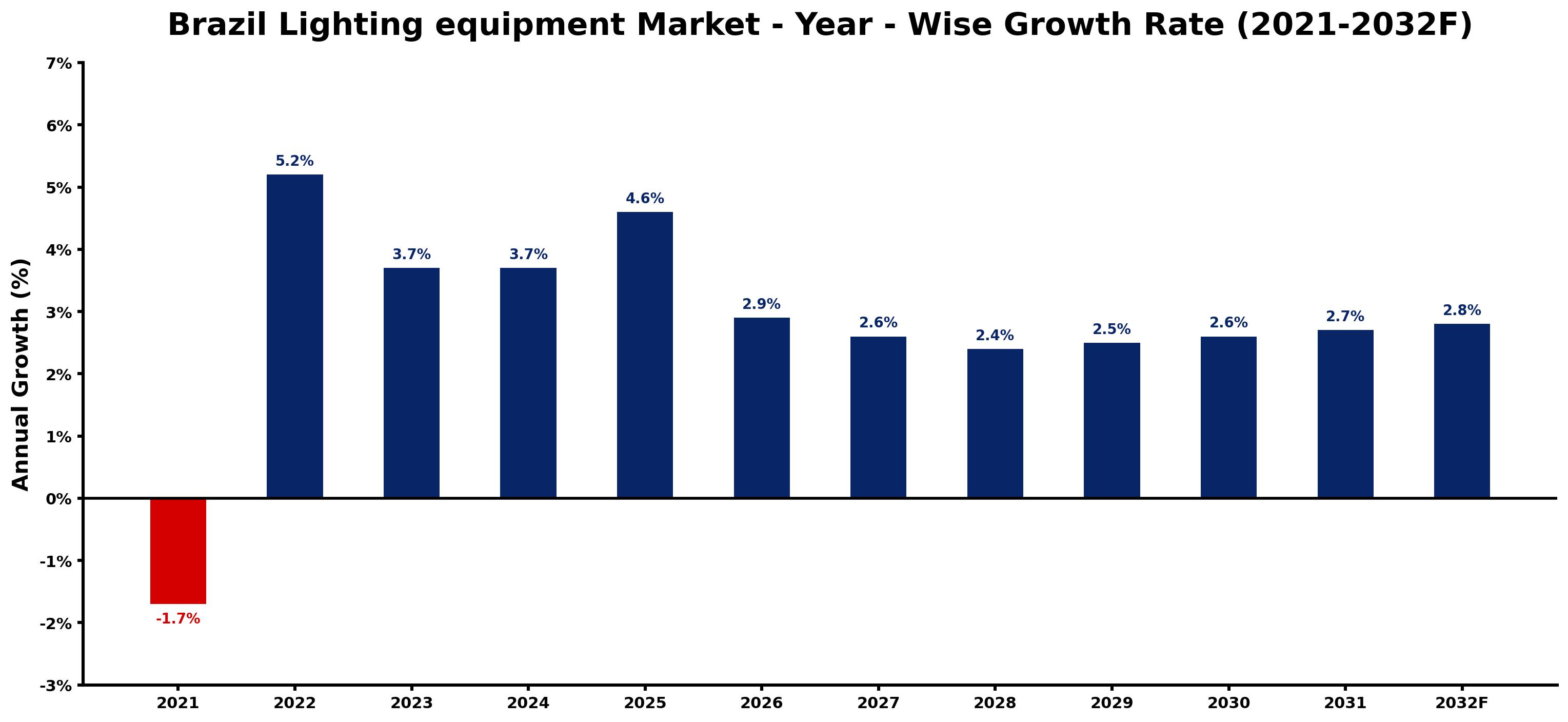
The table below presents the year wise growth rates along with the key drivers influencing the market
| Year | Growth Rate | Major Drivers |
| 2021 | -1.7% | Supply chain disruptions hindered timely product availability, leading to decreased sales in the lighting equipment sector. |
| 2022 | 5.2% | Corporate budgets increasingly allocated towards energy-efficient lighting technologies initiatives. |
| 2023 | 3.7% | Sustainability trends influenced consumer preferences for eco-friendly lighting products. |
| 2024 | 3.7% | Urbanization in Brazilian cities fueled development of smart lighting solutions. |
| 2025 | 4.6% | Local manufacturing capabilities improved production efficiency and reduced import dependencies. |
| 2026 | 2.9% | Increased construction projects in major cities highlighted the need for advanced lighting infrastructure. |
| 2027 | 2.6% | Growing awareness of energy consumption metrics accelerated the shift to LED technologies. |
| 2028 | 2.4% | Technological innovations in smart home devices prompted integration with intelligent lighting systems. |
| 2029 | 2.5% | Retail environments transformed, emphasizing atmospheric lighting to enhance shopper experiences. |
| 2030 | 2.6% | Public sector initiatives aimed at modernizing street lighting supported infrastructure development. |
| 2031 | 2.7% | Partnerships between tech companies and municipalities enhanced urban lighting solutions. |
| 2032 | 2.8% | Consumers increasingly prioritized brands with strong commitments to sustainability and innovation. |
Note - Market size estimations and growth projections presented in this report are based on 6Wresearch's advanced forecasting approach, validated with industry datasets as of June 2026.
Brazil Lighting equipment Market Synopsis
The Brazil Lighting equipment Market is projected to reach 2.9% and witness significant growth during the forecast period (2026-2032). This market encompasses a diverse array of lighting solutions ranging from traditional incandescent bulbs to advanced LED technologies and smart lighting systems. The evolution of urban landscapes, ongoing infrastructure projects, and heightened awareness regarding energy efficiency and sustainability are key factors influencing market dynamics. Additionally, the advent of IoT integration within lighting systems is poised to redefine the operational landscape of lighting technologies in Brazil.
Brazil Lighting equipment Market Drivers
The Brazil Lighting equipment Market is primarily propelled by several critical drivers:
- The surge in urbanization across Brazil leads to increased demand for effective and energy-efficient lighting solutions in residential, commercial, and public spaces.
- Infrastructure development initiatives by the government create a favorable environment for lighting product adoption, especially in newly constructed buildings and improved public facilities.
- Growing consumer preference for energy-efficient lighting options, particularly LED products, aligns with global trends towards sustainability and cost savings on energy bills.
- Government policies promoting technological advancements in lighting, including smart lighting systems, are instrumental in addressing energy consumption and enhancing user convenience.
- Architectural and decorative lighting trends contribute to market growth, with innovations focusing on aesthetic appeal and functionality being increasingly deemed essential in new construction projects.
Brazil Lighting equipment Market Challenges and Restraints
Despite its growth prospects, the Brazil Lighting equipment Market faces notable challenges that could hinder progress:
- The transition to energy-efficient solutions presents hurdles as existing infrastructure may not readily accommodate modern technologies, leading to increased initial investment costs.
- Compliance with stringent energy efficiency standards can be daunting for manufacturers, requiring continuous adaptations in product design and production processes.
- Technological obsolescence emerges as a critical challenge, compelling companies to innovate rapidly or risk becoming irrelevant in a competitive market.
- Environmental regulations concerning the disposal of traditional lighting technologies, such as incandescent bulbs, necessitate heightened awareness and action from consumers and businesses alike.
- The need for innovative and appealing designs to attract consumers in a saturated market adds pressure on manufacturers to continually enhance their offerings.
Brazil Lighting equipment Market Government Investment and Initiatives
The Brazil government plays a pivotal role in the advancement of the lighting equipment market through various investment initiatives and regulatory frameworks:
- Government policies geared towards energy efficiency focus on promoting the adoption of LED technology, thereby reducing overall energy consumption nationally.
- Public spending on infrastructure improvements often includes allocations for modern lighting solutions, thereby reinforcing the market's growth trajectory.
- Support for research and development in the lighting sector is demonstrated through funding and incentives aimed at fostering innovation and sustainability in product offerings.
- Regulatory measures ensure that lighting products meet safety standards, ultimately enhancing consumer trust and encouraging informed purchasing decisions.
- Phasing out of inefficient lighting technologies aligns with broader environmental goals, reflecting Brazil's commitment to reducing its carbon footprint in accordance with international agreements.
Brazil Lighting equipment Market Latest Developments (May 2025 - June 2026)
During the period from May 2025 to June 2026, the Brazil Lighting equipment Market has witnessed several significant developments that signal its evolving landscape:
- An increased focus on smart city initiatives has driven demand for integrated lighting systems capable of communication within urban environments, enhancing both efficacy and user experience.
- Brand awareness regarding the benefits of LED technology has surged, leading to more widespread adoption not only in urban centers but also in rural areas.
- Emerging trends in architectural lighting have prompted designers to incorporate innovative, energy-efficient solutions in both residential and commercial projects.
- Public-private partnerships have gained traction, fostering collaborative efforts to promote energy-saving technologies and sustainable lighting practices across various sectors.
- Advancements in lighting control technologies, including apps and automation tools, reflect an ongoing shift towards consumer-driven lighting solutions that emphasize convenience and personalization.
Brazil Lighting equipment Market - Key Attractiveness of the Report
- 10 Years of Market Numbers
- Historical Data Starting from 2022 to 2025
- Base Year: 2025
- Forecast Data until 2032
- Key Performance Indicators Impacting the Market
- Major Upcoming Developments and Projects
Key Highlights of the Report:
- Brazil Lighting equipment Market Outlook
- Market Size of Brazil Lighting equipment Market, 2025
- Forecast of Brazil Lighting equipment Market, 2032
- Historical Data and Forecast of Brazil Lighting equipment Revenues & Volume for the Period 2022-2032F
- Brazil Lighting equipment Market Trend Evolution
- Brazil Lighting equipment Market Drivers and Challenges
- Brazil Lighting equipment Price Trends
- Brazil Lighting equipment Porter's Five Forces
- Brazil Lighting equipment Industry Life Cycle
- Historical Data and Forecast of Brazil Lighting equipment Market Revenues & Volume By ?Application for the Period 2022-2032F
- Historical Data and Forecast of Brazil Lighting equipment Market Revenues & Volume By General Purpose Lighting for the Period 2022-2032F
- Historical Data and Forecast of Brazil Lighting equipment Market Revenues & Volume By Vehicle/Automobile Lighting for the Period 2022-2032F
- Historical Data and Forecast of Brazil Lighting equipment Market Revenues & Volume By Backlighting for the Period 2022-2032F
- Historical Data and Forecast of Brazil Lighting equipment Market Revenues & Volume By Others? for the Period 2022-2032F
- Historical Data and Forecast of Brazil Lighting equipment Market Revenues & Volume By Technology for the Period 2022-2032F
- Historical Data and Forecast of Brazil Lighting equipment Market Revenues & Volume By Conventional Lighting/Non-Environment Friendly Lighting for the Period 2022-2032F
- Historical Data and Forecast of Brazil Lighting equipment Market Revenues & Volume By Environment Friendly Lighting for the Period 2022-2032F
- Historical Data and Forecast of Brazil Lighting equipment Market Revenues & Volume By SSL (Solid State Lighting) for the Period 2022-2032F
- Historical Data and Forecast of Brazil Lighting equipment Market Revenues & Volume By LED (Light Emitting Diodes) for the Period 2022-2032F
- Historical Data and Forecast of Brazil Lighting equipment Market Revenues & Volume By OLED (Organic Light Emitting Diodes) for the Period 2022-2032F
- Historical Data and Forecast of Brazil Lighting equipment Market Revenues & Volume By PLED (Polymer Light Emitting Diodes)? for the Period 2022-2032F
- Historical Data and Forecast of Brazil Lighting equipment Market Revenues & Volume By ?End Users for the Period 2022-2032F
- Historical Data and Forecast of Brazil Lighting equipment Market Revenues & Volume By Industrial for the Period 2022-2032F
- Historical Data and Forecast of Brazil Lighting equipment Market Revenues & Volume By Commercial for the Period 2022-2032F
- Historical Data and Forecast of Brazil Lighting equipment Market Revenues & Volume By Others? for the Period 2022-2032F
- Brazil Lighting equipment Import Export Trade Statistics
- Market Opportunity Assessment By ?Application
- Market Opportunity Assessment By Technology
- Market Opportunity Assessment By ?End Users
- Brazil Lighting equipment Top Companies Market Share
- Brazil Lighting equipment Competitive Benchmarking By Technical and Operational Parameters
- Brazil Lighting equipment Company Profiles
- Brazil Lighting equipment Key Strategic Recommendations






































