Brazil Mimosa Extract Market Size, Share & Growth Rate
The Brazil Mimosa Extract Market was estimated at USD 232 Million in 2025 and is projected to reach USD 275 Million by 2032, growing at a CAGR of 2.5% from 2026 to 2032. This growth is significantly fueled by the increasing incorporation of mimosa extracts in pharmaceutical formulations and cosmetic products, as well as the rising consumer preference for natural, plant-based ingredients. Additionally, advancements in extraction technologies are enabling more efficient and sustainable production methods, which further drives market expansion.
Brazil Mimosa Extract Market Year-wise Growth Rate and Key Drivers
This graph highlights how the Brazil Mimosa Extract Market has steadily grown over the years, supported by major growth factors.
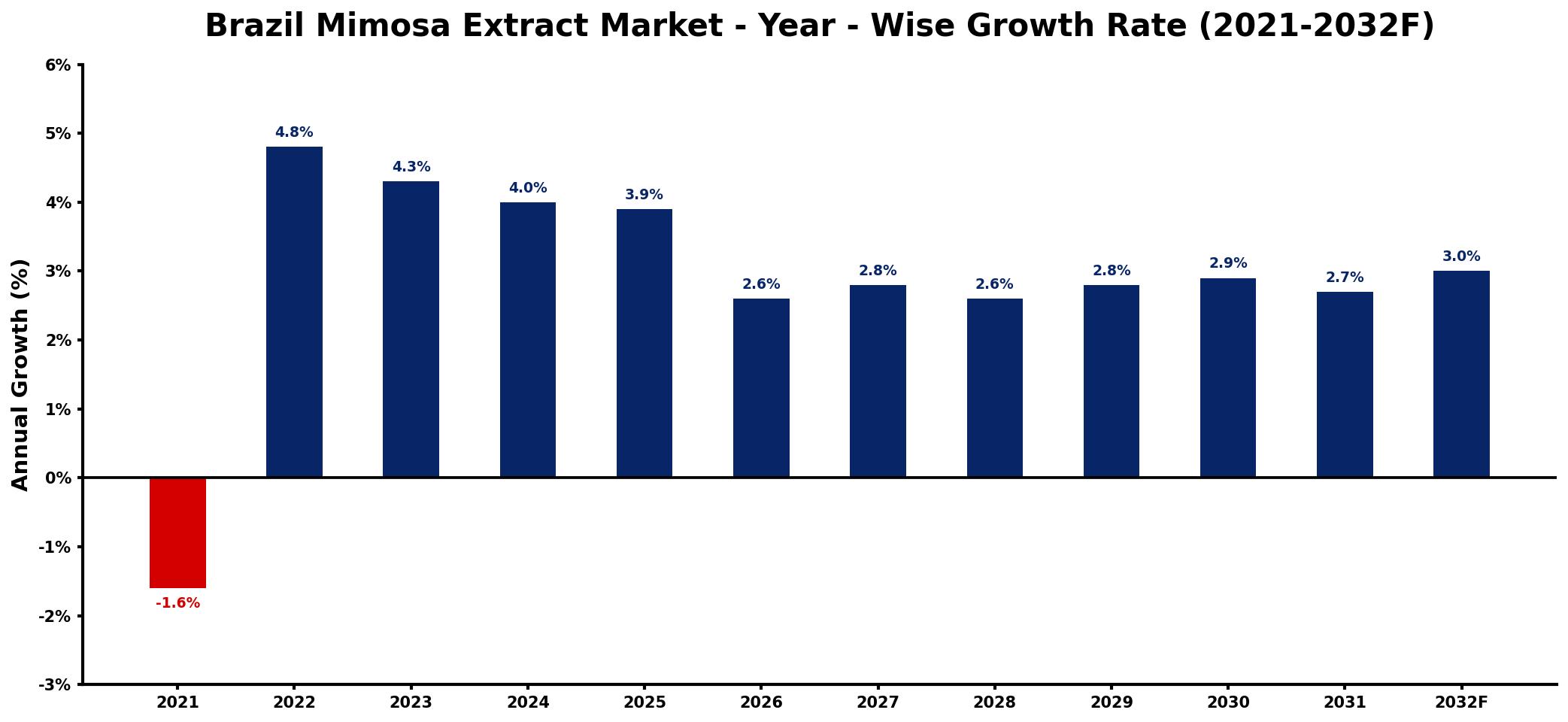
The table below presents the year‑wise growth rates along with the key drivers influencing the market
| Year | Growth Rate | Major Drivers |
| 2021 | -1.6% | decreased consumer interest in alternatives |
| 2022 | 4.8% | rising demand for natural ingredients |
| 2023 | 4.3% | expansion of wellness product lines |
| 2024 | 4.0% | increased investment in sustainable sourcing |
| 2025 | 3.9% | growing popularity of herbal remedies |
| 2026 | 2.6% | emerging markets adopting herbal solutions |
| 2027 | 2.8% | innovation in product formulations rising |
| 2028 | 2.6% | enhanced distribution channels expanding |
| 2029 | 2.8% | consumer awareness on health benefits |
| 2030 | 2.9% | increased collaboration with local farmers |
| 2031 | 2.7% | growth in eco-friendly packaging solutions |
| 2032 | 3.0% | expanding healthcare application demand |
Note: Market size estimations and growth projections presented in this report are based on 6Wresearch's proprietary forecasting methodology, utilizing the latest available industry data, government publications, and primary research inputs.
Brazil Mimosa Extract Market Synopsis
Currently, the most influential factor shaping the Brazil Mimosa Extract Market is the heightened demand for natural ingredients in cosmetics and health products. Consumers are increasingly aware of the therapeutic benefits of mimosa extracts, such as their antioxidant and anti-inflammatory properties, leading to greater incorporation in a variety of formulations.
Another significant force is the pharmaceutical industry's ongoing search for natural alternatives to synthetic compounds. Mimosa extract, with its proven efficacy and safety profile, is becoming a preferred choice for manufacturers looking to meet the growing demand for clean-label products. This trend indicates a promising trajectory for the market in the coming years.
Brazil Mimosa Extract Market Key Takeaways
- The market is experiencing a notable transition towards sustainable sourcing practices, aligning with consumer demand for ethically produced ingredients.
- Pharmaceutical applications are leading the charge in market expansion due to the recognized health benefits associated with mimosa extracts.
- Innovation in extraction technologies is improving product quality and boosting production efficiency.
- Increasing awareness about environmental sustainability is reshaping the supply chain dynamics in the mimosa extract sector.
- Competitive pressure is driving companies to differentiate their product offerings, focusing on unique applications in diverse industries.
Evaluation of Restraints in Brazil Mimosa Extract Market
Despite its growth potential, the Brazil Mimosa Extract Market faces several constraints that can impede progress. One of the primary challenges is the issue of sustainable sourcing, which is vital for maintaining ecological balance while meeting market demands. Many mimosa tree species are sensitive to overharvesting, and ensuring that extraction methods do not compromise the natural ecosystems is critical. Furthermore, fluctuations in market demand can affect production levels, creating uncertainty for suppliers and manufacturers alike. Quality control remains a significant concern, as variations in sourcing methods can lead to inconsistencies in product efficacy.
Brazil Mimosa Extract Market Trends
Several key trends are shaping the Brazil Mimosa Extract Market landscape. The growing trend towards green cosmetics is encouraging manufacturers to seek more natural and organic ingredients, which positions mimosa extract as a desirable component in formulations. Additionally, increased research on the health benefits of mimosa extracts is paving the way for new applications in nutraceuticals, reflecting a shift in consumer preferences towards holistic health solutions.
The rise of e-commerce is also influencing distribution channels, allowing for greater accessibility of mimosa extract products to end consumers. As online sales platforms expand, manufacturers are investing more in digital marketing strategies to reach targeted audiences, thus enhancing their market presence.
Brazil Mimosa Extract Market Opportunities
Emerging opportunities within the Brazil Mimosa Extract Market are abundant, particularly in sectors where natural ingredients are gaining prominence. The pharmaceutical industry presents significant prospects for growth, driven by an increasing focus on preventive healthcare and wellness products. Furthermore, exploring innovative applications in dietary supplements and functional foods could open new revenue streams. Collaborations with academic institutions and research organizations can also foster innovation, leading to new formulations and extraction techniques that could enhance product offerings.
Government Initiatives in the Brazil Mimosa Extract Market
The Brazilian government is actively involved in regulating the mimosa extract market to ensure product safety, quality, and ethical sourcing practices. Regulatory agencies set stringent standards for the production process, ingredient purity, and accurate labeling to protect consumers. Initiatives aimed at promoting sustainable harvesting and conservation are essential in maintaining biodiversity and supporting the local ecosystems that produce mimosa trees. Collaboration with industry stakeholders is crucial in fostering responsible practices within the market.
Future Insights of the Brazil Mimosa Extract Market
Looking ahead, the Brazil Mimosa Extract Market is poised for steady growth through 2032. A continued emphasis on health and wellness, combined with a shift towards environmentally friendly products, will create a fertile ground for expansion. As extraction technology evolves and consumer preferences tilt more towards natural ingredients, mimosa extract will likely find new applications and customer bases across various industries. Overall, the market is set to evolve dynamically, responding to both challenges and emerging opportunities.
Brazil Mimosa Extract Market Latest Developments (2025 - 2026)
Recent developments in the Brazil Mimosa Extract Market indicate a growing focus on sustainability and ethical sourcing. Several initiatives aimed at enhancing transparency in supply chains have emerged, allowing consumers to trace the origins of their products. Additionally, industry stakeholders are increasingly engaging in partnerships to promote research and development, aiming to explore the potential of mimosa extract in new formulations, particularly in the health and wellness sectors. These trends reflect a broader commitment to responsible practices within the market.
Brazil Mimosa Extract Market - Key Attractiveness of the Report
- 10 Years of Market Numbers
- Historical Data Starting from 2022 to 2025
- Base Year: 2025
- Forecast Data until 2032
- Key Performance Indicators Impacting the Market
- Major Upcoming Developments and Projects
Key Highlights of the Report:
- Brazil Mimosa Extract Market Outlook
- Market Size of Brazil Mimosa Extract Market, 2025
- Forecast of Brazil Mimosa Extract Market, 2032
- Historical Data and Forecast of Brazil Mimosa Extract Revenues & Volume for the Period 2022-2032F
- Brazil Mimosa Extract Market Trend Evolution
- Brazil Mimosa Extract Market Drivers and Challenges
- Brazil Mimosa Extract Price Trends
- Brazil Mimosa Extract Porter's Five Forces
- Brazil Mimosa Extract Industry Life Cycle
- Historical Data and Forecast of Brazil Mimosa Extract Market Revenues & Volume By End User for the Period 2022-2032F
- Historical Data and Forecast of Brazil Mimosa Extract Market Revenues & Volume By Forestry for the Period 2022-2032F
- Historical Data and Forecast of Brazil Mimosa Extract Market Revenues & Volume By Paper & Wood Products for the Period 2022-2032F
- Brazil Mimosa Extract Import Export Trade Statistics
- Market Opportunity Assessment By End User
- Brazil Mimosa Extract Top Companies Market Share
- Brazil Mimosa Extract Competitive Benchmarking By Technical and Operational Parameters
- Brazil Mimosa Extract Company Profiles
- Brazil Mimosa Extract Key Strategic Recommendations






































