Brazil Nuclear Imaging Market Size, Share & Growth Rate
The Brazil Nuclear Imaging Market was estimated at USD 267 Million in 2025 and is projected to reach USD 320 Million by 2032, growing at a CAGR of 2.6% from 2026 to 2032. This steady growth trajectory is primarily fueled by advancements in medical diagnostics, particularly in the adoption of PET and SPECT technologies. As the prevalence of chronic diseases rises, there is an increasing focus on early detection, enhancing the demand for innovative nuclear imaging solutions across the healthcare landscape.
Brazil Nuclear Imaging Market Year-wise Growth Rate and Key Drivers
This graph highlights how the Brazil Nuclear Imaging Market has steadily grown over the years, supported by major growth factors.
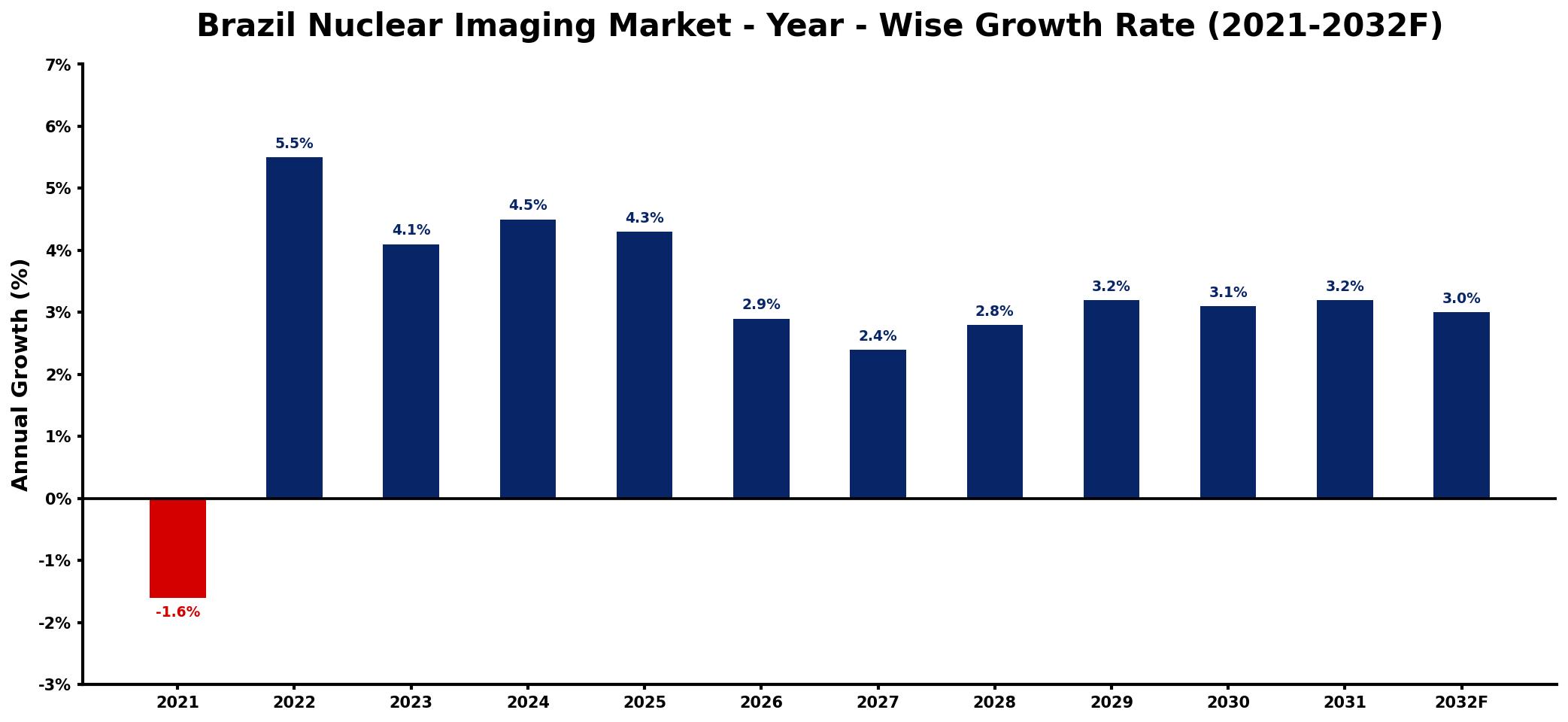
The table below presents the year‑wise growth rates along with the key drivers influencing the market
| Year | Growth Rate | Major Drivers |
| 2021 | -1.6% | decreased demand for healthcare services |
| 2022 | 5.5% | increased investment in healthcare infrastructure |
| 2023 | 4.1% | increased production capacity utilization |
| 2024 | 4.5% | growth in preventive healthcare initiatives |
| 2025 | 4.3% | rising prevalence of chronic diseases |
| 2026 | 2.9% | enhanced technological advancements adoption |
| 2027 | 2.4% | increased public health awareness campaigns |
| 2028 | 2.8% | strengthening underlying market demand |
| 2029 | 3.2% | expansion of telehealth services availability |
| 2030 | 3.1% | increased government healthcare funding |
| 2031 | 3.2% | rising end-use demand growth |
| 2032 | 3.0% | growing commercial sector adoption |
Note: Market size estimations and growth projections presented in this report are based on 6Wresearch's proprietary forecasting methodology, utilizing the latest available industry data, government publications, and primary research inputs.
Brazil Nuclear Imaging Market Synopsis
In Brazil, the nuclear imaging market is witnessing notable growth, driven by technological innovations that enhance imaging capabilities. Increased investments in healthcare infrastructure and medical imaging facilities are also propelling market expansion, reflecting a broader commitment to improving patient care and diagnostic accuracy.
The integration of personalized medicine with nuclear imaging methods such as PET and SPECT is becoming commonplace. As healthcare providers increasingly prioritize tailored treatment approaches, nuclear imaging technologies are positioned to play a vital role in disease management and patient outcomes.
Brazil Nuclear Imaging Market Key Takeaways
- Technological advancements significantly enhance image quality and diagnostic precision.
- Increased investment in healthcare infrastructure is expanding access to nuclear imaging technologies.
- The market is adapting to meet the rising demand for personalized healthcare solutions.
- Collaboration between research institutions and medical facilities is pivotal for innovation.
- Regulatory frameworks aim to ensure safety and efficacy within the sector.
Evaluation of Restraints in Brazil Nuclear Imaging Market
Despite the promising landscape, the Brazil nuclear imaging market faces several restraints. Navigating regulatory challenges is a significant concern, as compliance with safety standards can be complex and time-consuming. Furthermore, issues surrounding the maintenance and operational costs of imaging equipment can limit access for smaller healthcare providers. Skill shortages in nuclear medicine also hinder the efficient utilization of advanced imaging technologies, potentially affecting patient outcomes. Addressing these challenges will require concerted efforts between government bodies, healthcare providers, and industry stakeholders.
Brazil Nuclear Imaging Market Trends
Current trends in the Brazil nuclear imaging market include a shift towards hybrid imaging systems that combine different modalities, providing more comprehensive diagnostic information. Furthermore, there is a growing emphasis on AI and machine learning applications, which are being integrated into imaging analysis to enhance interpretation accuracy and reduce processing time. The focus on patient-centered care continues to rise, leading to increased demand for imaging techniques that enable timely and personalized treatment strategies.
Brazil Nuclear Imaging Market Opportunities
Significant growth opportunities exist within the Brazil nuclear imaging market, particularly in the areas of research and development. As Brazil looks to bolster its position in global healthcare, investments in innovative imaging technologies and partnerships with academic institutions are becoming essential. Furthermore, expanding outreach to underserved regions presents an opportunity to increase access to advanced imaging solutions, thereby enhancing diagnostic capabilities across the country.
Government Initiatives in the Brazil Nuclear Imaging Market
Brazilian government policies increasingly support the nuclear imaging market, prioritizing access to diagnostic services while ensuring compliance with safety regulations. Initiatives include funding for research and development projects aimed at enhancing imaging technologies. Additionally, the government is investing in training programs for healthcare professionals to address skill shortages in the field, ultimately promoting higher standards of care and ensuring that nuclear imaging practices align with international safety benchmarks.
Future Insights of the Brazil Nuclear Imaging Market
Looking ahead to the period from 2026 to 2032, the Brazil nuclear imaging market is poised for continued growth driven by advancements in technology and increasing awareness of the importance of early disease detection. The integration of nuclear imaging into routine clinical practice is expected to expand, facilitated by government support and an evolving healthcare infrastructure. As diagnostic imaging becomes more central to patient care, Brazil's nuclear imaging sector is likely to experience a transformation that emphasizes both innovation and improved patient outcomes.
Brazil Nuclear Imaging Market Latest Developments (2025 - 2026)
Recent developments in the Brazil nuclear imaging market reflect a strong commitment to enhancing diagnostic capabilities and patient care. There has been a notable rise in collaborative efforts between healthcare institutions and research organizations, focusing on developing cutting-edge imaging technologies. Furthermore, updates to regulatory frameworks are being implemented to streamline compliance processes, encouraging innovation and investment in the sector.
Brazil Nuclear Imaging Market - Key Attractiveness of the Report
- 10 Years of Market Numbers
- Historical Data Starting from 2022 to 2025
- Base Year: 2025
- Forecast Data until 2032
- Key Performance Indicators Impacting the Market
- Major Upcoming Developments and Projects
Key Highlights of the Report:
- Brazil Nuclear Imaging Market Outlook
- Market Size of Brazil Nuclear Imaging Market, 2025
- Forecast of Brazil Nuclear Imaging Market, 2032
- Historical Data and Forecast of Brazil Nuclear Imaging Revenues & Volume for the Period 2022-2032F
- Brazil Nuclear Imaging Market Trend Evolution
- Brazil Nuclear Imaging Market Drivers and Challenges
- Brazil Nuclear Imaging Price Trends
- Brazil Nuclear Imaging Porter's Five Forces
- Brazil Nuclear Imaging Industry Life Cycle
- Historical Data and Forecast of Brazil Nuclear Imaging Market Revenues & Volume By Product for the Period 2022-2032F
- Historical Data and Forecast of Brazil Nuclear Imaging Market Revenues & Volume By Single Photon-Emission Computed Tomography (SPECT) for the Period 2022-2032F
- Historical Data and Forecast of Brazil Nuclear Imaging Market Revenues & Volume By Hybrid Pet for the Period 2022-2032F
- Historical Data and Forecast of Brazil Nuclear Imaging Market Revenues & Volume By Planar Scintigraphy for the Period 2022-2032F
- Historical Data and Forecast of Brazil Nuclear Imaging Market Revenues & Volume By Application for the Period 2022-2032F
- Historical Data and Forecast of Brazil Nuclear Imaging Market Revenues & Volume By Oncology for the Period 2022-2032F
- Historical Data and Forecast of Brazil Nuclear Imaging Market Revenues & Volume By Cardiology for the Period 2022-2032F
- Historical Data and Forecast of Brazil Nuclear Imaging Market Revenues & Volume By Neurology for the Period 2022-2032F
- Historical Data and Forecast of Brazil Nuclear Imaging Market Revenues & Volume By Others for the Period 2022-2032F
- Historical Data and Forecast of Brazil Nuclear Imaging Market Revenues & Volume By Portability for the Period 2022-2032F
- Historical Data and Forecast of Brazil Nuclear Imaging Market Revenues & Volume By Pocket-Sized/Handheld Device for the Period 2022-2032F
- Historical Data and Forecast of Brazil Nuclear Imaging Market Revenues & Volume By Fixed for the Period 2022-2032F
- Historical Data and Forecast of Brazil Nuclear Imaging Market Revenues & Volume By End user for the Period 2022-2032F
- Historical Data and Forecast of Brazil Nuclear Imaging Market Revenues & Volume By Hospitals for the Period 2022-2032F
- Historical Data and Forecast of Brazil Nuclear Imaging Market Revenues & Volume By Imaging Centers for the Period 2022-2032F
- Historical Data and Forecast of Brazil Nuclear Imaging Market Revenues & Volume By Academic and Research Centers for the Period 2022-2032F
- Historical Data and Forecast of Brazil Nuclear Imaging Market Revenues & Volume By Others for the Period 2022-2032F
- Brazil Nuclear Imaging Import Export Trade Statistics
- Market Opportunity Assessment By Product
- Market Opportunity Assessment By Application
- Market Opportunity Assessment By Portability
- Market Opportunity Assessment By End user
- Brazil Nuclear Imaging Top Companies Market Share
- Brazil Nuclear Imaging Competitive Benchmarking By Technical and Operational Parameters
- Brazil Nuclear Imaging Company Profiles
- Brazil Nuclear Imaging Key Strategic Recommendations






































