Brazil Nuclear Power Plant and Equipment Market Size, Share & Growth Rate
The Brazil Nuclear Power Plant and Equipment Market was estimated at USD 419 Million in 2025 and is projected to reach USD 500 Million by 2032, growing at a CAGR of 2.6% from 2026 to 2032. This projected growth is primarily attributed to Brazil's commitment to diversifying its energy portfolio, reducing greenhouse gas emissions, and minimizing dependence on fossil fuels. As demand for stable and sustainable energy sources rises, the nuclear sector is poised to play a pivotal role in ensuring Brazil meets its future electricity needs.
Brazil Nuclear Power Plant and Equipment Market Year-wise Growth Rate and Key Drivers
This graph highlights how the Brazil Nuclear Power Plant and Equipment Market has steadily grown over the years, supported by major growth factors.
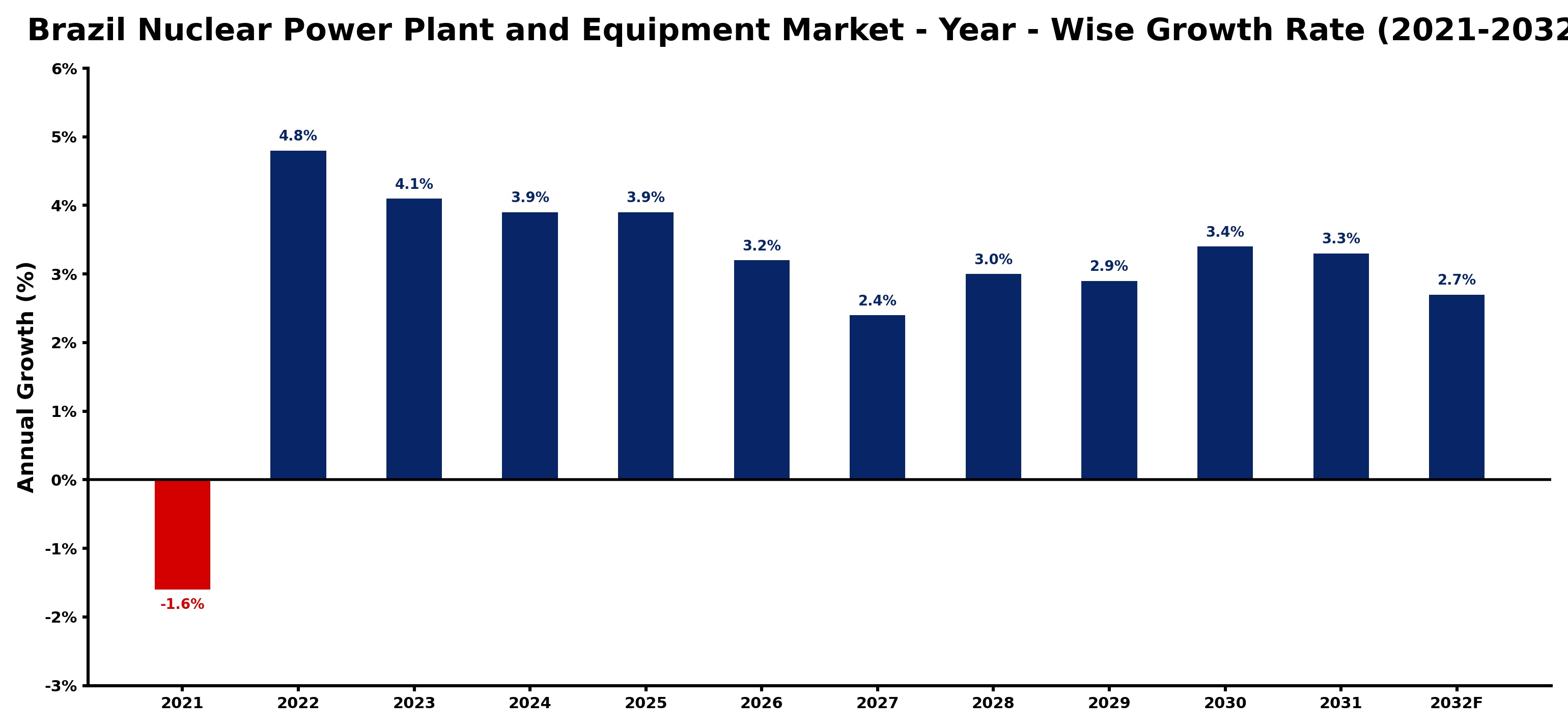
The table below presents the year‑wise growth rates along with the key drivers influencing the market
| Year | Growth Rate | Major Drivers |
| 2021 | -1.6% | Growing urbanization and commercial development |
| 2022 | 4.8% | Rapid growth in telecom and data center sectors |
| 2023 | 4.1% | Expansion of transportation and logistics networks |
| 2024 | 3.9% | Growing urbanization and commercial development |
| 2025 | 3.9% | Expansion of commercial construction activities |
| 2026 | 3.2% | Increasing industrial automation investments |
| 2027 | 2.4% | Increasing industrial automation investments |
| 2028 | 3.0% | Expansion of commercial construction activities |
| 2029 | 2.9% | Expansion of manufacturing activities |
| 2030 | 3.4% | Increasing adoption of advanced technologies |
| 2031 | 3.3% | Increasing industrial automation investments |
| 2032 | 2.7% | Expansion of commercial construction activities |
Note - Market size estimations and growth projections presented in this report are based on 6Wresearch’s advanced forecasting approach, validated with industry datasets as of June 2026.
Brazil Nuclear Power Plant and Equipment Market Synopsis
In recent years, Brazil has increasingly recognized the necessity of incorporating nuclear power into its energy landscape. This shift is driven by the country's ambitions for energy independence and sustainability amid growing electricity demand and climate change concerns. Nuclear energy is seen as a viable solution, offering a low-carbon footprint while fulfilling a significant portion of Brazil's energy requirements.
However, the advancement of nuclear energy in Brazil is not without its hurdles. Public apprehensions surrounding safety and regulatory complexities remain critical factors that must be addressed. Proactive communication and adherence to international safety standards will be essential for building public trust and fostering the nuclear sector's acceptance.
Brazil Nuclear Power Plant and Equipment Market Key Takeaways
- Steady growth expected in the nuclear power sector, driven by increasing energy demands and a shift towards low-carbon solutions.
- Government policies significantly influence investment strategies and regulatory frameworks, impacting market dynamics.
- Job creation and technological advancements within the nuclear industry enhance its appeal as a sustainable energy source.
- Building public trust and addressing safety concerns are essential for the future of nuclear energy in Brazil.
- Strategic partnerships and transparent communication are crucial for overcoming barriers and ensuring the sector's growth.
Evaluation of Restraints in Brazil Nuclear Power Plant and Equipment Market
Despite the promising outlook for the Brazil Nuclear Power Plant and Equipment market, several significant restraints hinder its growth. Public perception continues to be a major challenge, as concerns regarding nuclear safety persist. This is compounded by regulatory hurdles that can delay project approvals and significantly increase costs. Furthermore, the capital-intensive nature of nuclear energy projects necessitates substantial investment, which can be a barrier for potential investors. Without effective strategies to build trust and navigate regulatory landscapes, the expansion of the nuclear sector may face prolonged difficulties.
Brazil Nuclear Power Plant and Equipment Market Trends
Current trends in the Brazil Nuclear Power Plant and Equipment market reflect a shift towards modernization and innovation. Technological advancements are making nuclear facilities safer and more efficient, while digitalization within plant operations enhances operational performance. Additionally, there is a growing emphasis on sustainability, with the industry exploring advanced reactor designs that utilize smaller, modular technology. These trends are not only shaping the operational landscape but also attracting investment interest as Brazil seeks to bolster its energy security.
Brazil Nuclear Power Plant and Equipment Market Opportunities
The potential for growth within the Brazil Nuclear Power Plant and Equipment market is significant. Opportunities lie in leveraging government support for infrastructure development and public-private partnerships aimed at enhancing nuclear power capabilities. Moreover, Brazil's strategic geographical location can facilitate collaboration with other Latin American countries pursuing similar nuclear initiatives, allowing for shared resources and expertise. As Brazil continues to navigate its energy challenges, the nuclear sector presents a promising avenue for investment and development.
Government Initiatives in the Brazil Nuclear Power Plant and Equipment Market
Government initiatives play a critical role in shaping the Brazil Nuclear Power Plant and Equipment market. The Brazilian government's commitment to energy security and environmental sustainability is reflected in policies that support nuclear energy development. Regulations surrounding safety standards and waste management are vital for establishing a robust framework. Furthermore, Brazil's adherence to international non-proliferation agreements reinforces its dedication to responsible nuclear energy use, thus enhancing global confidence in its nuclear ambitions.
Future Insights of the Brazil Nuclear Power Plant and Equipment Market
Looking ahead to 2026-2032, the Brazil Nuclear Power Plant and Equipment market is positioned for gradual yet steady growth. As energy demands escalate and the urgency for sustainable solutions intensifies, the nuclear sector will likely become increasingly integral to Brazil's energy strategy. By addressing public concerns and fostering regulatory clarity, Brazil can unlock the full potential of its nuclear capabilities, paving the way for enhanced energy security and diversification of its energy mix.
Brazil Nuclear Power Plant and Equipment Market Latest Developments (May 2025 - June 2026)
In recent months, the Brazil Nuclear Power Plant and Equipment market has witnessed significant movements aimed at enhancing the industry's infrastructure and safety protocols. Discussions regarding new safety standards have gained traction, aiming to ensure public confidence and regulatory compliance. Furthermore, there has been an increase in investment interest from both domestic and international stakeholders, focusing on modernization projects and technological upgrades that promise to boost operational efficiency and safety within nuclear facilities.
Brazil Nuclear Power Plant and Equipment Market - Key Attractiveness of the Report
- 10 Years of Market Numbers
- Historical Data Starting from 2022 to 2025
- Base Year: 2025
- Forecast Data until 2032
- Key Performance Indicators Impacting the Market
- Major Upcoming Developments and Projects
Key Highlights of the Report:
- Brazil Nuclear Power Plant and Equipment Market Outlook
- Market Size of Brazil Nuclear Power Plant and Equipment Market, 2025
- Forecast of Brazil Nuclear Power Plant and Equipment Market, 2032
- Historical Data and Forecast of Brazil Nuclear Power Plant and Equipment Revenues & Volume for the Period 2022-2032F
- Brazil Nuclear Power Plant and Equipment Market Trend Evolution
- Brazil Nuclear Power Plant and Equipment Market Drivers and Challenges
- Brazil Nuclear Power Plant and Equipment Price Trends
- Brazil Nuclear Power Plant and Equipment Porter's Five Forces
- Brazil Nuclear Power Plant and Equipment Industry Life Cycle
- Historical Data and Forecast of Brazil Nuclear Power Plant and Equipment Market Revenues & Volume By Reactor Type for the Period 2022-2032F
- Historical Data and Forecast of Brazil Nuclear Power Plant and Equipment Market Revenues & Volume By PWR for the Period 2022-2032F
- Historical Data and Forecast of Brazil Nuclear Power Plant and Equipment Market Revenues & Volume By PHWR for the Period 2022-2032F
- Historical Data and Forecast of Brazil Nuclear Power Plant and Equipment Market Revenues & Volume By Boiling water reactor for the Period 2022-2032F
- Historical Data and Forecast of Brazil Nuclear Power Plant and Equipment Market Revenues & Volume By High temperature gas cooled reactor for the Period 2022-2032F
- Historical Data and Forecast of Brazil Nuclear Power Plant and Equipment Market Revenues & Volume By Fast Breeder Reactor for the Period 2022-2032F
- Historical Data and Forecast of Brazil Nuclear Power Plant and Equipment Market Revenues & Volume By Others for the Period 2022-2032F
- Historical Data and Forecast of Brazil Nuclear Power Plant and Equipment Market Revenues & Volume By Equipment for the Period 2022-2032F
- Historical Data and Forecast of Brazil Nuclear Power Plant and Equipment Market Revenues & Volume By Island Equipment for the Period 2022-2032F
- Historical Data and Forecast of Brazil Nuclear Power Plant and Equipment Market Revenues & Volume By Auxiliary Equipment for the Period 2022-2032F
- Brazil Nuclear Power Plant and Equipment Import Export Trade Statistics
- Market Opportunity Assessment By Reactor Type
- Market Opportunity Assessment By Equipment
- Brazil Nuclear Power Plant and Equipment Top Companies Market Share
- Brazil Nuclear Power Plant and Equipment Competitive Benchmarking By Technical and Operational Parameters
- Brazil Nuclear Power Plant and Equipment Company Profiles
- Brazil Nuclear Power Plant and Equipment Key Strategic Recommendations






































