United States (US) Nuclear Power Plant and Equipment Market Size, Share & Growth Rate
The United States (US) Nuclear Power Plant and Equipment Market was estimated at USD 107 Million in 2025 and is projected to reach USD 126 Million by 2032, growing at a CAGR of 2.4% from 2026 to 2032. This growth trajectory is supported by several key factors, including increasing investment in advanced nuclear technologies, and the urgent need to upgrade aging infrastructure for improved safety and efficiency. Moreover, the heightened focus on low-carbon energy sources amidst global climate commitments further propels the market forward.
United States (US) Nuclear Power Plant and Equipment Market Year-wise Growth Rate and Key Drivers
This graph highlights how the United States (US) Nuclear Power Plant and Equipment Market has steadily grown over the years, supported by major growth factors.
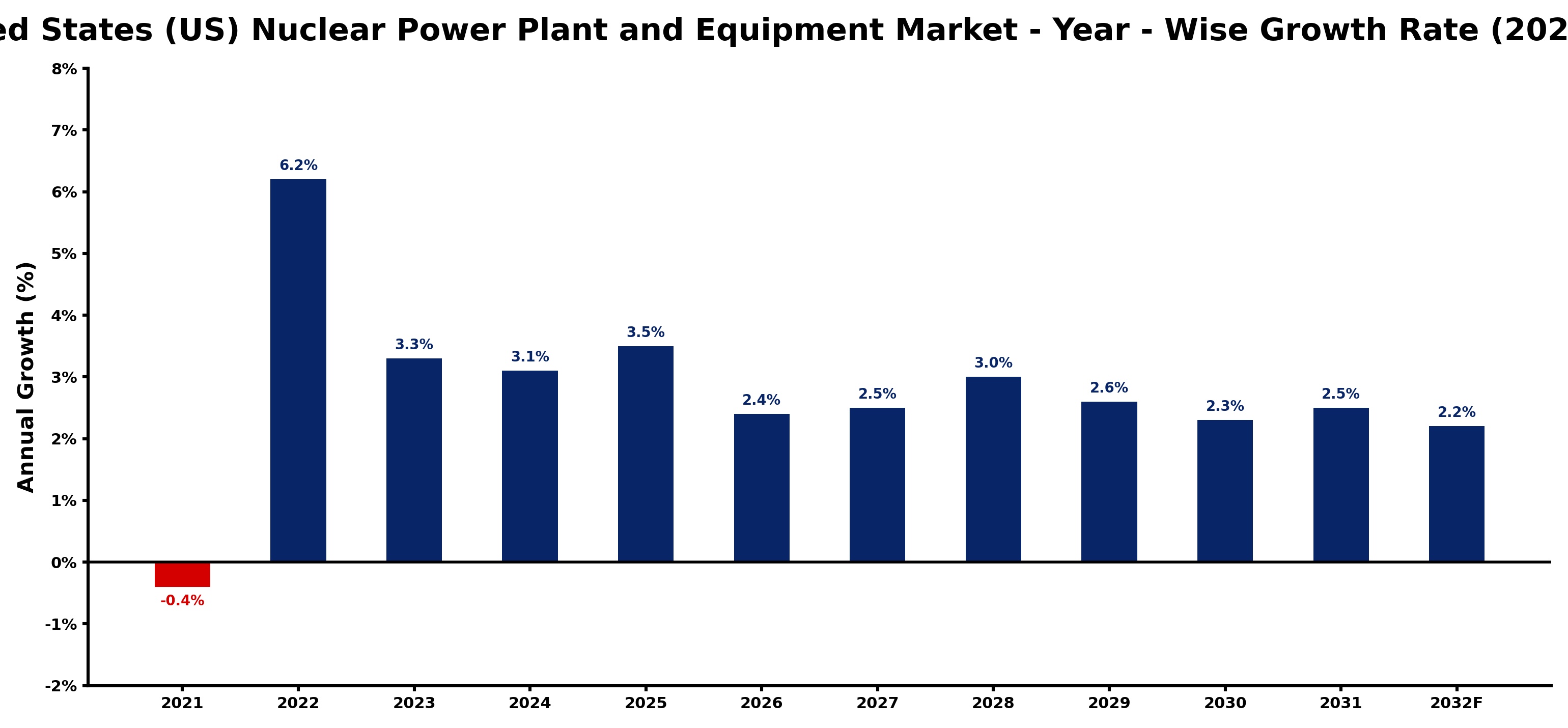
The table below presents the year‑wise growth rates along with the key drivers influencing the market
| Year | Growth Rate | Major Drivers |
| 2021 | -0.4% | Increasing smart city development projects |
| 2022 | 6.2% | Rapid growth in telecom and data center sectors |
| 2023 | 3.3% | Rising electricity demand across industries |
| 2024 | 3.1% | Increasing industrial infrastructure investments |
| 2025 | 3.5% | Rising electricity demand across industries |
| 2026 | 2.4% | Expansion of commercial construction activities |
| 2027 | 2.5% | Rising electricity demand across industries |
| 2028 | 3.0% | Increasing adoption of advanced technologies |
| 2029 | 2.6% | Growing urbanization and commercial development |
| 2030 | 2.3% | Expansion of commercial construction activities |
| 2031 | 2.5% | Increasing smart city development projects |
| 2032 | 2.2% | Rapid growth in telecom and data center sectors |
Note - Market size estimations and growth projections presented in this report are based on 6Wresearch’s advanced forecasting approach, validated with industry datasets as of June 2026.
United States (US) Nuclear Power Plant and Equipment Market Synopsis
Despite recent stagnation in new nuclear plant construction, the United States Nuclear Power Plant and Equipment Market is on the cusp of transformation. Future prospects signal a shift toward technological innovation and expansion, driven by regulatory support and increasing awareness of nuclear energy's environmental benefits.
The market's existing infrastructure, while aging, presents unique opportunities for modernization and life extension projects. As more stakeholders recognize nuclear power's role in achieving energy sustainability, investment in both equipment upgrades and next-generation technologies is expected to accelerate significantly.
United States (US) Nuclear Power Plant and Equipment Market Key Takeaways
- The market is projected to grow from USD 107 Million in 2025 to USD 126 Million by 2032.
- Investment in advanced nuclear technologies is increasing, particularly in small modular reactors (SMRs).
- There is a rising emphasis on infrastructure modernization and regulatory support.
- Public interest in low-carbon energy sources boosts the nuclear sector's visibility.
- Digitalization and automation technologies are reshaping plant operations and safety protocols.
Evaluation of Restraints in United States (US) Nuclear Power Plant and Equipment Market
Despite promising growth potential, the United States Nuclear Power Plant and Equipment Market is hindered by a variety of restraints. High capital costs for constructing and maintaining facilities can deter potential investments, while lengthy regulatory processes introduce uncertainty into project timelines. Public apprehension surrounding safety, environmental concerns, and waste disposal further complicate the landscape. These challenges necessitate careful navigation to align market growth with stakeholder interests.
United States (US) Nuclear Power Plant and Equipment Market Trends
Several pivotal trends are currently shaping the United States Nuclear Power Plant and Equipment Market. A noteworthy trend is the increasing investment in small modular reactors (SMRs), which promise enhanced safety and flexibility. Additionally, the integration of digitalization and automation technologies is transforming how plants operate, aiming to maximize efficiency while minimizing risks. Finally, the growing recognition of nuclear energy as a viable solution for reducing greenhouse gas emissions is encouraging renewed support and investment in the sector.
United States (US) Nuclear Power Plant and Equipment Market Opportunities
Opportunities for growth and investment within the United States Nuclear Power Plant and Equipment Market are abundant. There is significant potential for modernization projects that address the aging infrastructure of existing plants. Furthermore, the advancing nuclear technology landscape offers prospects for introducing innovative solutions that enhance safety and efficiency. Partnerships with government agencies can also facilitate the development of new projects, particularly as stakeholders prioritize cleaner energy options.
Government Initiatives in the United States (US) Nuclear Power Plant and Equipment Market
The US government plays a crucial role in shaping the Nuclear Power Plant and Equipment Market through various policies and initiatives. Regulatory bodies like the Nuclear Regulatory Commission (NRC) focus on ensuring safety and compliance, while the Department of Energy (DOE) supports research and innovation in nuclear technologies. Financial incentives, such as loan guarantees and tax credits, are also provided to promote nuclear energy's expansion. As the debate on waste management and energy policy continues, these initiatives aim to balance safety with the need for sustainable energy solutions.
Future Insights of the United States (US) Nuclear Power Plant and Equipment Market
Looking ahead to 2026-2032, the United States Nuclear Power Plant and Equipment Market is positioned for notable growth. The increasing demand for low-carbon energy, coupled with a commitment to modernize aging facilities, sets a promising stage. Advances in nuclear technologies, particularly small modular reactors, are expected to catalyze investment and innovation. While challenges remain, a concerted effort toward regulatory clarity and public engagement is likely to enhance the market's viability in the coming years.
United States (US) Nuclear Power Plant and Equipment Market Latest Developments (May 2025 - June 2026)
Recent developments within the United States Nuclear Power Plant and Equipment Market indicate a strategic pivot towards modernization and technological innovation. Industry stakeholders are increasingly exploring advanced reactor designs, alongside initiatives aimed at enhancing operational efficiencies through digital tools. Furthermore, discussions surrounding regulatory reforms are gaining traction, potentially paving the way for new investments and projects in the nuclear sector.
United States (US) Nuclear Power Plant and Equipment Market - Key Attractiveness of the Report
- 10 Years of Market Numbers
- Historical Data Starting from 2022 to 2025
- Base Year: 2025
- Forecast Data until 2032
- Key Performance Indicators Impacting the Market
- Major Upcoming Developments and Projects
Key Highlights of the Report:
- United States (US) Nuclear Power Plant and Equipment Market Outlook
- Market Size of United States (US) Nuclear Power Plant and Equipment Market, 2025
- Forecast of United States (US) Nuclear Power Plant and Equipment Market, 2032
- Historical Data and Forecast of United States (US) Nuclear Power Plant and Equipment Revenues & Volume for the Period 2022-2032F
- United States (US) Nuclear Power Plant and Equipment Market Trend Evolution
- United States (US) Nuclear Power Plant and Equipment Market Drivers and Challenges
- United States (US) Nuclear Power Plant and Equipment Price Trends
- United States (US) Nuclear Power Plant and Equipment Porter's Five Forces
- United States (US) Nuclear Power Plant and Equipment Industry Life Cycle
- Historical Data and Forecast of United States (US) Nuclear Power Plant and Equipment Market Revenues & Volume By Reactor Type for the Period 2022-2032F
- Historical Data and Forecast of United States (US) Nuclear Power Plant and Equipment Market Revenues & Volume By PWR for the Period 2022-2032F
- Historical Data and Forecast of United States (US) Nuclear Power Plant and Equipment Market Revenues & Volume By PHWR for the Period 2022-2032F
- Historical Data and Forecast of United States (US) Nuclear Power Plant and Equipment Market Revenues & Volume By Boiling water reactor for the Period 2022-2032F
- Historical Data and Forecast of United States (US) Nuclear Power Plant and Equipment Market Revenues & Volume By High temperature gas cooled reactor for the Period 2022-2032F
- Historical Data and Forecast of United States (US) Nuclear Power Plant and Equipment Market Revenues & Volume By Fast Breeder Reactor for the Period 2022-2032F
- Historical Data and Forecast of United States (US) Nuclear Power Plant and Equipment Market Revenues & Volume By Others for the Period 2022-2032F
- Historical Data and Forecast of United States (US) Nuclear Power Plant and Equipment Market Revenues & Volume By Equipment for the Period 2022-2032F
- Historical Data and Forecast of United States (US) Nuclear Power Plant and Equipment Market Revenues & Volume By Island Equipment for the Period 2022-2032F
- Historical Data and Forecast of United States (US) Nuclear Power Plant and Equipment Market Revenues & Volume By Auxiliary Equipment for the Period 2022-2032F
- United States (US) Nuclear Power Plant and Equipment Import Export Trade Statistics
- Market Opportunity Assessment By Reactor Type
- Market Opportunity Assessment By Equipment
- United States (US) Nuclear Power Plant and Equipment Top Companies Market Share
- United States (US) Nuclear Power Plant and Equipment Competitive Benchmarking By Technical and Operational Parameters
- United States (US) Nuclear Power Plant and Equipment Company Profiles
- United States (US) Nuclear Power Plant and Equipment Key Strategic Recommendations






































