Chile Nuclear Power Plant and Equipment Market Size, Share & Growth Rate
The Chile Nuclear Power Plant and Equipment Market was estimated at USD 398 Million in 2025 and is projected to reach USD 526 Million by 2032, growing at a CAGR of 4.1% from 2026 to 2032. This growth trajectory is primarily fueled by Chile's commitment to diversifying its energy mix and transitioning toward cleaner energy sources. With a recognized need to reduce greenhouse gas emissions and the depletion of fossil fuels, the government is increasingly exploring nuclear energy as a viable solution.
Chile Nuclear Power Plant and Equipment Market Year-wise Growth Rate and Key Drivers
This graph highlights how the Chile Nuclear Power Plant and Equipment Market has steadily grown over the years, supported by major growth factors.
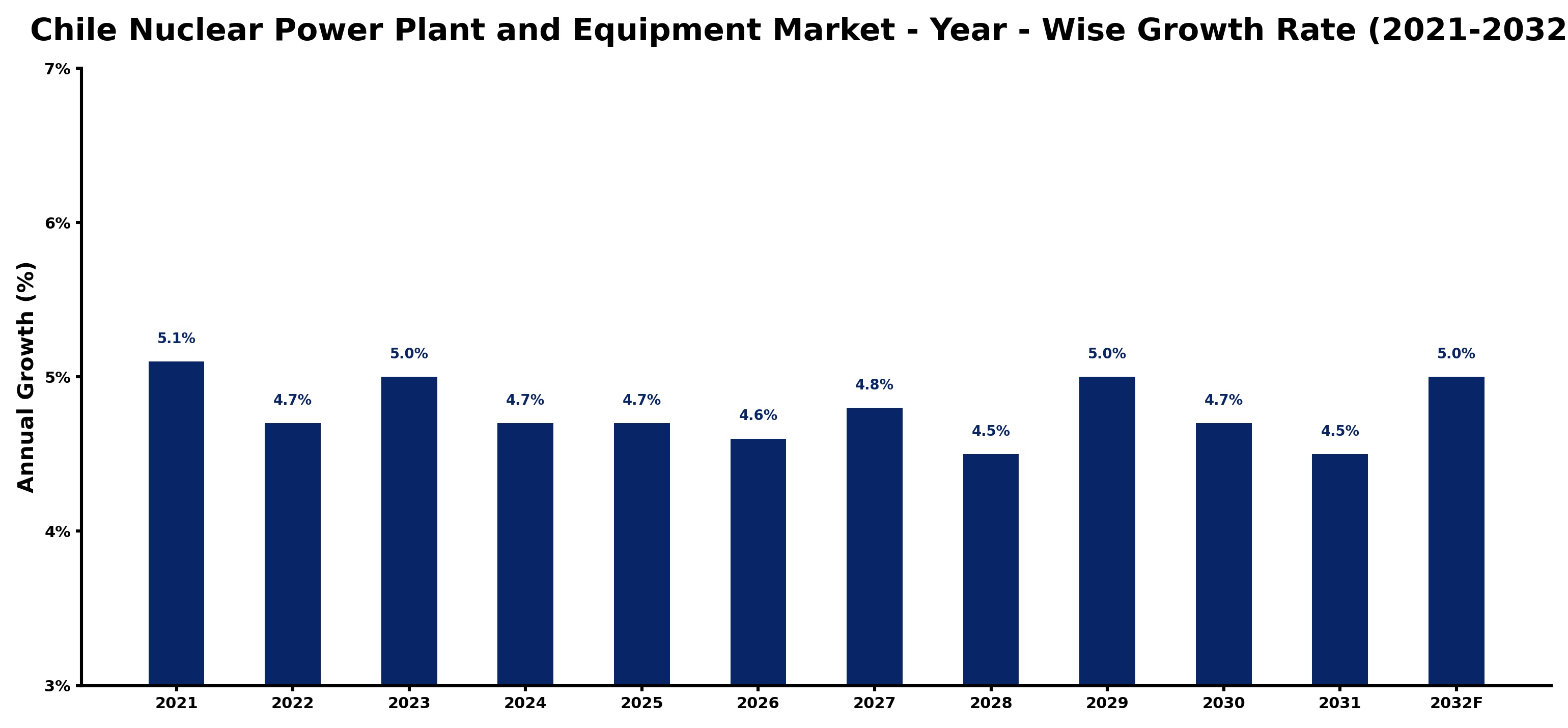
The table below presents the year‑wise growth rates along with the key drivers influencing the market
| Year | Growth Rate | Major Drivers |
| 2021 | 5.1% | Expansion of commercial construction activities |
| 2022 | 4.7% | Expansion of transportation and logistics networks |
| 2023 | 5.0% | Expansion of manufacturing activities |
| 2024 | 4.7% | Growing renewable energy integration projects |
| 2025 | 4.7% | Expansion of commercial construction activities |
| 2026 | 4.6% | Growing urbanization and commercial development |
| 2027 | 4.8% | Expansion of manufacturing activities |
| 2028 | 4.5% | Expansion of commercial construction activities |
| 2029 | 5.0% | Growing renewable energy integration projects |
| 2030 | 4.7% | Increasing industrial infrastructure investments |
| 2031 | 4.5% | Expansion of commercial construction activities |
| 2032 | 5.0% | Increasing smart city development projects |
Note - Market size estimations and growth projections presented in this report are based on 6Wresearch's advanced forecasting approach, validated with industry datasets as of June 2026.
Chile Nuclear Power Plant and Equipment Market Synopsis
In recent years, there has been a notable shift in Chile's energy strategy, leaning towards nuclear energy to meet the growing electricity demand. This interest contrasts sharply with a previous emphasis on renewable sources, underscoring a significant evolution in public and governmental attitudes towards nuclear power.
Looking forward, the market is positioned at a critical juncture. While the emphasis on renewable energy remains strong, the potential for nuclear energy as a complementary source is gaining traction. As technology advances and safety concerns are addressed, nuclear power could play a crucial role in achieving Chile's sustainability targets.
Chile Nuclear Power Plant and Equipment Market Key Takeaways
- The market is witnessing a shift towards nuclear energy as part of a diverse energy portfolio.
- Government interest in exploring nuclear options reflects a broader commitment to reducing carbon emissions.
- Investment in advanced technologies is crucial for improving safety and operational efficiency.
- Public opinion and regulatory frameworks will play a significant role in market development.
- Collaboration with international experts is key to building a robust nuclear infrastructure in Chile.
Evaluation of Restraints in Chile Nuclear Power Plant and Equipment Market
Despite the potential for growth, the Chile Nuclear Power Plant and Equipment Market faces considerable restraints. A strong commitment to renewable energy sources, such as solar and wind, has created a competitive landscape that may hinder nuclear advancements. Additionally, public opposition rooted in safety concerns and historical incidents poses a substantial challenge. These factors, combined with the absence of comprehensive government policies specifically supporting nuclear development, create an environment of uncertainty, complicating investment justifications for stakeholders in the nuclear sector.
Chile Nuclear Power Plant and Equipment Market Trends
Several key trends are shaping the Chile Nuclear Power Plant and Equipment Market. Firstly, there is an increasing focus on enhancing safety standards through the adoption of advanced technologies. Investors are also showing interest in collaborative ventures with established international nuclear firms to tap into their expertise. Moreover, as global awareness of climate change grows, so does the momentum for sustainable energy solutions that include nuclear options. Such trends suggest a transitional phase where nuclear energy is being reconsidered as an essential component of a cleaner energy future.
Chile Nuclear Power Plant and Equipment Market Opportunities
The Chile Nuclear Power Plant and Equipment Market presents a range of investment opportunities. With a clear government initiative to diversify energy sources and reduce emissions, investors can explore avenues such as the development of nuclear power plants and associated technologies. Advanced safety systems and equipment maintenance solutions also represent promising sectors for long-term investment. However, potential investors should remain cognizant of regulatory landscapes and public sentiment while pursuing these opportunities.
Government Initiatives in the Chile Nuclear Power Plant and Equipment Market
The Chilean government has maintained a cautious stance towards nuclear energy, prioritizing renewable sources. While there are no current operational nuclear plants or specific policies promoting nuclear energy, the government has expressed interest in assessing nuclear power's viability as a future energy source. Chile's commitments to international nuclear safety agreements demonstrate a recognition of the importance of adhering to high standards. However, any movement towards nuclear development would necessitate thorough evaluations regarding safety, environmental impact, and public consensus.
Future Insights of the Chile Nuclear Power Plant and Equipment Market
The future of the Chile Nuclear Power Plant and Equipment Market appears to be on a gradual upward trajectory. The ongoing push for a diverse energy mix suggests that nuclear power could eventually become a cornerstone in meeting the nation's energy requirements. As electricity demand continues to rise, coupled with an increasing urgency to cut greenhouse gas emissions, nuclear energy's role may become more pronounced. However, navigating public perception and regulatory complexities will be essential for realizing this market potential.
Chile Nuclear Power Plant and Equipment Market Latest Developments (May 2025 - June 2026)
Recent developments indicate a growing acknowledgment of nuclear power within Chile's broader energy strategy. Collaborative discussions with international nuclear experts are underway, focusing on knowledge transfer and technology sharing. Simultaneously, there is an observable increase in research initiatives aimed at understanding public concerns and regulatory expectations surrounding nuclear energy. These steps suggest a slowly shifting landscape where nuclear energy may find a more established place within the country's future energy framework.
Chile Nuclear Power Plant and Equipment Market - Key Attractiveness of the Report
- 10 Years of Market Numbers
- Historical Data Starting from 2022 to 2025
- Base Year: 2025
- Forecast Data until 2032
- Key Performance Indicators Impacting the Market
- Major Upcoming Developments and Projects
Key Highlights of the Report:
- Chile Nuclear Power Plant and Equipment Market Outlook
- Market Size of Chile Nuclear Power Plant and Equipment Market, 2025
- Forecast of Chile Nuclear Power Plant and Equipment Market, 2032
- Historical Data and Forecast of Chile Nuclear Power Plant and Equipment Revenues & Volume for the Period 2022-2032F
- Chile Nuclear Power Plant and Equipment Market Trend Evolution
- Chile Nuclear Power Plant and Equipment Market Drivers and Challenges
- Chile Nuclear Power Plant and Equipment Price Trends
- Chile Nuclear Power Plant and Equipment Porter's Five Forces
- Chile Nuclear Power Plant and Equipment Industry Life Cycle
- Historical Data and Forecast of Chile Nuclear Power Plant and Equipment Market Revenues & Volume By Reactor Type for the Period 2022-2032F
- Historical Data and Forecast of Chile Nuclear Power Plant and Equipment Market Revenues & Volume By PWR for the Period 2022-2032F
- Historical Data and Forecast of Chile Nuclear Power Plant and Equipment Market Revenues & Volume By PHWR for the Period 2022-2032F
- Historical Data and Forecast of Chile Nuclear Power Plant and Equipment Market Revenues & Volume By Boiling water reactor for the Period 2022-2032F
- Historical Data and Forecast of Chile Nuclear Power Plant and Equipment Market Revenues & Volume By High temperature gas cooled reactor for the Period 2022-2032F
- Historical Data and Forecast of Chile Nuclear Power Plant and Equipment Market Revenues & Volume By Fast Breeder Reactor for the Period 2022-2032F
- Historical Data and Forecast of Chile Nuclear Power Plant and Equipment Market Revenues & Volume By Others for the Period 2022-2032F
- Historical Data and Forecast of Chile Nuclear Power Plant and Equipment Market Revenues & Volume By Equipment for the Period 2022-2032F
- Historical Data and Forecast of Chile Nuclear Power Plant and Equipment Market Revenues & Volume By Island Equipment for the Period 2022-2032F
- Historical Data and Forecast of Chile Nuclear Power Plant and Equipment Market Revenues & Volume By Auxiliary Equipment for the Period 2022-2032F
- Chile Nuclear Power Plant and Equipment Import Export Trade Statistics
- Market Opportunity Assessment By Reactor Type
- Market Opportunity Assessment By Equipment
- Chile Nuclear Power Plant and Equipment Top Companies Market Share
- Chile Nuclear Power Plant and Equipment Competitive Benchmarking By Technical and Operational Parameters
- Chile Nuclear Power Plant and Equipment Company Profiles
- Chile Nuclear Power Plant and Equipment Key Strategic Recommendations






































