Myanmar Nuclear Power Plant and Equipment Market Size, Share & Growth Rate
The Myanmar Nuclear Power Plant and Equipment Market was estimated at USD 466 Million in 2025 and is projected to reach USD 625 Million by 2032, growing at a CAGR of 4.3% from 2026 to 2032. This growth trajectory is largely driven by Myanmar's urgent need to diversify its energy sources amidst rising electricity demand and the increasing viability of nuclear energy as a sustainable solution. As international interest grows, partnerships with countries like Russia and Japan could further catalyze this evolution.
Myanmar Nuclear Power Plant and Equipment Market Year-wise Growth Rate and Key Drivers
This graph highlights how the Myanmar Nuclear Power Plant and Equipment Market has steadily grown over the years, supported by major growth factors.
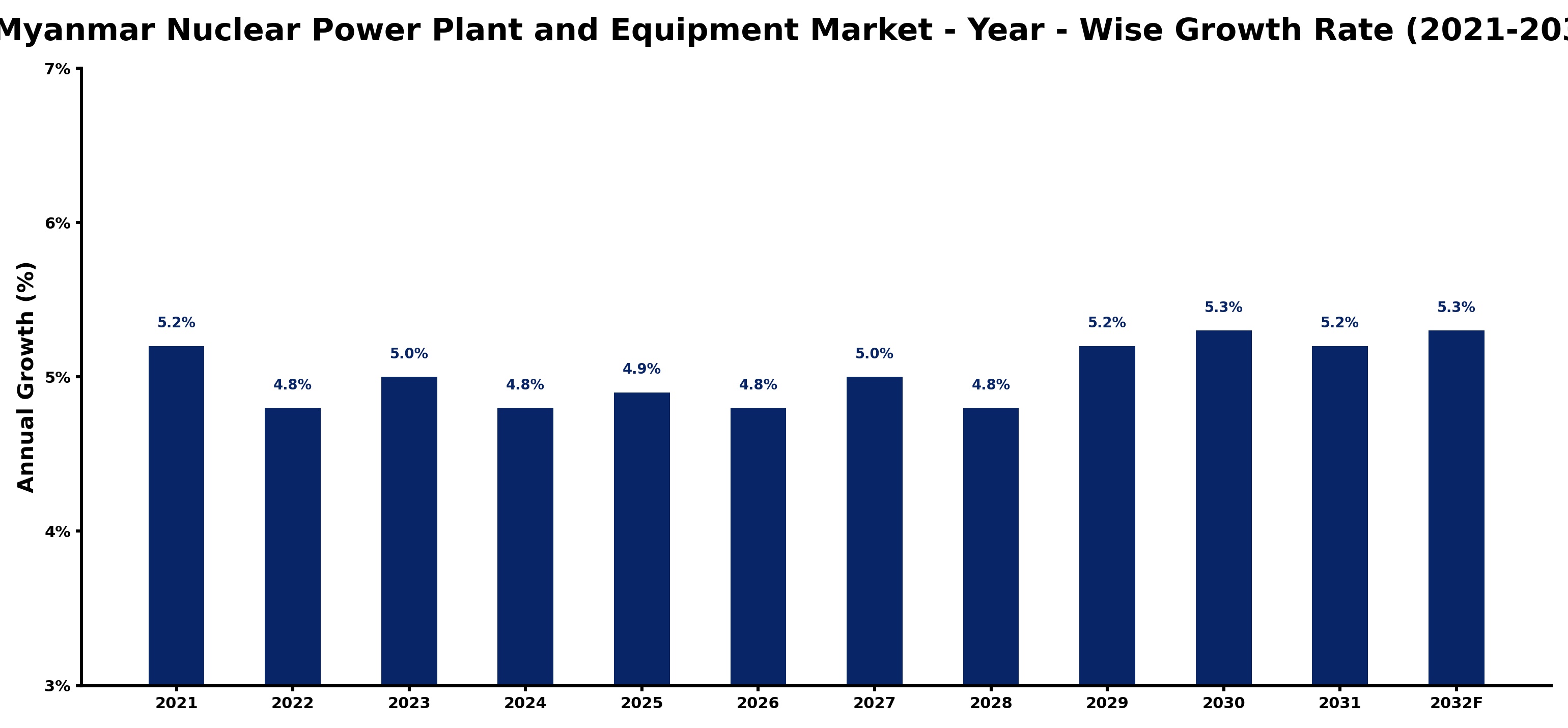
The table below presents the year‑wise growth rates along with the key drivers influencing the market
| Year | Growth Rate | Major Drivers |
| 2021 | 5.2% | Rising electricity demand across industries |
| 2022 | 4.8% | Expansion of transportation and logistics networks |
| 2023 | 5.0% | Expansion of manufacturing activities |
| 2024 | 4.8% | Increasing industrial infrastructure investments |
| 2025 | 4.9% | Rising electricity demand across industries |
| 2026 | 4.8% | Increasing industrial infrastructure investments |
| 2027 | 5.0% | Increasing industrial automation investments |
| 2028 | 4.8% | Government infrastructure modernization initiatives |
| 2029 | 5.2% | Increasing adoption of advanced technologies |
| 2030 | 5.3% | Increasing smart city development projects |
| 2031 | 5.2% | Rising electricity demand across industries |
| 2032 | 5.3% | Rapid growth in telecom and data center sectors |
Note - Market size estimations and growth projections presented in this report are based on 6Wresearch's advanced forecasting approach, validated with industry datasets as of June 2026.
Myanmar Nuclear Power Plant and Equipment Market Synopsis
Despite the nascent stage of its nuclear power sector, Myanmar is experiencing increasing momentum as the government explores nuclear energy to meet soaring energy demands. Recent developments signal a shift in policy focus and growing engagement with international partners, indicating potential for future investment and infrastructure development.
Looking forward, the landscape for the Myanmar Nuclear Power Plant and Equipment Market remains uncertain. The lack of established regulatory frameworks and the need for comprehensive safety measures are significant hurdles that must be addressed. However, the country's strategic positioning between China and India presents a unique opportunity for Myanmar to emerge as a key player in the regional nuclear energy market.
Myanmar Nuclear Power Plant and Equipment Market Key Takeaways
- The market is projected to experience steady growth, reaching USD 625 Million by 2032.
- International collaboration is essential for technological advancement and infrastructure development.
- Public perception and safety regulations are crucial for market acceptance and growth.
- Investment opportunities are abundant in technology supply, training, and maintenance services.
- The market is set against a backdrop of increasing energy demand and a shift towards cleaner energy sources.
Evaluation of Restraints in Myanmar Nuclear Power Plant and Equipment Market
The Myanmar Nuclear Power Plant and Equipment Market faces multiple constraints that hinder its progress. A significant challenge is the absence of a comprehensive legal framework governing nuclear energy, which generates regulatory uncertainties that can deter foreign investment. Additionally, the lack of a skilled workforce poses a technical barrier to establishing and operating nuclear facilities effectively. Environmental concerns and public opposition are further complicating factors, making it vital for stakeholders to engage in extensive community outreach and education to foster acceptance of nuclear energy as a viable option.
Myanmar Nuclear Power Plant and Equipment Market Trends
As the Myanmar Nuclear Power Plant and Equipment Market develops, several trends are emerging that shape its landscape. There is an increasing focus on adopting international safety standards and best practices, driven by the need for public assurance regarding nuclear safety. Additionally, as the government emphasizes nuclear energy in its long-term strategy, stakeholders are exploring innovative technologies and advanced systems to support nuclear power plant construction and operation. Collaborative partnerships with established nuclear nations are also on the rise, further fostering technological transfer and local capacity building.
Myanmar Nuclear Power Plant and Equipment Market Opportunities
The path ahead for investment in the Myanmar Nuclear Power Plant and Equipment Market is filled with lucrative opportunities. Suppliers of advanced nuclear technology and equipment have a unique chance to tap into this emerging market. Furthermore, as Myanmar navigates its energy transition, there is a significant demand for expertise in nuclear training and operational maintenance. The potential for Myanmar to serve as a regional hub for nuclear technology exports due to its geographical location further accentuates the attractiveness of this market for investors willing to navigate the associated risks and challenges.
Government Initiatives in the Myanmar Nuclear Power Plant and Equipment Market
Currently, the Myanmar government has not established any specific policies pertaining to the nuclear power sector. Their primary focus remains on renewable energy development and strengthening existing power generation infrastructure. However, as energy demands escalate, it is anticipated that the government may need to create supportive policies and frameworks to facilitate the safe exploration and eventual implementation of nuclear power. Engagement with international bodies and adherence to global safety protocols will likely play a critical role in shaping future governmental initiatives.
Future Insights of the Myanmar Nuclear Power Plant and Equipment Market
Looking forward to the 2026-2032 horizon, the Myanmar Nuclear Power Plant and Equipment Market appears poised for gradual growth. However, realization of its potential hinges on overcoming regulatory and technical obstacles. Continued international cooperation will be imperative, as will efforts to build public trust in nuclear energy. If the government succeeds in establishing a robust legal framework and safety standards, the nuclear sector could significantly contribute to the nation's energy diversification strategy, positioning Myanmar as a notable player in the regional energy landscape.
Myanmar Nuclear Power Plant and Equipment Market Latest Developments (May 2025 - June 2026)
Recent developments in the Myanmar Nuclear Power Plant and Equipment Market have included increased dialogues between Myanmar and several nuclear technology suppliers from abroad. The government has been actively evaluating potential models for nuclear energy development, exploring international best practices, and engaging with technical experts to formulate foundational policies. Public consultations and safety workshops have begun to address community concerns and build a framework for public acceptance. These initiatives signal a shift towards a more structured approach to developing the nuclear energy sector in Myanmar.
Myanmar Nuclear Power Plant and Equipment Market - Key Attractiveness of the Report
- 10 Years of Market Numbers
- Historical Data Starting from 2022 to 2025
- Base Year: 2025
- Forecast Data until 2032
- Key Performance Indicators Impacting the Market
- Major Upcoming Developments and Projects
Key Highlights of the Report:
- Myanmar Nuclear Power Plant and Equipment Market Outlook
- Market Size of Myanmar Nuclear Power Plant and Equipment Market, 2025
- Forecast of Myanmar Nuclear Power Plant and Equipment Market, 2032
- Historical Data and Forecast of Myanmar Nuclear Power Plant and Equipment Revenues & Volume for the Period 2022-2032F
- Myanmar Nuclear Power Plant and Equipment Market Trend Evolution
- Myanmar Nuclear Power Plant and Equipment Market Drivers and Challenges
- Myanmar Nuclear Power Plant and Equipment Price Trends
- Myanmar Nuclear Power Plant and Equipment Porter's Five Forces
- Myanmar Nuclear Power Plant and Equipment Industry Life Cycle
- Historical Data and Forecast of Myanmar Nuclear Power Plant and Equipment Market Revenues & Volume By Reactor Type for the Period 2022-2032F
- Historical Data and Forecast of Myanmar Nuclear Power Plant and Equipment Market Revenues & Volume By PWR for the Period 2022-2032F
- Historical Data and Forecast of Myanmar Nuclear Power Plant and Equipment Market Revenues & Volume By PHWR for the Period 2022-2032F
- Historical Data and Forecast of Myanmar Nuclear Power Plant and Equipment Market Revenues & Volume By Boiling water reactor for the Period 2022-2032F
- Historical Data and Forecast of Myanmar Nuclear Power Plant and Equipment Market Revenues & Volume By High temperature gas cooled reactor for the Period 2022-2032F
- Historical Data and Forecast of Myanmar Nuclear Power Plant and Equipment Market Revenues & Volume By Fast Breeder Reactor for the Period 2022-2032F
- Historical Data and Forecast of Myanmar Nuclear Power Plant and Equipment Market Revenues & Volume By Others for the Period 2022-2032F
- Historical Data and Forecast of Myanmar Nuclear Power Plant and Equipment Market Revenues & Volume By Equipment for the Period 2022-2032F
- Historical Data and Forecast of Myanmar Nuclear Power Plant and Equipment Market Revenues & Volume By Island Equipment for the Period 2022-2032F
- Historical Data and Forecast of Myanmar Nuclear Power Plant and Equipment Market Revenues & Volume By Auxiliary Equipment for the Period 2022-2032F
- Myanmar Nuclear Power Plant and Equipment Import Export Trade Statistics
- Market Opportunity Assessment By Reactor Type
- Market Opportunity Assessment By Equipment
- Myanmar Nuclear Power Plant and Equipment Top Companies Market Share
- Myanmar Nuclear Power Plant and Equipment Competitive Benchmarking By Technical and Operational Parameters
- Myanmar Nuclear Power Plant and Equipment Company Profiles
- Myanmar Nuclear Power Plant and Equipment Key Strategic Recommendations






































