Nepal Nuclear Power Plant and Equipment Market Size, Share & Growth Rate
The Nepal Nuclear Power Plant and Equipment Market was estimated at USD 183 Million in 2025 and is projected to reach USD 242 Million by 2032, growing at a CAGR of 4.1% from 2026 to 2032. This trajectory is primarily driven by the country's urgent need to diversify energy sources and decrease reliance on imported electricity. As Nepal's energy demands escalate, so too does the commitment to investing in nuclear power infrastructure, positioning the sector for substantial expansion.
Nepal Nuclear Power Plant and Equipment Market Year-wise Growth Rate and Key Drivers
This graph highlights how the Nepal Nuclear Power Plant and Equipment Market has steadily grown over the years, supported by major growth factors.
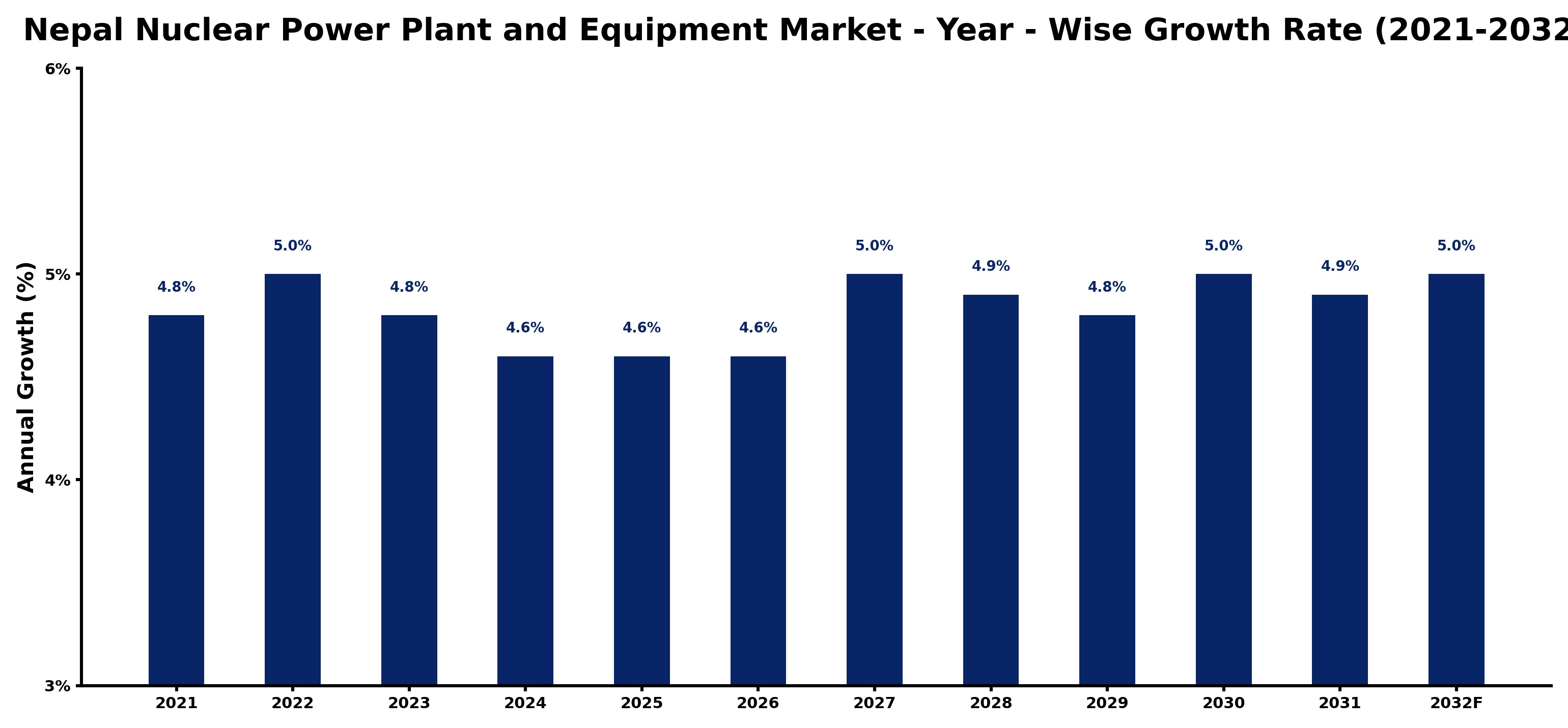
The table below presents the year‑wise growth rates along with the key drivers influencing the market
| Year | Growth Rate | Major Drivers |
| 2021 | 4.8% | Government infrastructure modernization initiatives |
| 2022 | 5.0% | Increasing adoption of advanced technologies |
| 2023 | 4.8% | Government infrastructure modernization initiatives |
| 2024 | 4.6% | Increasing industrial automation investments |
| 2025 | 4.6% | Rapid growth in telecom and data center sectors |
| 2026 | 4.6% | Increasing industrial automation investments |
| 2027 | 5.0% | Increasing industrial infrastructure investments |
| 2028 | 4.9% | Increasing adoption of advanced technologies |
| 2029 | 4.8% | Growing urbanization and commercial development |
| 2030 | 5.0% | Rising electricity demand across industries |
| 2031 | 4.9% | Rising electricity demand across industries |
| 2032 | 5.0% | Increasing industrial automation investments |
Note - Market size estimations and growth projections presented in this report are based on 6Wresearch's advanced forecasting approach, validated with industry datasets as of June 2026.
Nepal Nuclear Power Plant and Equipment Market Synopsis
The strongest force shaping the Nepal Nuclear Power Plant and Equipment Market right now is the government's determination to embrace nuclear energy as a solution to energy sustainability. This is evidenced by proactive initiatives aimed at establishing a regulatory framework and securing public awareness about the benefits of nuclear power.
Alongside regulatory efforts, international collaborations are gaining momentum, facilitating knowledge transfer and technological advancement. These partnerships are critical as Nepal aims to integrate advanced nuclear technologies while ensuring safety and efficiency in energy generation, thus fostering a more robust energy sector.
Nepal Nuclear Power Plant and Equipment Market Key Takeaways
- The market is forecasted to grow significantly, reflecting increasing energy demands and governmental support.
- Investment opportunities exist across various sectors including research, development, and construction related to nuclear power.
- Strong collaborations between local and international players are emerging to enhance technological capabilities.
- Safety and regulatory frameworks remain pivotal to gaining public acceptance of nuclear energy in Nepal.
- Enhanced focus on clean energy solutions positions nuclear power as a critical component of Nepal's energy strategy.
Evaluation of Restraints in Nepal Nuclear Power Plant and Equipment Market
The Nepal Nuclear Power Plant and Equipment Market faces several significant restraints. Notably, the country's geographical conditions, including its location in a seismically active region, raise pressing safety concerns regarding nuclear installations. Furthermore, the existing infrastructure is insufficient to support robust nuclear power development, hampered by a lack of technical expertise and financial resources. The absence of a clearly defined regulatory framework also complicates the market landscape, causing delays and uncertainties in project implementation. Public acceptance of nuclear energy remains a complex issue, as perceptions about safety and environmental impacts continue to influence the discourse on energy policy.
Nepal Nuclear Power Plant and Equipment Market Trends
The market is witnessing notable trends that are shaping both demand and technology. An increasing emphasis on enhancing the safety and efficiency of nuclear power plants is evident, with stakeholders focusing on adopting advanced technologies and operational practices. Moreover, there's a growing collaboration between various sectors, integrating local expertise with international best practices. This trend of knowledge sharing is crucial for developing a competent workforce that can sustain and innovate in the nuclear power sector.
Nepal Nuclear Power Plant and Equipment Market Opportunities
Investment opportunities in the Nepal Nuclear Power Plant and Equipment Market are numerous and varied. With a clear drive towards clean and reliable energy sources, there is significant potential in the development and construction of nuclear power plants. Specific areas ripe for investment include nuclear technology research and development, equipment manufacturing, and maintenance services. Additionally, forging partnerships with established international nuclear companies could enable access to cutting-edge technologies and best practices, further enhancing project viability and operational efficiency.
Government Initiatives in the Nepal Nuclear Power Plant and Equipment Market
The Nepalese government has taken meaningful steps towards the exploration of nuclear power, including the establishment of the Nepal Atomic Energy Authority (NAEA) to oversee the regulation and promotion of nuclear energy initiatives. Current efforts are focused on enhancing nuclear safety, conducting public consultations to address community concerns, and laying the groundwork for future nuclear projects through feasibility studies. Additionally, the government is fostering international partnerships to support the development of infrastructure, thereby reinforcing its commitment to a diversified energy strategy.
Future Insights of the Nepal Nuclear Power Plant and Equipment Market
Looking ahead to 2026-2032, the Nepal Nuclear Power Plant and Equipment Market is poised for growth driven by heightened energy demands and a robust government commitment to diversifying the energy mix. With ongoing initiatives aimed at attracting foreign investments and developing nuclear capabilities, the market is likely to witness substantial advancements. However, it is essential that challenges surrounding regulatory frameworks and public perception are effectively addressed to ensure a smooth trajectory for future developments in the nuclear sector.
Nepal Nuclear Power Plant and Equipment Market Latest Developments (May 2025 - June 2026)
In recent months, the direction of the Nepal Nuclear Power Plant and Equipment Market has been characterized by increased engagement in feasibility studies and safety assessments. The government has ramped up efforts to consult with international experts and stakeholders to ensure best practices are incorporated into future projects. Public outreach campaigns have also been initiated, aimed at increasing awareness and acceptance of nuclear energy within local communities, which is crucial for garnering support for upcoming initiatives.
Nepal Nuclear Power Plant and Equipment Market - Key Attractiveness of the Report
- 10 Years of Market Numbers
- Historical Data Starting from 2022 to 2025
- Base Year: 2025
- Forecast Data until 2032
- Key Performance Indicators Impacting the Market
- Major Upcoming Developments and Projects
Key Highlights of the Report:
- Nepal Nuclear Power Plant and Equipment Market Outlook
- Market Size of Nepal Nuclear Power Plant and Equipment Market, 2025
- Forecast of Nepal Nuclear Power Plant and Equipment Market, 2032
- Historical Data and Forecast of Nepal Nuclear Power Plant and Equipment Revenues & Volume for the Period 2022-2032F
- Nepal Nuclear Power Plant and Equipment Market Trend Evolution
- Nepal Nuclear Power Plant and Equipment Market Drivers and Challenges
- Nepal Nuclear Power Plant and Equipment Price Trends
- Nepal Nuclear Power Plant and Equipment Porter's Five Forces
- Nepal Nuclear Power Plant and Equipment Industry Life Cycle
- Historical Data and Forecast of Nepal Nuclear Power Plant and Equipment Market Revenues & Volume By Reactor Type for the Period 2022-2032F
- Historical Data and Forecast of Nepal Nuclear Power Plant and Equipment Market Revenues & Volume By PWR for the Period 2022-2032F
- Historical Data and Forecast of Nepal Nuclear Power Plant and Equipment Market Revenues & Volume By PHWR for the Period 2022-2032F
- Historical Data and Forecast of Nepal Nuclear Power Plant and Equipment Market Revenues & Volume By Boiling water reactor for the Period 2022-2032F
- Historical Data and Forecast of Nepal Nuclear Power Plant and Equipment Market Revenues & Volume By High temperature gas cooled reactor for the Period 2022-2032F
- Historical Data and Forecast of Nepal Nuclear Power Plant and Equipment Market Revenues & Volume By Fast Breeder Reactor for the Period 2022-2032F
- Historical Data and Forecast of Nepal Nuclear Power Plant and Equipment Market Revenues & Volume By Others for the Period 2022-2032F
- Historical Data and Forecast of Nepal Nuclear Power Plant and Equipment Market Revenues & Volume By Equipment for the Period 2022-2032F
- Historical Data and Forecast of Nepal Nuclear Power Plant and Equipment Market Revenues & Volume By Island Equipment for the Period 2022-2032F
- Historical Data and Forecast of Nepal Nuclear Power Plant and Equipment Market Revenues & Volume By Auxiliary Equipment for the Period 2022-2032F
- Nepal Nuclear Power Plant and Equipment Import Export Trade Statistics
- Market Opportunity Assessment By Reactor Type
- Market Opportunity Assessment By Equipment
- Nepal Nuclear Power Plant and Equipment Top Companies Market Share
- Nepal Nuclear Power Plant and Equipment Competitive Benchmarking By Technical and Operational Parameters
- Nepal Nuclear Power Plant and Equipment Company Profiles
- Nepal Nuclear Power Plant and Equipment Key Strategic Recommendations






































