Nigeria Nuclear Power Plant and Equipment Market Size, Share & Growth Rate
The Nigeria Nuclear Power Plant and Equipment Market was estimated at USD 339 Million in 2025 and is projected to reach USD 458 Million by 2032, growing at a CAGR of 4.4% from 2026 to 2032. This growth trajectory is primarily driven by Nigeria's urgent need to diversify its energy portfolio and bolster its power generation capabilities. A concerted focus on nuclear energy, positioned as a cleaner alternative to traditional fossil fuels, is set to play a pivotal role in meeting the country's escalating electricity demands.
Nigeria Nuclear Power Plant and Equipment Market Year-wise Growth Rate and Key Drivers
This graph highlights how the Nigeria Nuclear Power Plant and Equipment Market has steadily grown over the years, supported by major growth factors.
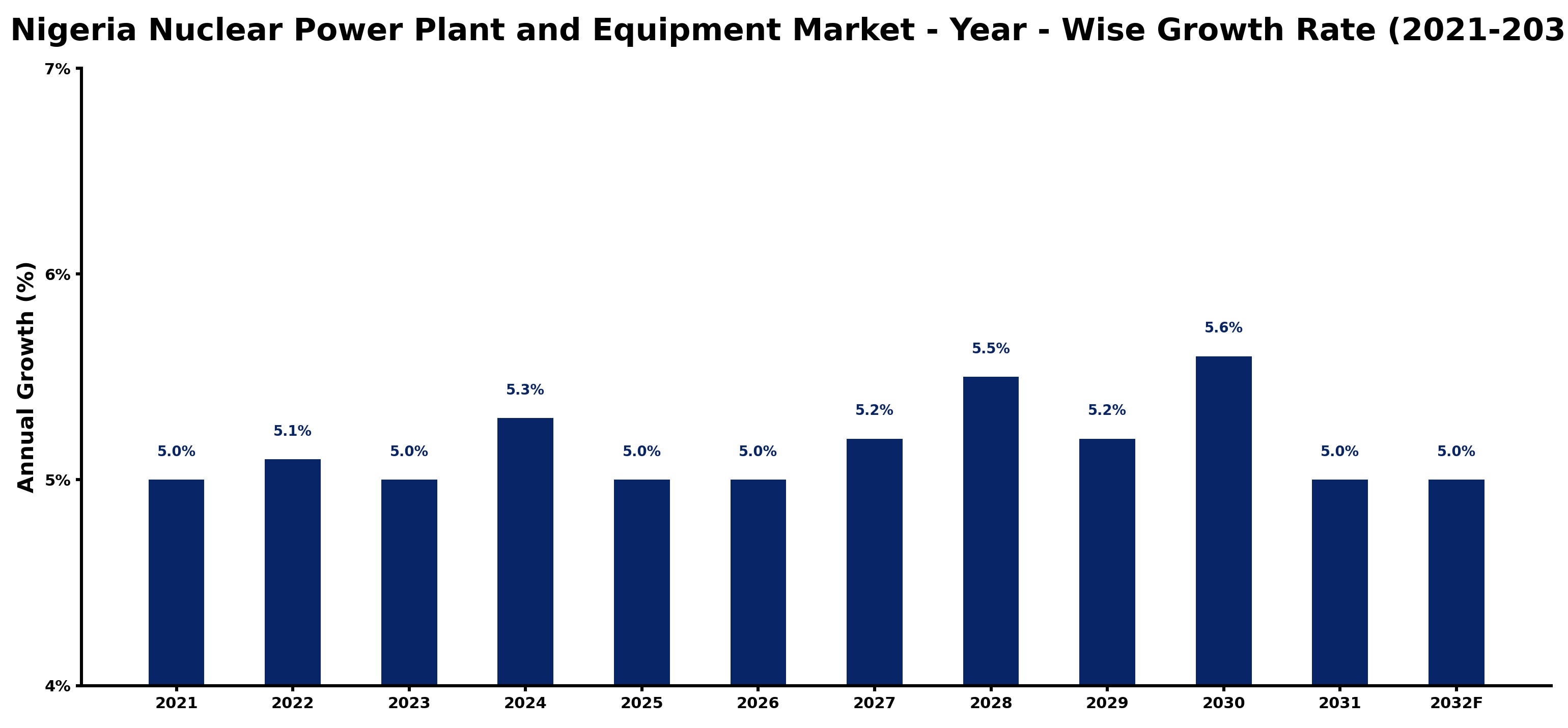
The table below presents the year‑wise growth rates along with the key drivers influencing the market
| Year | Growth Rate | Major Drivers |
| 2021 | 5.0% | Increasing industrial automation investments |
| 2022 | 5.1% | Increasing industrial automation investments |
| 2023 | 5.0% | Rising electricity demand across industries |
| 2024 | 5.3% | Increasing industrial automation investments |
| 2025 | 5.0% | Growing urbanization and commercial development |
| 2026 | 5.0% | Increasing industrial infrastructure investments |
| 2027 | 5.2% | Expansion of manufacturing activities |
| 2028 | 5.5% | Rapid growth in telecom and data center sectors |
| 2029 | 5.2% | Increasing adoption of advanced technologies |
| 2030 | 5.6% | Expansion of manufacturing activities |
| 2031 | 5.0% | Increasing smart city development projects |
| 2032 | 5.0% | Government infrastructure modernization initiatives |
Note - Market size estimations and growth projections presented in this report are based on 6Wresearch's advanced forecasting approach, validated with industry datasets as of June 2026.
Nigeria Nuclear Power Plant and Equipment Market Synopsis
While the Nigeria Nuclear Power Plant and Equipment Market has shown promising initial momentum, it is at a crossroads, balancing between potential expansion and existing obstacles. The government's intent to incorporate nuclear energy into its long-term energy strategy signifies a strategic pivot, highlighting the role of nuclear power as a sustainable energy solution.
However, as investments and partnerships are explored, the market's future remains contingent on overcoming regulatory and public perception hurdles. The interplay of these factors will ultimately dictate the pace at which the sector can evolve, underscoring the dynamic landscape of Nigeria's energy market.
Nigeria Nuclear Power Plant and Equipment Market Key Takeaways
- The market is on a growth trajectory, reflecting Nigeria's focus on energy diversification.
- Regulatory frameworks and safety standards are critical determinants of market development.
- Investment opportunities abound, particularly in plant construction and equipment supply.
- Government engagement with international organizations is vital for capacity building.
- Public perception of nuclear energy remains a crucial barrier to market expansion.
Evaluation of Restraints in Nigeria Nuclear Power Plant and Equipment Market
The Nigeria Nuclear Power Plant and Equipment Market faces several significant restraints that may inhibit its growth trajectory. A lack of clear regulatory frameworks poses challenges for potential investors, as uncertainty around safety standards and operational protocols can deter participation. Furthermore, public skepticism surrounding nuclear safety continues to cloud the sector's reputation. Limited funding opportunities also restrict infrastructure development, as the capital-intensive nature of nuclear projects requires substantial investment upfront. Addressing these restraints is crucial to fostering a conducive environment for nuclear energy to flourish in Nigeria.
Nigeria Nuclear Power Plant and Equipment Market Trends
Emerging trends in the Nigeria Nuclear Power Plant and Equipment Market include a heightened emphasis on sustainable energy and technological innovations. As global attention shifts towards clean energy alternatives, nuclear power is increasingly viewed as a key player in the transition to greener energy systems. Advances in nuclear technology, such as modular reactors and safety enhancements, are paving the way for a more favorable investment climate. Additionally, collaborative ventures with international firms are expected to bring in expertise, further catalyzing growth within the sector.
Nigeria Nuclear Power Plant and Equipment Market Opportunities
Significant investment opportunities exist in constructing new nuclear facilities and modernizing existing ones. The Nigerian government's interest in nuclear energy as a sustainable solution to power generation opens avenues for domestic and international partnerships. Moreover, the supply chain for equipment and technology in the nuclear sector presents another lucrative area for investors. As the demand for reliable electricity continues to grow, stakeholders are poised to capitalize on the evolving landscape of Nigeria's energy market.
Government Initiatives in the Nigeria Nuclear Power Plant and Equipment Market
The Nigerian government has taken preliminary steps to establish a framework for nuclear energy development, demonstrated by the Nuclear Safety and Radiation Protection Act of 1995. Engagement with international organizations like the International Atomic Energy Agency (IAEA) has been instrumental in enhancing regulatory oversight and safety protocols. However, more cohesive policies and investment in nuclear infrastructure are necessary to realize the full potential of this sector. Plans for new nuclear projects remain under discussion, reflecting the government's commitment to diversifying Nigeria's energy sources.
Future Insights of the Nigeria Nuclear Power Plant and Equipment Market
Looking ahead to 2026-2032, the Nigeria Nuclear Power Plant and Equipment Market appears poised for growth, albeit amidst challenges. The persistent need for reliable and clean energy will drive ongoing government interest in nuclear capabilities. Nonetheless, successful advancement hinges on addressing key issues, such as regulatory clarity and public acceptance. If stakeholders can foster a collaborative environment that emphasizes safety and technological innovation, Nigeria's nuclear sector has the potential to become a cornerstone of its energy strategy.
Nigeria Nuclear Power Plant and Equipment Market Latest Developments (May 2025 - June 2026)
Recent developments in the Nigeria Nuclear Power Plant and Equipment Market indicate a growing commitment to nuclear energy. The government is reportedly pursuing international partnerships to enhance technical capacity and regulatory frameworks. Discussions surrounding the construction of new nuclear facilities have intensified, reflecting a broader strategic vision to integrate nuclear power into the national energy mix. Continued dialogue with industry stakeholders suggests a positive momentum towards establishing a robust nuclear infrastructure.
Nigeria Nuclear Power Plant and Equipment Market - Key Attractiveness of the Report
- 10 Years of Market Numbers
- Historical Data Starting from 2022 to 2025
- Base Year: 2025
- Forecast Data until 2032
- Key Performance Indicators Impacting the Market
- Major Upcoming Developments and Projects
Key Highlights of the Report:
- Nigeria Nuclear Power Plant and Equipment Market Outlook
- Market Size of Nigeria Nuclear Power Plant and Equipment Market, 2025
- Forecast of Nigeria Nuclear Power Plant and Equipment Market, 2032
- Historical Data and Forecast of Nigeria Nuclear Power Plant and Equipment Revenues & Volume for the Period 2022-2032F
- Nigeria Nuclear Power Plant and Equipment Market Trend Evolution
- Nigeria Nuclear Power Plant and Equipment Market Drivers and Challenges
- Nigeria Nuclear Power Plant and Equipment Price Trends
- Nigeria Nuclear Power Plant and Equipment Porter's Five Forces
- Nigeria Nuclear Power Plant and Equipment Industry Life Cycle
- Historical Data and Forecast of Nigeria Nuclear Power Plant and Equipment Market Revenues & Volume By Reactor Type for the Period 2022-2032F
- Historical Data and Forecast of Nigeria Nuclear Power Plant and Equipment Market Revenues & Volume By PWR for the Period 2022-2032F
- Historical Data and Forecast of Nigeria Nuclear Power Plant and Equipment Market Revenues & Volume By PHWR for the Period 2022-2032F
- Historical Data and Forecast of Nigeria Nuclear Power Plant and Equipment Market Revenues & Volume By Boiling water reactor for the Period 2022-2032F
- Historical Data and Forecast of Nigeria Nuclear Power Plant and Equipment Market Revenues & Volume By High temperature gas cooled reactor for the Period 2022-2032F
- Historical Data and Forecast of Nigeria Nuclear Power Plant and Equipment Market Revenues & Volume By Fast Breeder Reactor for the Period 2022-2032F
- Historical Data and Forecast of Nigeria Nuclear Power Plant and Equipment Market Revenues & Volume By Others for the Period 2022-2032F
- Historical Data and Forecast of Nigeria Nuclear Power Plant and Equipment Market Revenues & Volume By Equipment for the Period 2022-2032F
- Historical Data and Forecast of Nigeria Nuclear Power Plant and Equipment Market Revenues & Volume By Island Equipment for the Period 2022-2032F
- Historical Data and Forecast of Nigeria Nuclear Power Plant and Equipment Market Revenues & Volume By Auxiliary Equipment for the Period 2022-2032F
- Nigeria Nuclear Power Plant and Equipment Import Export Trade Statistics
- Market Opportunity Assessment By Reactor Type
- Market Opportunity Assessment By Equipment
- Nigeria Nuclear Power Plant and Equipment Top Companies Market Share
- Nigeria Nuclear Power Plant and Equipment Competitive Benchmarking By Technical and Operational Parameters
- Nigeria Nuclear Power Plant and Equipment Company Profiles
- Nigeria Nuclear Power Plant and Equipment Key Strategic Recommendations






































