Kenya Nuclear Power Plant and Equipment Market Size, Share & Growth Rate
The Kenya Nuclear Power Plant and Equipment Market was estimated at USD 276 Million in 2025 and is projected to reach USD 372 Million by 2032, growing at a CAGR of 4.4% from 2026 to 2032. This growth trajectory is largely fueled by the government's commitment to diversifying the energy mix, enhancing energy security, and reducing the carbon footprint associated with fossil fuels. The planned establishment of the first nuclear power plant by 2027 is expected to catalyze further investments and development in nuclear technologies and infrastructure.
Kenya Nuclear Power Plant and Equipment Market Year-wise Growth Rate and Key Drivers
This graph highlights how the Kenya Nuclear Power Plant and Equipment Market has steadily grown over the years, supported by major growth factors.
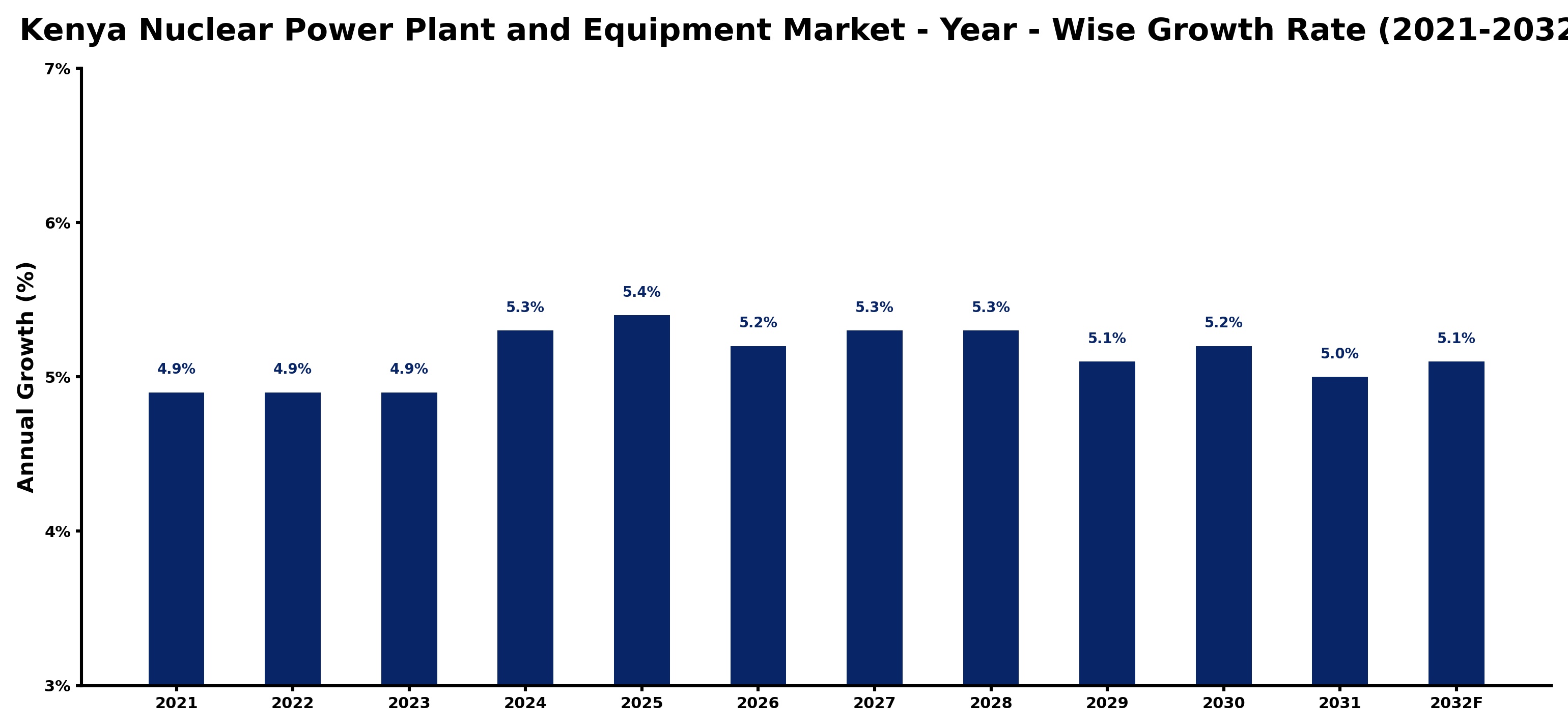
The table below presents the year‑wise growth rates along with the key drivers influencing the market
| Year | Growth Rate | Major Drivers |
| 2021 | 4.9% | Expansion of manufacturing activities |
| 2022 | 4.9% | Increasing industrial infrastructure investments |
| 2023 | 4.9% | Expansion of commercial construction activities |
| 2024 | 5.3% | Expansion of transportation and logistics networks |
| 2025 | 5.4% | Government infrastructure modernization initiatives |
| 2026 | 5.2% | Rising electricity demand across industries |
| 2027 | 5.3% | Increasing industrial automation investments |
| 2028 | 5.3% | Growing renewable energy integration projects |
| 2029 | 5.1% | Growing renewable energy integration projects |
| 2030 | 5.2% | Increasing smart city development projects |
| 2031 | 5.0% | Increasing smart city development projects |
| 2032 | 5.1% | Government infrastructure modernization initiatives |
Note - Market size estimations and growth projections presented in this report are based on 6Wresearch's advanced forecasting approach, validated with industry datasets as of June 2026.
Kenya Nuclear Power Plant and Equipment Market Synopsis
The most significant force currently shaping the Kenya Nuclear Power Plant and Equipment Market is the government's strategic initiative to introduce nuclear energy into its energy portfolio. This ambitious plan reflects Kenya's need to meet rising electricity demands while transitioning towards more sustainable energy sources.
In addition to the government's proactive measures, there is a growing interest from both domestic and international companies aiming to capitalize on opportunities within this market. This influx of investment is fostering advancements in technology, safety protocols, and public engagement initiatives that aim to bolster acceptance of nuclear energy among Kenyan citizens.
Kenya Nuclear Power Plant and Equipment Market Key Takeaways
- The market is projected to grow significantly, with an estimated value of USD 372 Million by 2032.
- Government initiatives are a driving force, focusing on energy diversification and sustainability.
- Investments are increasingly directed towards enhancing safety and operational capabilities of nuclear facilities.
- Public engagement and education will play a critical role in addressing concerns regarding nuclear energy.
- Investment opportunities abound in equipment supply, technological partnerships, and workforce development.
Evaluation of Restraints in Kenya Nuclear Power Plant and Equipment Market
The Kenya Nuclear Power Plant and Equipment Market faces several constraints that could impede its growth trajectory. Regulatory frameworks regarding nuclear energy are still being developed, leading to uncertainties for potential investors and project developers. Public perception remains a significant challenge, with lingering concerns over safety, environmental implications, and waste management. Additionally, the current lack of skilled personnel in the nuclear sector further complicates the landscape, necessitating comprehensive training and educational programs to build a competent workforce capable of managing nuclear facilities efficiently.
Kenya Nuclear Power Plant and Equipment Market Trends
Several current and emerging trends are shaping the Kenya Nuclear Power Plant and Equipment Market. A heightened focus on safety measures, coupled with advancements in reactor technologies, is enhancing operational efficiency and sustainability. Furthermore, partnerships with international suppliers are becoming increasingly common as they provide necessary expertise and resources. Notably, educational initiatives aimed at cultivating a skilled workforce are gaining traction, ensuring that the local population is equipped to manage and maintain nuclear power plants effectively.
Kenya Nuclear Power Plant and Equipment Market Opportunities
The market presents numerous investment opportunities for both local and foreign entities. With the Kenyan government aiming to diversify its energy portfolio, demand for nuclear power equipment and technologies is poised for growth. Investors can explore various avenues, including supplying reactor components, safety systems, and control instrumentation. Additionally, there is potential for partnerships that focus on research and development in innovative nuclear technologies, alongside initiatives that promote knowledge transfer and training with local companies.
Government Initiatives in the Kenya Nuclear Power Plant and Equipment Market
The Kenyan government has established a clear vision for nuclear power development, manifesting in the creation of the Nuclear Power and Energy Agency (NuPEA). This agency is tasked with overseeing the implementation and regulation of nuclear energy projects. Since 2016, cooperative agreements with countries like South Korea have facilitated the development of nuclear infrastructure. Furthermore, the government emphasizes transparency and public engagement, aiming to foster a supportive environment for the nuclear energy sector through informed decision-making and community involvement.
Future Insights of the Kenya Nuclear Power Plant and Equipment Market
The future outlook for the Kenya Nuclear Power Plant and Equipment Market appears optimistic as the country progresses towards integrating nuclear energy into its broader energy strategy. By 2035, the establishment of the first nuclear power plant is expected to drive significant demand for related technologies and services. This transition will not only address the increasing electricity demand but also align with the global shift towards cleaner energy solutions. However, addressing regulatory challenges and cultivating public support will be crucial in realizing this vision and ensuring sustainable growth in the sector.
Kenya Nuclear Power Plant and Equipment Market Latest Developments (May 2025 - June 2026)
Recent developments indicate a strong commitment from the Kenyan government to establish a nuclear power framework. Notable strides have been made in regulatory processes, with updates aimed at enhancing safety and environmental standards. Engagement with international partners continues to facilitate knowledge sharing and infrastructure development, while initiatives to increase public awareness about nuclear energy's benefits are underway. These efforts collectively strengthen the foundation for successful implementation of nuclear projects in Kenya.
Kenya Nuclear Power Plant and Equipment Market - Key Attractiveness of the Report
- 10 Years of Market Numbers
- Historical Data Starting from 2022 to 2025
- Base Year: 2025
- Forecast Data until 2032
- Key Performance Indicators Impacting the Market
- Major Upcoming Developments and Projects
Key Highlights of the Report:
- Kenya Nuclear Power Plant and Equipment Market Outlook
- Market Size of Kenya Nuclear Power Plant and Equipment Market, 2025
- Forecast of Kenya Nuclear Power Plant and Equipment Market, 2032
- Historical Data and Forecast of Kenya Nuclear Power Plant and Equipment Revenues & Volume for the Period 2022-2032F
- Kenya Nuclear Power Plant and Equipment Market Trend Evolution
- Kenya Nuclear Power Plant and Equipment Market Drivers and Challenges
- Kenya Nuclear Power Plant and Equipment Price Trends
- Kenya Nuclear Power Plant and Equipment Porter's Five Forces
- Kenya Nuclear Power Plant and Equipment Industry Life Cycle
- Historical Data and Forecast of Kenya Nuclear Power Plant and Equipment Market Revenues & Volume By Reactor Type for the Period 2022-2032F
- Historical Data and Forecast of Kenya Nuclear Power Plant and Equipment Market Revenues & Volume By PWR for the Period 2022-2032F
- Historical Data and Forecast of Kenya Nuclear Power Plant and Equipment Market Revenues & Volume By PHWR for the Period 2022-2032F
- Historical Data and Forecast of Kenya Nuclear Power Plant and Equipment Market Revenues & Volume By Boiling water reactor for the Period 2022-2032F
- Historical Data and Forecast of Kenya Nuclear Power Plant and Equipment Market Revenues & Volume By High temperature gas cooled reactor for the Period 2022-2032F
- Historical Data and Forecast of Kenya Nuclear Power Plant and Equipment Market Revenues & Volume By Fast Breeder Reactor for the Period 2022-2032F
- Historical Data and Forecast of Kenya Nuclear Power Plant and Equipment Market Revenues & Volume By Others for the Period 2022-2032F
- Historical Data and Forecast of Kenya Nuclear Power Plant and Equipment Market Revenues & Volume By Equipment for the Period 2022-2032F
- Historical Data and Forecast of Kenya Nuclear Power Plant and Equipment Market Revenues & Volume By Island Equipment for the Period 2022-2032F
- Historical Data and Forecast of Kenya Nuclear Power Plant and Equipment Market Revenues & Volume By Auxiliary Equipment for the Period 2022-2032F
- Kenya Nuclear Power Plant and Equipment Import Export Trade Statistics
- Market Opportunity Assessment By Reactor Type
- Market Opportunity Assessment By Equipment
- Kenya Nuclear Power Plant and Equipment Top Companies Market Share
- Kenya Nuclear Power Plant and Equipment Competitive Benchmarking By Technical and Operational Parameters
- Kenya Nuclear Power Plant and Equipment Company Profiles
- Kenya Nuclear Power Plant and Equipment Key Strategic Recommendations






































