Tunisia Nuclear Power Plant and Equipment Market Size, Share & Growth Rate
The Tunisia Nuclear Power Plant and Equipment Market was estimated at USD 455 Million in 2025 and is projected to reach USD 625 Million by 2032, growing at a CAGR of 4.6% from 2026 to 2032. This growth trajectory is fueled by increasing energy demands as Tunisia seeks to diversify its energy portfolio beyond fossil fuels. Additionally, strategic investments in nuclear infrastructure and international collaborations for technology transfer are contributing to this optimistic market forecast.
Tunisia Nuclear Power Plant and Equipment Market Year-wise Growth Rate and Key Drivers
This graph highlights how the Tunisia Nuclear Power Plant and Equipment Market has steadily grown over the years, supported by major growth factors.
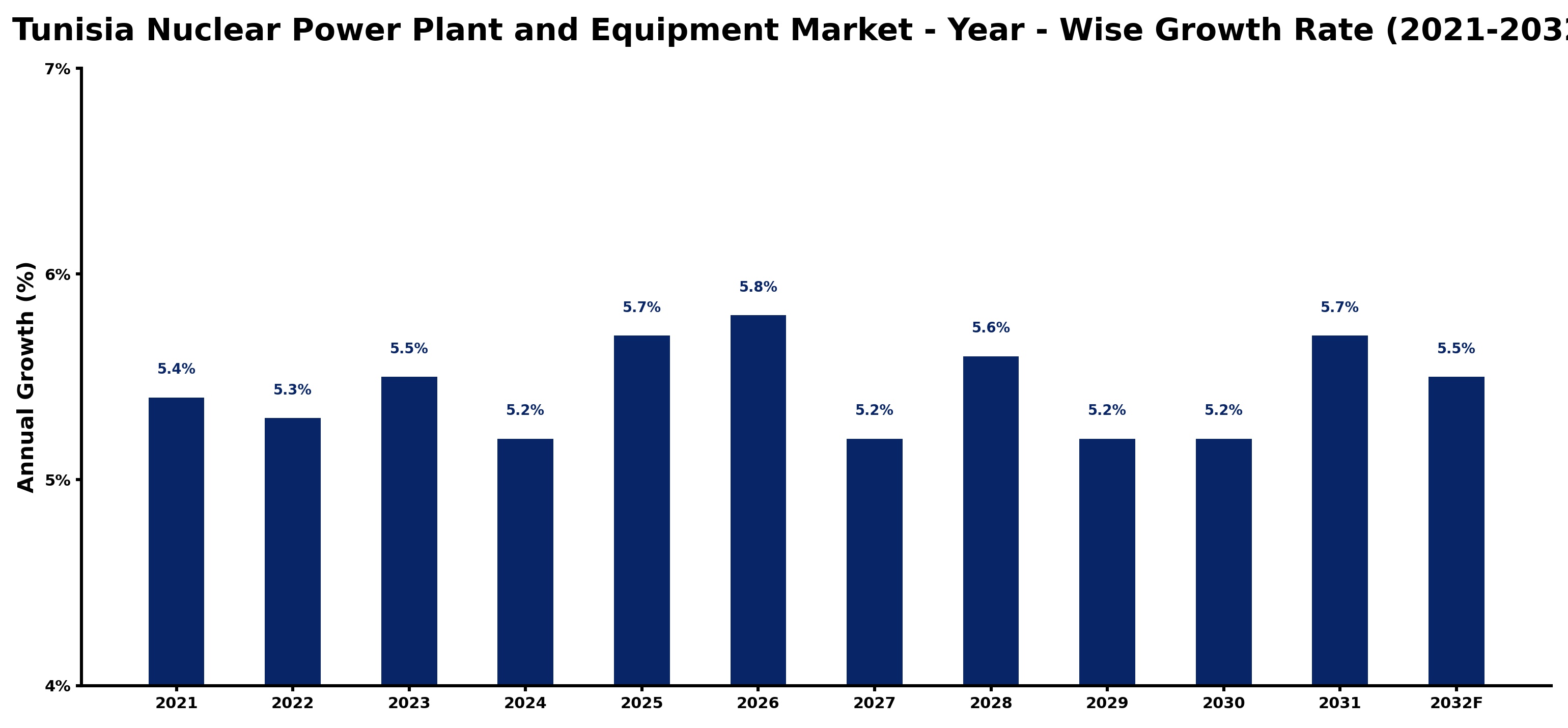
The table below presents the year‑wise growth rates along with the key drivers influencing the market
| Year | Growth Rate | Major Drivers |
| 2021 | 5.4% | Government investment in infrastructure |
| 2022 | 5.3% | Increased energy demand drives projects |
| 2023 | 5.5% | International partnerships enhance technology |
| 2024 | 5.2% | Regulatory support for nuclear initiatives |
| 2025 | 5.7% | Public awareness of energy sustainability |
| 2026 | 5.8% | Research funding boosts innovation efforts |
| 2027 | 5.2% | Local workforce training programs expanded |
| 2028 | 5.6% | Renewable energy integration strategies developed |
| 2029 | 5.2% | Nuclear safety standards improved significantly |
| 2030 | 5.2% | Energy diversification strategies implemented |
| 2031 | 5.7% | Technological advancements in reactor design |
| 2032 | 5.5% | Regional energy cooperation initiatives launched |
Note - Market size estimations and growth projections presented in this report are based on 6Wresearch's advanced forecasting approach, validated with industry datasets as of June 2026.
Tunisia Nuclear Power Plant and Equipment Market Synopsis
Recently, Tunisia has shown a renewed interest in nuclear energy, marking a shift from its previous focus on renewable resources alone. The government recognizes the pressing need to ensure energy security, which has opened the door for nuclear power as a viable alternative. Looking ahead, however, the market must navigate significant challenges, including public perception and safety concerns, that could temper rapid growth.
In contrast to the historical hesitance towards nuclear energy, the current momentum reflects a crucial turning point. With a clear mandate to expand energy options, Tunisia is looking at nuclear power not only as a sustainable energy solution but also as a means to fulfill its growing electricity needs. As the landscape evolves, partnerships with international stakeholders will play a crucial role in defining the market's future.
Tunisia Nuclear Power Plant and Equipment Market Key Takeaways
- The market is projected to grow significantly, driven by increasing energy demands and government initiatives to diversify energy sources.
- Strategic partnerships with international suppliers and technology providers are essential for the development of nuclear infrastructure.
- Concerns regarding safety and public acceptance remain major factors impacting the progress of nuclear projects.
- Investment opportunities exist in construction, engineering services, and specialized training within the nuclear sector.
- The government's commitment to energy diversification will likely drive regulatory changes and infrastructure investments.
Evaluation of Restraints in Tunisia Nuclear Power Plant and Equipment Market
One of the most significant limitations to the Tunisia Nuclear Power Plant and Equipment Market is the absence of a robust regulatory framework and infrastructure for nuclear energy. The lack of operational experience in this field poses challenges for safe implementation and management of nuclear projects. Additionally, public concerns about safety and potential environmental impacts have historically hindered progress. Coupled with the need for substantial investment and financing, these factors create a complex landscape that requires careful navigation and strategic planning to move forward effectively.
Tunisia Nuclear Power Plant and Equipment Market Trends
Current trends show a significant shift towards adopting nuclear power as a key element in Tunisia's energy strategy. The government is increasingly investing in safety regulations that align with international standards to enhance public trust. Moreover, the focus on technological advancements and collaborations with experienced global partners is fostering innovation in nuclear systems and safety protocols. This trend is vital for attracting investment and ensuring the long-term viability of the nuclear energy initiative in Tunisia.
Tunisia Nuclear Power Plant and Equipment Market Opportunities
Opportunities for growth and investment in the Tunisia Nuclear Power Plant and Equipment Market are on the rise. Key areas include the provision of construction and engineering services essential for the establishment of new nuclear facilities. Furthermore, there is a growing demand for specialized training programs and consulting services to develop a skilled workforce within the nuclear sector. As Tunisia plans to bolster its energy capacity, advanced nuclear technologies and innovative infrastructure upgrades will also become increasingly valuable.
Government Initiatives in the Tunisia Nuclear Power Plant and Equipment Market
The Tunisian government has made strides in exploring nuclear energy's potential as part of its broader strategy to ensure energy security and sustainability. Although initial plans, including a cooperation agreement with Russia, have faced delays, the government's commitment remains evident. Ongoing assessments of nuclear power's feasibility continue as public discourse on energy options evolves. As the government seeks to integrate nuclear power within its energy mix, prospective policies will likely focus on safety, public engagement, and technological advancements.
Future Insights of the Tunisia Nuclear Power Plant and Equipment Market
Looking ahead to 2026-2032, the Tunisia Nuclear Power Plant and Equipment Market is poised for cautious expansion. Despite the obstacles, the increasing recognition of nuclear power's potential benefits is likely to foster investments in nuclear infrastructure. Effective management of safety concerns and public perception will be crucial in shaping this market's landscape. With the government's continued focus on energy diversification, the nuclear sector may ultimately play a pivotal role in achieving Tunisia's long-term energy goals.
Tunisia Nuclear Power Plant and Equipment Market Latest Developments (May 2025 - June 2026)
Recent developments in the Tunisia Nuclear Power Plant and Equipment Market highlight the government's proactive measures to engage with international partners for knowledge exchange and technology transfer. Efforts are underway to enhance regulatory frameworks, ensuring they meet international safety standards. Community engagement initiatives are also being implemented to address public concerns regarding nuclear safety and environmental impact. These directions indicate a gradual but steady move towards establishing a foundational framework for future nuclear projects.
Tunisia Nuclear Power Plant and Equipment Market - Key Attractiveness of the Report
- 10 Years of Market Numbers
- Historical Data Starting from 2022 to 2025
- Base Year: 2025
- Forecast Data until 2032
- Key Performance Indicators Impacting the Market
- Major Upcoming Developments and Projects
Key Highlights of the Report:
- Tunisia Nuclear Power Plant and Equipment Market Outlook
- Market Size of Tunisia Nuclear Power Plant and Equipment Market, 2025
- Forecast of Tunisia Nuclear Power Plant and Equipment Market, 2032
- Historical Data and Forecast of Tunisia Nuclear Power Plant and Equipment Revenues & Volume for the Period 2022-2032F
- Tunisia Nuclear Power Plant and Equipment Market Trend Evolution
- Tunisia Nuclear Power Plant and Equipment Market Drivers and Challenges
- Tunisia Nuclear Power Plant and Equipment Price Trends
- Tunisia Nuclear Power Plant and Equipment Porter's Five Forces
- Tunisia Nuclear Power Plant and Equipment Industry Life Cycle
- Historical Data and Forecast of Tunisia Nuclear Power Plant and Equipment Market Revenues & Volume By Reactor Type for the Period 2022-2032F
- Historical Data and Forecast of Tunisia Nuclear Power Plant and Equipment Market Revenues & Volume By PWR for the Period 2022-2032F
- Historical Data and Forecast of Tunisia Nuclear Power Plant and Equipment Market Revenues & Volume By PHWR for the Period 2022-2032F
- Historical Data and Forecast of Tunisia Nuclear Power Plant and Equipment Market Revenues & Volume By Boiling water reactor for the Period 2022-2032F
- Historical Data and Forecast of Tunisia Nuclear Power Plant and Equipment Market Revenues & Volume By High temperature gas cooled reactor for the Period 2022-2032F
- Historical Data and Forecast of Tunisia Nuclear Power Plant and Equipment Market Revenues & Volume By Fast Breeder Reactor for the Period 2022-2032F
- Historical Data and Forecast of Tunisia Nuclear Power Plant and Equipment Market Revenues & Volume By Others for the Period 2022-2032F
- Historical Data and Forecast of Tunisia Nuclear Power Plant and Equipment Market Revenues & Volume By Equipment for the Period 2022-2032F
- Historical Data and Forecast of Tunisia Nuclear Power Plant and Equipment Market Revenues & Volume By Island Equipment for the Period 2022-2032F
- Historical Data and Forecast of Tunisia Nuclear Power Plant and Equipment Market Revenues & Volume By Auxiliary Equipment for the Period 2022-2032F
- Tunisia Nuclear Power Plant and Equipment Import Export Trade Statistics
- Market Opportunity Assessment By Reactor Type
- Market Opportunity Assessment By Equipment
- Tunisia Nuclear Power Plant and Equipment Top Companies Market Share
- Tunisia Nuclear Power Plant and Equipment Competitive Benchmarking By Technical and Operational Parameters
- Tunisia Nuclear Power Plant and Equipment Company Profiles
- Tunisia Nuclear Power Plant and Equipment Key Strategic Recommendations






































