Tanzania Nuclear Power Plant and Equipment Market Size, Share & Growth Rate
The Tanzania Nuclear Power Plant and Equipment Market was estimated at USD 322 Million in 2025 and is projected to reach USD 441 Million by 2032, growing at a CAGR of 4.6% from 2026 to 2032. This growth trajectory is driven by Tanzania's urgent need for reliable electricity to support its expanding economy and the government's commitment to diversifying its energy portfolio. A strategic focus on nuclear power as a clean alternative to fossil fuels adds significant momentum to market prospects.
Tanzania Nuclear Power Plant and Equipment Market Year-wise Growth Rate and Key Drivers
This graph highlights how the Tanzania Nuclear Power Plant and Equipment Market has steadily grown over the years, supported by major growth factors.
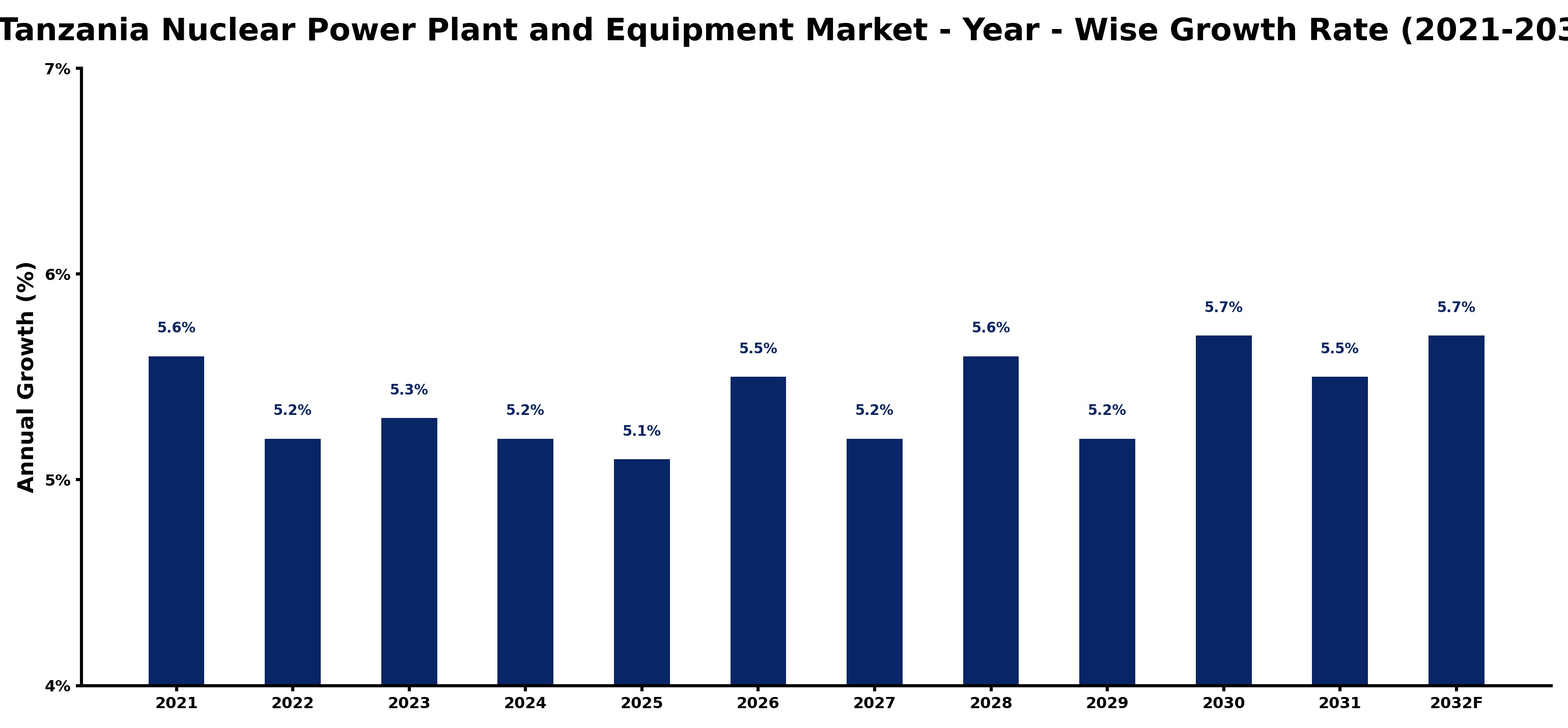
The table below presents the year‑wise growth rates along with the key drivers influencing the market
| Year | Growth Rate | Major Drivers |
| 2021 | 5.6% | Increasing adoption of advanced technologies |
| 2022 | 5.2% | Expansion of manufacturing activities |
| 2023 | 5.3% | Growing renewable energy integration projects |
| 2024 | 5.2% | Increasing smart city development projects |
| 2025 | 5.1% | Rapid growth in telecom and data center sectors |
| 2026 | 5.5% | Increasing smart city development projects |
| 2027 | 5.2% | Expansion of manufacturing activities |
| 2028 | 5.6% | Rapid growth in telecom and data center sectors |
| 2029 | 5.2% | Increasing industrial automation investments |
| 2030 | 5.7% | Growing urbanization and commercial development |
| 2031 | 5.5% | Expansion of transportation and logistics networks |
| 2032 | 5.7% | Rapid growth in telecom and data center sectors |
Note - Market size estimations and growth projections presented in this report are based on 6Wresearch's advanced forecasting approach, validated with industry datasets as of June 2026.
Tanzania Nuclear Power Plant and Equipment Market Synopsis
The most influential factor currently shaping the Tanzania Nuclear Power Plant and Equipment Market is the government's proactive stance on exploring nuclear energy. This has catalyzed efforts to implement nuclear technologies as a feasible solution to power shortages, enabling the nation to meet its rising energy demands sustainably.
Further, collaboration with international organizations is enhancing local capacities, paving the way for successful nuclear plant initiatives. These partnerships are essential for not only technological transfer but also for fostering public trust in nuclear energy through shared safety and operational standards.
Tanzania Nuclear Power Plant and Equipment Market Key Takeaways
- The market is witnessing a transformation fueled by strong governmental support and international collaborations.
- Investment opportunities abound in reactor components, safety systems, and waste management solutions.
- Public perception and regulatory frameworks are crucial for the successful implementation of nuclear energy initiatives.
- Emerging technologies, particularly Small Modular Reactors (SMRs), offer scalability and cost-effectiveness.
- Long-term energy strategies emphasize reducing reliance on fossil fuels, driving nuclear energy adoption.
Evaluation of Restraints in Tanzania Nuclear Power Plant and Equipment Market
Despite its growth potential, the Tanzania Nuclear Power Plant and Equipment Market faces significant restraints. Regulatory frameworks currently lack clarity, which can impede timely approvals for nuclear projects. Additionally, public apprehension surrounding nuclear safety poses challenges to broad acceptance. These issues must be addressed through transparent communication and concerted efforts to educate the public, ensuring that all stakeholders are informed about the safety protocols and benefits of nuclear energy. Moreover, securing sufficient funding remains a hurdle that can complicate the market's advancement.
Tanzania Nuclear Power Plant and Equipment Market Trends
There is a notable trend towards the adoption of advanced nuclear technologies, including Small Modular Reactors (SMRs), which promise to be more adaptable and economical for Tanzania's energy landscape. Furthermore, there is an increased emphasis on integrating renewable energy sources alongside nuclear energy to create a more resilient and diversified power supply. The focus on safety and sustainability in nuclear operations is also driving technological innovation, enhancing operational efficiencies while addressing environmental concerns.
Tanzania Nuclear Power Plant and Equipment Market Opportunities
The landscape for investment in Tanzania's nuclear power sector is rich with potential. Opportunities lie not only in the development of nuclear plants but also in ancillary sectors such as the supply of nuclear fuels and components, safety systems, and comprehensive waste management solutions. Partnerships that facilitate technology transfers and training programs for local personnel are also promising avenues for engagement, allowing investors to play a vital role in establishing a robust nuclear energy framework.
Government Initiatives in the Tanzania Nuclear Power Plant and Equipment Market
The Tanzanian government is taking decisive action to foster the growth of nuclear energy as part of its broader energy strategy. Through the Tanzania Atomic Energy Commission (TAEC), regulatory guidelines have been set to ensure the safe and secure development of nuclear power plants. Collaborations with global agencies such as the International Atomic Energy Agency (IAEA) are crucial for receiving technical guidance and promoting best practices in nuclear safety. These initiatives underscore the government's commitment to a safer, more diversified energy future.
Future Insights of the Tanzania Nuclear Power Plant and Equipment Market
Looking ahead to 2026-2032, the Tanzania Nuclear Power Plant and Equipment Market is poised for notable growth. With the government's clear commitment to diversifying its energy portfolio and reducing fossil fuel dependency, significant investments in nuclear infrastructure are anticipated. Key factors driving this growth will include advancements in safety protocols, public education campaigns to alleviate concerns, and the establishment of a conducive regulatory environment. By addressing these critical areas, Tanzania can unlock the full potential of its nuclear energy resources.
Tanzania Nuclear Power Plant and Equipment Market Latest Developments (May 2025 - June 2026)
Recent developments in Tanzania's nuclear energy sector indicate a strengthening focus on constructing foundational infrastructure for nuclear power plants. Collaborative efforts between the government and international experts are gaining momentum to finalize feasibility studies. Additionally, there are ongoing dialogues aimed at improving public perceptions of nuclear energy, highlighting safety improvements and environmental benefits to facilitate smoother project approvals.
Tanzania Nuclear Power Plant and Equipment Market - Key Attractiveness of the Report
- 10 Years of Market Numbers
- Historical Data Starting from 2022 to 2025
- Base Year: 2025
- Forecast Data until 2032
- Key Performance Indicators Impacting the Market
- Major Upcoming Developments and Projects
Key Highlights of the Report:
- Tanzania Nuclear Power Plant and Equipment Market Outlook
- Market Size of Tanzania Nuclear Power Plant and Equipment Market, 2025
- Forecast of Tanzania Nuclear Power Plant and Equipment Market, 2032
- Historical Data and Forecast of Tanzania Nuclear Power Plant and Equipment Revenues & Volume for the Period 2022-2032F
- Tanzania Nuclear Power Plant and Equipment Market Trend Evolution
- Tanzania Nuclear Power Plant and Equipment Market Drivers and Challenges
- Tanzania Nuclear Power Plant and Equipment Price Trends
- Tanzania Nuclear Power Plant and Equipment Porter's Five Forces
- Tanzania Nuclear Power Plant and Equipment Industry Life Cycle
- Historical Data and Forecast of Tanzania Nuclear Power Plant and Equipment Market Revenues & Volume By Reactor Type for the Period 2022-2032F
- Historical Data and Forecast of Tanzania Nuclear Power Plant and Equipment Market Revenues & Volume By PWR for the Period 2022-2032F
- Historical Data and Forecast of Tanzania Nuclear Power Plant and Equipment Market Revenues & Volume By PHWR for the Period 2022-2032F
- Historical Data and Forecast of Tanzania Nuclear Power Plant and Equipment Market Revenues & Volume By Boiling water reactor for the Period 2022-2032F
- Historical Data and Forecast of Tanzania Nuclear Power Plant and Equipment Market Revenues & Volume By High temperature gas cooled reactor for the Period 2022-2032F
- Historical Data and Forecast of Tanzania Nuclear Power Plant and Equipment Market Revenues & Volume By Fast Breeder Reactor for the Period 2022-2032F
- Historical Data and Forecast of Tanzania Nuclear Power Plant and Equipment Market Revenues & Volume By Others for the Period 2022-2032F
- Historical Data and Forecast of Tanzania Nuclear Power Plant and Equipment Market Revenues & Volume By Equipment for the Period 2022-2032F
- Historical Data and Forecast of Tanzania Nuclear Power Plant and Equipment Market Revenues & Volume By Island Equipment for the Period 2022-2032F
- Historical Data and Forecast of Tanzania Nuclear Power Plant and Equipment Market Revenues & Volume By Auxiliary Equipment for the Period 2022-2032F
- Tanzania Nuclear Power Plant and Equipment Import Export Trade Statistics
- Market Opportunity Assessment By Reactor Type
- Market Opportunity Assessment By Equipment
- Tanzania Nuclear Power Plant and Equipment Top Companies Market Share
- Tanzania Nuclear Power Plant and Equipment Competitive Benchmarking By Technical and Operational Parameters
- Tanzania Nuclear Power Plant and Equipment Company Profiles
- Tanzania Nuclear Power Plant and Equipment Key Strategic Recommendations






































