United Kingdom (UK) Nuclear Power Plant and Equipment Market Size, Share & Growth Rate
The United Kingdom (UK) Nuclear Power Plant and Equipment Market was estimated at USD 262 Million in 2025 and is projected to reach USD 323 Million by 2032, growing at a CAGR of 3.0% from 2026 to 2032. This growth is primarily driven by the UK's commitment to achieving net-zero carbon emissions by 2050, which necessitates investment in nuclear energy as a clean, sustainable energy source. Furthermore, the ongoing modernization of aging nuclear infrastructure and a focus on safety enhancements contribute to this positive trajectory.
United Kingdom (UK) Nuclear Power Plant and Equipment Market Year-wise Growth Rate and Key Drivers
This graph highlights how the United Kingdom (UK) Nuclear Power Plant and Equipment Market has steadily grown over the years, supported by major growth factors.
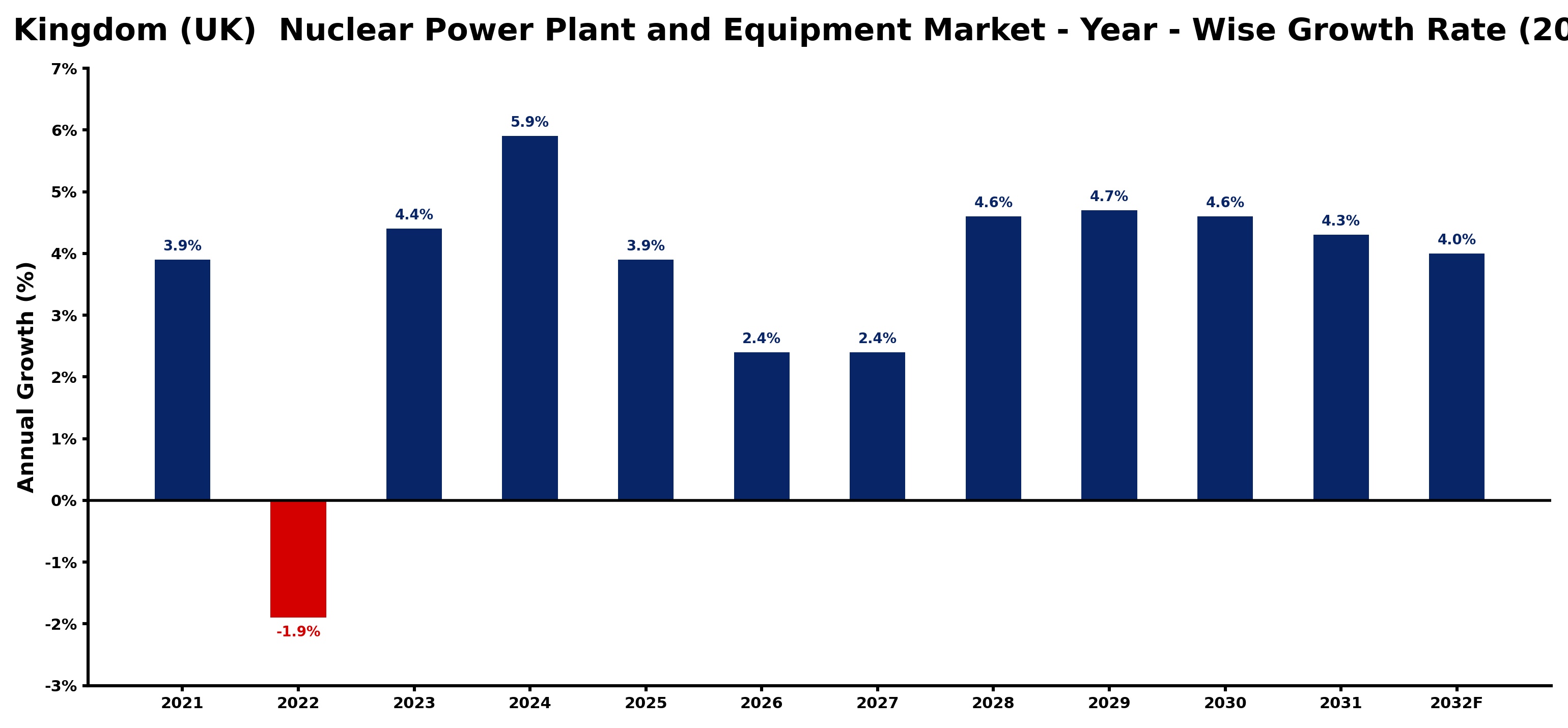
The table below presents the year‑wise growth rates along with the key drivers influencing the market
| Year | Growth Rate | Major Drivers |
| 2021 | 3.9% | Expansion of transportation and logistics networks |
| 2022 | -1.9% | Expansion of manufacturing activities |
| 2023 | 4.4% | Government infrastructure modernization initiatives |
| 2024 | 5.9% | Increasing smart city development projects |
| 2025 | 3.9% | Rapid growth in telecom and data center sectors |
| 2026 | 2.4% | Increasing smart city development projects |
| 2027 | 2.4% | Rising electricity demand across industries |
| 2028 | 4.6% | Growing renewable energy integration projects |
| 2029 | 4.7% | Government infrastructure modernization initiatives |
| 2030 | 4.6% | Increasing adoption of advanced technologies |
| 2031 | 4.3% | Government infrastructure modernization initiatives |
| 2032 | 4.0% | Government infrastructure modernization initiatives |
Note - Market size estimations and growth projections presented in this report are based on 6Wresearch's advanced forecasting approach, validated with industry datasets as of June 2026.
United Kingdom (UK) Nuclear Power Plant and Equipment Market Synopsis
In the wake of global climate initiatives, the UK nuclear power sector is undergoing a transformative period. The government's favorable stance toward nuclear energy is catalyzing innovation and investment, ensuring that this industry remains a vital component of the nation's energy framework.
As existing plants age, there is an urgent need for upgrades, decommissioning, and the development of advanced reactor technologies. This shifting landscape presents both opportunities and challenges for stakeholders in the nuclear power plant and equipment market.
United Kingdom (UK) Nuclear Power Plant and Equipment Market Key Takeaways
- The UK government prioritizes nuclear energy as a cornerstone of its clean energy strategy, promoting investments in the sector.
- There is an increasing demand for advanced reactor technologies and equipment due to modernization and safety improvements.
- Collaborations among industry stakeholders and research institutions are fostering innovation in nuclear technologies.
- Investment opportunities exist in upgrading aging plants and managing decommissioning projects.
- The regulatory environment remains complex, with ongoing public scrutiny impacting the pace of project approvals.
Evaluation of Restraints in United Kingdom (UK) Nuclear Power Plant and Equipment Market
Despite the promising outlook, the UK Nuclear Power Plant and Equipment Market faces significant restraints. Regulatory challenges can lead to delays in project execution, coupled with public opposition that complicates the acceptance of nuclear energy initiatives. Furthermore, high capital investment requirements for plant construction and maintenance may deter potential investors, particularly when alternative energy sources appear less costly. The continuous focus on safety and security adds layers of complexity, requiring substantial investments in training and technology to meet evolving standards. These factors necessitate a careful and strategic approach to ensure sustainable market growth.
United Kingdom (UK) Nuclear Power Plant and Equipment Market Trends
Current trends in the UK nuclear power plant and equipment market are leaning toward modernization and enhanced safety protocols. The government has initiated efforts to support cutting-edge reactor designs while also investing in workforce development to address skill gaps. Additionally, there is a growing emphasis on decommissioning older plants efficiently, driven by environmental concerns and regulatory requirements. The collaborative efforts between various stakeholders are paving the way for innovations that aim to make nuclear energy not just cleaner but also more reliable and cost-effective.
United Kingdom (UK) Nuclear Power Plant and Equipment Market Opportunities
Significant growth and investment opportunities exist in the UK Nuclear Power Plant and Equipment Market, particularly in the realms of technological advancement and infrastructure development. The government's commitment to nuclear energy creates a favorable environment for investment in both new builds and retrofitting existing plants. Additionally, services related to waste management, decommissioning, and maintenance are increasingly in demand as the nuclear fleet ages. This creates a landscape ripe for innovation and expansion for both new and established players in the sector.
Government Initiatives in the United Kingdom (UK) Nuclear Power Plant and Equipment Market
The UK government has implemented various initiatives to promote the nuclear sector as part of its broader energy strategy. The Nuclear Sector Deal emphasizes the development of new nuclear technologies, aims to strengthen supply chains, and seeks to enhance workforce skills within the industry. Projects like Hinkley Point C receive government backing, and the exploration of new developments, such as Sizewell C, indicates a sustained commitment to expanding nuclear capabilities. Regulatory frameworks ensure compliance with safety standards and international obligations, contributing to a stable environment for stakeholders.
Future Insights of the United Kingdom (UK) Nuclear Power Plant and Equipment Market
Looking ahead to 2026-2032, the UK Nuclear Power Plant and Equipment Market is poised for moderate growth, driven by the necessity for a reliable, low-carbon energy source. The government's ambitious net-zero emissions targets will likely spur investments in both new and existing nuclear facilities. However, stakeholders must navigate challenges related to public perception and regulatory approval processes that can affect project timelines. Overall, the focus on modernization, safety, and efficiency will shape the future landscape of this essential energy sector.
United Kingdom (UK) Nuclear Power Plant and Equipment Market Latest Developments (May 2025 - June 2026)
Recent developments in the UK Nuclear Power Plant and Equipment Market include heightened investments in innovative reactor designs and safety systems. The government has also announced new initiatives aimed at improving nuclear waste management protocols while supporting the workforce through targeted training programs. Collaborations between private firms and public entities are on the rise, fostering a culture of innovation designed to keep the sector aligned with modern energy needs and environmental goals.
United Kingdom (UK) Nuclear Power Plant and Equipment Market - Key Attractiveness of the Report
- 10 Years of Market Numbers
- Historical Data Starting from 2022 to 2025
- Base Year: 2025
- Forecast Data until 2032
- Key Performance Indicators Impacting the Market
- Major Upcoming Developments and Projects
Key Highlights of the Report:
- United Kingdom (UK) Nuclear Power Plant and Equipment Market Outlook
- Market Size of United Kingdom (UK) Nuclear Power Plant and Equipment Market, 2025
- Forecast of United Kingdom (UK) Nuclear Power Plant and Equipment Market, 2032
- Historical Data and Forecast of United Kingdom (UK) Nuclear Power Plant and Equipment Revenues & Volume for the Period 2022-2032F
- United Kingdom (UK) Nuclear Power Plant and Equipment Market Trend Evolution
- United Kingdom (UK) Nuclear Power Plant and Equipment Market Drivers and Challenges
- United Kingdom (UK) Nuclear Power Plant and Equipment Price Trends
- United Kingdom (UK) Nuclear Power Plant and Equipment Porter's Five Forces
- United Kingdom (UK) Nuclear Power Plant and Equipment Industry Life Cycle
- Historical Data and Forecast of United Kingdom (UK) Nuclear Power Plant and Equipment Market Revenues & Volume By Reactor Type for the Period 2022-2032F
- Historical Data and Forecast of United Kingdom (UK) Nuclear Power Plant and Equipment Market Revenues & Volume By PWR for the Period 2022-2032F
- Historical Data and Forecast of United Kingdom (UK) Nuclear Power Plant and Equipment Market Revenues & Volume By PHWR for the Period 2022-2032F
- Historical Data and Forecast of United Kingdom (UK) Nuclear Power Plant and Equipment Market Revenues & Volume By Boiling water reactor for the Period 2022-2032F
- Historical Data and Forecast of United Kingdom (UK) Nuclear Power Plant and Equipment Market Revenues & Volume By High temperature gas cooled reactor for the Period 2022-2032F
- Historical Data and Forecast of United Kingdom (UK) Nuclear Power Plant and Equipment Market Revenues & Volume By Fast Breeder Reactor for the Period 2022-2032F
- Historical Data and Forecast of United Kingdom (UK) Nuclear Power Plant and Equipment Market Revenues & Volume By Others for the Period 2022-2032F
- Historical Data and Forecast of United Kingdom (UK) Nuclear Power Plant and Equipment Market Revenues & Volume By Equipment for the Period 2022-2032F
- Historical Data and Forecast of United Kingdom (UK) Nuclear Power Plant and Equipment Market Revenues & Volume By Island Equipment for the Period 2022-2032F
- Historical Data and Forecast of United Kingdom (UK) Nuclear Power Plant and Equipment Market Revenues & Volume By Auxiliary Equipment for the Period 2022-2032F
- United Kingdom (UK) Nuclear Power Plant and Equipment Import Export Trade Statistics
- Market Opportunity Assessment By Reactor Type
- Market Opportunity Assessment By Equipment
- United Kingdom (UK) Nuclear Power Plant and Equipment Top Companies Market Share
- United Kingdom (UK) Nuclear Power Plant and Equipment Competitive Benchmarking By Technical and Operational Parameters
- United Kingdom (UK) Nuclear Power Plant and Equipment Company Profiles
- United Kingdom (UK) Nuclear Power Plant and Equipment Key Strategic Recommendations






































