Pakistan Nuclear Power Plant and Equipment Market Size, Share & Growth Rate
The Pakistan Nuclear Power Plant and Equipment Market was estimated at USD 243 Million in 2025 and is projected to reach USD 336 Million by 2032, growing at a CAGR of 4.7% from 2026 to 2032. This growth trajectory is primarily driven by Pakistan's urgent need to address escalating energy demands and its commitment to diversifying its energy sources. The country's strategic initiatives to promote nuclear power as a clean energy alternative and reduce reliance on fossil fuels further bolster this optimistic forecast.
Pakistan Nuclear Power Plant and Equipment Market Year-wise Growth Rate and Key Drivers
This graph highlights how the Pakistan Nuclear Power Plant and Equipment Market has steadily grown over the years, supported by major growth factors.
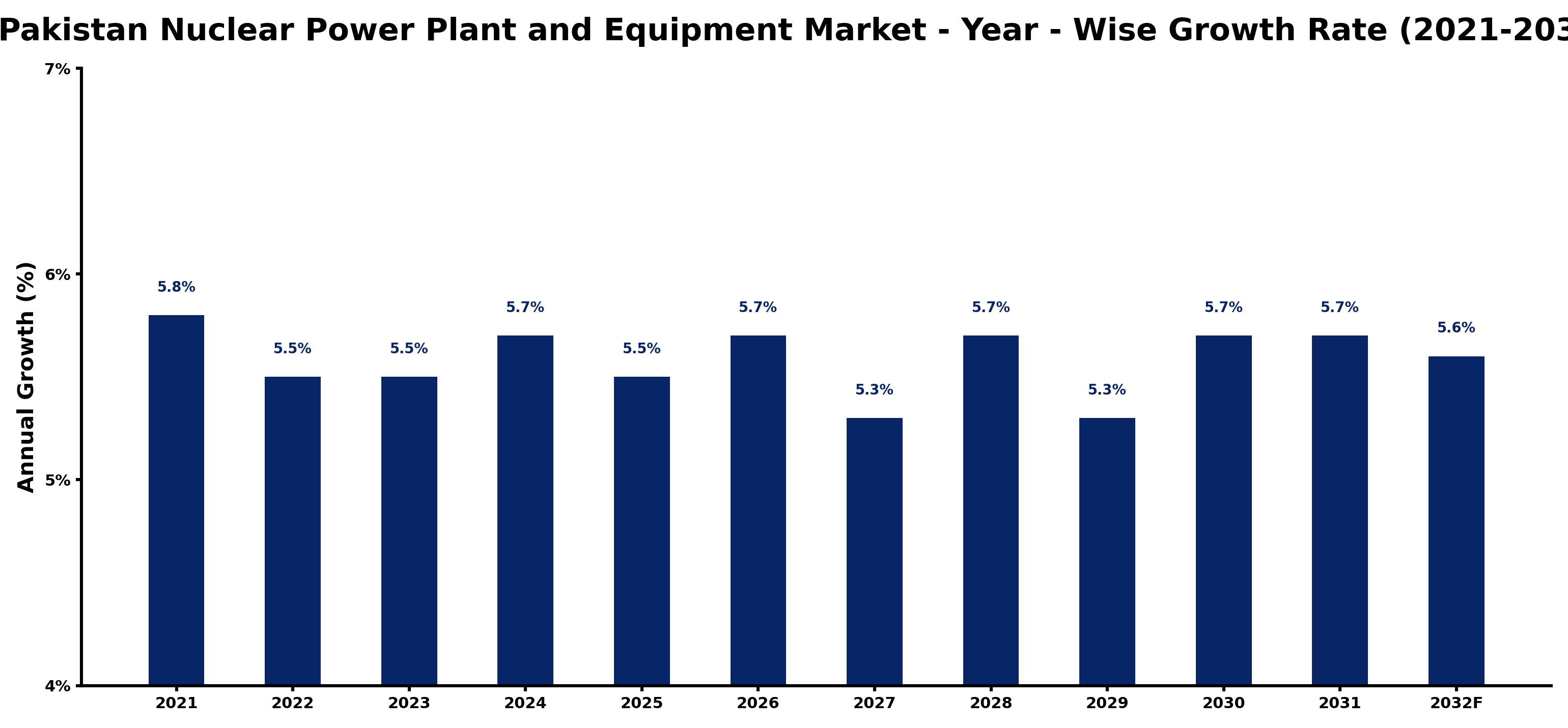
The table below presents the year‑wise growth rates along with the key drivers influencing the market
| Year | Growth Rate | Major Drivers |
| 2021 | 5.8% | Increasing smart city development projects |
| 2022 | 5.5% | Expansion of transportation and logistics networks |
| 2023 | 5.5% | Increasing industrial automation investments |
| 2024 | 5.7% | Expansion of commercial construction activities |
| 2025 | 5.5% | Increasing smart city development projects |
| 2026 | 5.7% | Increasing adoption of advanced technologies |
| 2027 | 5.3% | Increasing industrial infrastructure investments |
| 2028 | 5.7% | Increasing smart city development projects |
| 2029 | 5.3% | Expansion of transportation and logistics networks |
| 2030 | 5.7% | Increasing smart city development projects |
| 2031 | 5.7% | Growing renewable energy integration projects |
| 2032 | 5.6% | Growing renewable energy integration projects |
Note - Market size estimations and growth projections presented in this report are based on 6Wresearch's advanced forecasting approach, validated with industry datasets as of June 2026.
Pakistan Nuclear Power Plant and Equipment Market Synopsis
The Pakistan Nuclear Power Plant and Equipment Market is currently at a pivotal stage, underscored by the government's proactive policies aimed at enhancing nuclear energy production. As four operational nuclear power plants pave the way for expansion, there exists a significant demand for advanced nuclear technology and equipment to support this growth.
The market not only reflects the urgency of meeting energy needs but also indicates a broader commitment to sustainability and energy diversification. Investment in this sector, bolstered by international collaboration, presents a unique opportunity for stakeholders looking to capitalize on a developing industry with substantial potential.
Pakistan Nuclear Power Plant and Equipment Market Key Takeaways
- The market is driven by increasing energy demands and a government focus on clean energy solutions.
- Significant investments are expected in the expansion and modernization of nuclear infrastructure.
- Partnerships with international organizations are key to technology transfer and expertise enhancement.
- Emerging technologies like small modular reactors (SMRs) are gaining momentum in Pakistan's energy landscape.
- Government initiatives aim to create a favorable environment for nuclear energy development and investment.
Evaluation of Restraints in Pakistan Nuclear Power Plant and Equipment Market
While the potential for growth in the Pakistan Nuclear Power Plant and Equipment Market is substantial, several factors continue to hinder its progress. The need for considerable capital investment poses a challenge for both domestic and international stakeholders. Furthermore, complex regulatory frameworks can create delays in project approvals and implementation. Concerns around safety and security, including public perception of nuclear energy, also play a crucial role in shaping the market's landscape. Addressing these restraints requires a concerted effort to promote transparency and build trust among the populace, ensuring a stable and sustainable pathway forward.
Pakistan Nuclear Power Plant and Equipment Market Trends
The market is currently witnessing notable trends, particularly the shift towards modernization and the adoption of advanced nuclear technologies. Small modular reactors (SMRs) are being explored for their safety and efficiency benefits, aligning with global advancements in nuclear energy. Additionally, the trend towards increased collaboration with international technology providers is emerging, which is essential for enhancing local capabilities and knowledge transfer. There is also a growing emphasis on sustainability, pushing the market to adopt practices that align with international safety and environmental standards.
Pakistan Nuclear Power Plant and Equipment Market Opportunities
Investment opportunities are burgeoning within the Pakistan Nuclear Power Plant and Equipment Market. As the country embarks on expanding its nuclear capacity, there is significant demand for the construction and maintenance of new facilities. Moreover, suppliers of advanced nuclear equipment and technology are well-positioned to benefit from this growth. As Pakistan strives to diversify its energy mix and reduce its fossil fuel dependence, stakeholders have a ripe opportunity to engage in this developing market, contributing to the nation's energy infrastructure and sustainability efforts.
Government Initiatives in the Pakistan Nuclear Power Plant and Equipment Market
The government of Pakistan is actively fostering a supportive policy environment to promote nuclear power development. Regulatory frameworks have been established to streamline approvals for new projects, while incentives for foreign investments are being implemented to attract global expertise and capital. In parallel, public safety and security measures are being prioritized to ensure the responsible deployment of nuclear technology. These initiatives are designed to enhance the energy landscape in Pakistan, firmly positioning nuclear power as a key component of the country's future energy strategy.
Future Insights of the Pakistan Nuclear Power Plant and Equipment Market
Looking ahead, the Pakistan Nuclear Power Plant and Equipment Market is poised for significant growth. With ambitious targets set by the government for increasing nuclear capacity, the sector is likely to see expanded investments and technological advancements. The strategic location of Pakistan, particularly along the China-Pakistan Economic Corridor (CPEC), presents further opportunities for collaboration and knowledge sharing in nuclear energy. However, navigating regulatory landscapes and addressing public concerns will be essential to achieving sustainable growth in this promising market.
Pakistan Nuclear Power Plant and Equipment Market Latest Developments (May 2025 - June 2026)
Recent developments in the Pakistan Nuclear Power Plant and Equipment Market have highlighted the government's commitment to scaling up nuclear energy production. New agreements and partnerships are being formed with international bodies for technology transfer and financing, aimed at bolstering the country's nuclear capabilities. Additionally, there are ongoing discussions to initiate new projects that align with modernization efforts, reflecting a proactive approach to meet rising energy demands and enhance infrastructure.
Pakistan Nuclear Power Plant and Equipment Market - Key Attractiveness of the Report
- 10 Years of Market Numbers
- Historical Data Starting from 2022 to 2025
- Base Year: 2025
- Forecast Data until 2032
- Key Performance Indicators Impacting the Market
- Major Upcoming Developments and Projects
Key Highlights of the Report:
- Pakistan Nuclear Power Plant and Equipment Market Outlook
- Market Size of Pakistan Nuclear Power Plant and Equipment Market, 2025
- Forecast of Pakistan Nuclear Power Plant and Equipment Market, 2032
- Historical Data and Forecast of Pakistan Nuclear Power Plant and Equipment Revenues & Volume for the Period 2022-2032F
- Pakistan Nuclear Power Plant and Equipment Market Trend Evolution
- Pakistan Nuclear Power Plant and Equipment Market Drivers and Challenges
- Pakistan Nuclear Power Plant and Equipment Price Trends
- Pakistan Nuclear Power Plant and Equipment Porter's Five Forces
- Pakistan Nuclear Power Plant and Equipment Industry Life Cycle
- Historical Data and Forecast of Pakistan Nuclear Power Plant and Equipment Market Revenues & Volume By Reactor Type for the Period 2022-2032F
- Historical Data and Forecast of Pakistan Nuclear Power Plant and Equipment Market Revenues & Volume By PWR for the Period 2022-2032F
- Historical Data and Forecast of Pakistan Nuclear Power Plant and Equipment Market Revenues & Volume By PHWR for the Period 2022-2032F
- Historical Data and Forecast of Pakistan Nuclear Power Plant and Equipment Market Revenues & Volume By Boiling water reactor for the Period 2022-2032F
- Historical Data and Forecast of Pakistan Nuclear Power Plant and Equipment Market Revenues & Volume By High temperature gas cooled reactor for the Period 2022-2032F
- Historical Data and Forecast of Pakistan Nuclear Power Plant and Equipment Market Revenues & Volume By Fast Breeder Reactor for the Period 2022-2032F
- Historical Data and Forecast of Pakistan Nuclear Power Plant and Equipment Market Revenues & Volume By Others for the Period 2022-2032F
- Historical Data and Forecast of Pakistan Nuclear Power Plant and Equipment Market Revenues & Volume By Equipment for the Period 2022-2032F
- Historical Data and Forecast of Pakistan Nuclear Power Plant and Equipment Market Revenues & Volume By Island Equipment for the Period 2022-2032F
- Historical Data and Forecast of Pakistan Nuclear Power Plant and Equipment Market Revenues & Volume By Auxiliary Equipment for the Period 2022-2032F
- Pakistan Nuclear Power Plant and Equipment Import Export Trade Statistics
- Market Opportunity Assessment By Reactor Type
- Market Opportunity Assessment By Equipment
- Pakistan Nuclear Power Plant and Equipment Top Companies Market Share
- Pakistan Nuclear Power Plant and Equipment Competitive Benchmarking By Technical and Operational Parameters
- Pakistan Nuclear Power Plant and Equipment Company Profiles
- Pakistan Nuclear Power Plant and Equipment Key Strategic Recommendations






































