Australia Nuclear Power Plant and Equipment Market Size, Share & Growth Rate
The Australia Nuclear Power Plant and Equipment Market was estimated at USD 195 Million in 2025 and is projected to reach USD 228 Million by 2032, growing at a CAGR of 2.3% from 2026 to 2032. This growth trajectory is largely driven by an increasing global emphasis on sustainable energy solutions, which has led to renewed discussions about nuclear energy's role in Australia's energy landscape. Although the country currently lacks operational nuclear power plants, advancements in nuclear technology and international cooperation are paving the way for potential future investments.
Australia Nuclear Power Plant and Equipment Market Year-wise Growth Rate and Key Drivers
This graph highlights how the Australia Nuclear Power Plant and Equipment Market has steadily grown over the years, supported by major growth factors.
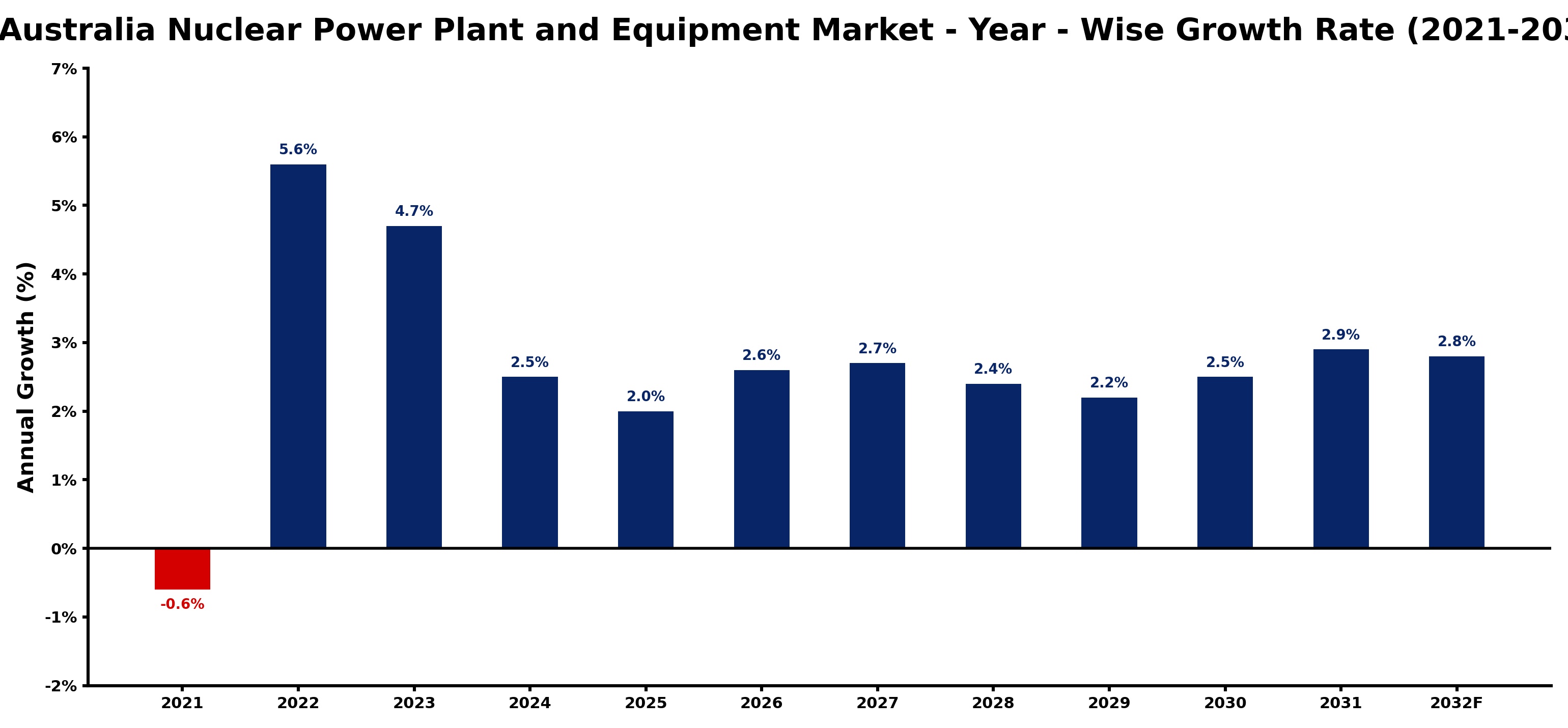
The table below presents the year‑wise growth rates along with the key drivers influencing the market
| Year | Growth Rate | Major Drivers |
| 2021 | -0.6% | Rapid growth in telecom and data center sectors |
| 2022 | 5.6% | Government infrastructure modernization initiatives |
| 2023 | 4.7% | Growing renewable energy integration projects |
| 2024 | 2.5% | Government infrastructure modernization initiatives |
| 2025 | 2.0% | Increasing adoption of advanced technologies |
| 2026 | 2.6% | Expansion of manufacturing activities |
| 2027 | 2.7% | Increasing smart city development projects |
| 2028 | 2.4% | Increasing smart city development projects |
| 2029 | 2.2% | Increasing industrial automation investments |
| 2030 | 2.5% | Increasing adoption of advanced technologies |
| 2031 | 2.9% | Rapid growth in telecom and data center sectors |
| 2032 | 2.8% | Increasing industrial infrastructure investments |
Note - Market size estimations and growth projections presented in this report are based on 6Wresearch's advanced forecasting approach, validated with industry datasets as of June 2026.
Australia Nuclear Power Plant and Equipment Market Synopsis
Despite Australia's current absence of operational nuclear power plants, the market is experiencing a shift in momentum towards exploring nuclear energy as a viable option for future energy security. The ongoing dialogue surrounding the need for low-carbon energy alternatives is creating a fertile ground for potential nuclear development.
Research initiatives and international collaborations are becoming increasingly important as Australia navigates its energy policies. While significant regulatory hurdles exist, the conversation about nuclear energy is evolving, setting the stage for future developments in the nuclear power plant and equipment market.
Australia Nuclear Power Plant and Equipment Market Key Takeaways
- The market is experiencing gradual growth, influenced by global trends toward low-carbon energy.
- Research and safety equipment remain critical components of the current market landscape.
- International collaborations are vital for knowledge exchange and technological advancements.
- Regulatory frameworks and public sentiment play pivotal roles in shaping market dynamics.
- Investment in safety equipment and advanced nuclear technologies presents notable opportunities.
Evaluation of Restraints in Australia Nuclear Power Plant and Equipment Market
The Australia Nuclear Power Plant and Equipment Market is significantly constrained by stringent regulatory frameworks and public opposition to nuclear energy. The lack of operational nuclear facilities creates a challenging environment for investment, particularly given the high costs associated with establishing new infrastructure. Additionally, the reliance on imported equipment complicates logistics, limiting domestic growth potential. These factors collectively contribute to a cautious approach towards nuclear energy adoption in the country.
Australia Nuclear Power Plant and Equipment Market Trends
Several key trends are currently shaping the Australia Nuclear Power Plant and Equipment Market. Growing public awareness of climate change is fostering a more favorable environment for discussing nuclear energy as a sustainable alternative. Technological advancements, such as small modular reactors (SMRs), are gaining traction due to their potential for enhanced safety and reduced capital costs. Additionally, increasing collaboration with international nuclear organizations is driving innovation and improving safety standards in nuclear research and equipment development.
Australia Nuclear Power Plant and Equipment Market Opportunities
Investment opportunities in the Australia Nuclear Power Plant and Equipment Market lie primarily in the fields of advanced nuclear technology research and safety equipment manufacturing. As global demand for clean energy grows, Australia may see a shift in energy policy that favors nuclear energy solutions. Furthermore, partnerships with international entities could facilitate knowledge transfer and enhance the local industry's capabilities, positioning Australia to leverage nuclear energy for energy security and sustainability.
Government Initiatives in the Australia Nuclear Power Plant and Equipment Market
The Australian government maintains a complex regulatory framework governing nuclear energy, focusing on safety, environmental impact, and national security. Current policies promote research and development in nuclear technology while adhering to strict safety measures. Public funding initiatives aim to enhance the nation's nuclear capabilities and align with international safety standards, although comprehensive nuclear energy adoption remains contentious within the political landscape.
Future Insights of the Australia Nuclear Power Plant and Equipment Market
Looking ahead to 2026-2032, the Australia Nuclear Power Plant and Equipment Market is expected to evolve as public sentiment shifts and regulatory frameworks potentially become more favorable toward nuclear energy. The focus will likely remain on the development of advanced technologies and safety measures to allay public concerns. As global pressures for low-carbon energy alternatives persist, Australia may consider nuclear energy more seriously, creating an environment ripe for investment and collaboration in nuclear research and infrastructure.
Australia Nuclear Power Plant and Equipment Market Latest Developments (May 2025 - June 2026)
Recent developments within the Australia Nuclear Power Plant and Equipment Market indicate an increasing interest in nuclear energy discussions among policymakers. Research institutions are ramping up initiatives aimed at exploring innovative nuclear technologies, including safety protocols and waste management solutions. Simultaneously, international partnerships are being forged to strengthen Australia's nuclear research capacity and enhance compliance with global safety standards.
Australia Nuclear Power Plant and Equipment Market - Key Attractiveness of the Report
- 10 Years of Market Numbers
- Historical Data Starting from 2022 to 2025
- Base Year: 2025
- Forecast Data until 2032
- Key Performance Indicators Impacting the Market
- Major Upcoming Developments and Projects
Key Highlights of the Report:
- Australia Nuclear Power Plant and Equipment Market Outlook
- Market Size of Australia Nuclear Power Plant and Equipment Market, 2025
- Forecast of Australia Nuclear Power Plant and Equipment Market, 2032
- Historical Data and Forecast of Australia Nuclear Power Plant and Equipment Revenues & Volume for the Period 2022-2032F
- Australia Nuclear Power Plant and Equipment Market Trend Evolution
- Australia Nuclear Power Plant and Equipment Market Drivers and Challenges
- Australia Nuclear Power Plant and Equipment Price Trends
- Australia Nuclear Power Plant and Equipment Porter's Five Forces
- Australia Nuclear Power Plant and Equipment Industry Life Cycle
- Historical Data and Forecast of Australia Nuclear Power Plant and Equipment Market Revenues & Volume By Reactor Type for the Period 2022-2032F
- Historical Data and Forecast of Australia Nuclear Power Plant and Equipment Market Revenues & Volume By PWR for the Period 2022-2032F
- Historical Data and Forecast of Australia Nuclear Power Plant and Equipment Market Revenues & Volume By PHWR for the Period 2022-2032F
- Historical Data and Forecast of Australia Nuclear Power Plant and Equipment Market Revenues & Volume By Boiling water reactor for the Period 2022-2032F
- Historical Data and Forecast of Australia Nuclear Power Plant and Equipment Market Revenues & Volume By High temperature gas cooled reactor for the Period 2022-2032F
- Historical Data and Forecast of Australia Nuclear Power Plant and Equipment Market Revenues & Volume By Fast Breeder Reactor for the Period 2022-2032F
- Historical Data and Forecast of Australia Nuclear Power Plant and Equipment Market Revenues & Volume By Others for the Period 2022-2032F
- Historical Data and Forecast of Australia Nuclear Power Plant and Equipment Market Revenues & Volume By Equipment for the Period 2022-2032F
- Historical Data and Forecast of Australia Nuclear Power Plant and Equipment Market Revenues & Volume By Island Equipment for the Period 2022-2032F
- Historical Data and Forecast of Australia Nuclear Power Plant and Equipment Market Revenues & Volume By Auxiliary Equipment for the Period 2022-2032F
- Australia Nuclear Power Plant and Equipment Import Export Trade Statistics
- Market Opportunity Assessment By Reactor Type
- Market Opportunity Assessment By Equipment
- Australia Nuclear Power Plant and Equipment Top Companies Market Share
- Australia Nuclear Power Plant and Equipment Competitive Benchmarking By Technical and Operational Parameters
- Australia Nuclear Power Plant and Equipment Company Profiles
- Australia Nuclear Power Plant and Equipment Key Strategic Recommendations






































