Brazil Planting Equipment Market Size, Share & Growth Rate
The Brazil Planting Equipment Market was estimated at USD 184 Million in 2025 and is projected to reach USD 218 Million by 2032, growing at a CAGR of 2.5% from 2026 to 2032. This growth trajectory is driven primarily by the increasing mechanization of agriculture, as farmers seek to enhance productivity and reduce labor costs. Additionally, advancements in technology are prompting demand for more sophisticated planting equipment, which aligns with Brazil's goals for agricultural modernization.
Brazil Planting Equipment Market Year-wise Growth Rate and Key Drivers
This graph highlights how the Brazil Planting Equipment Market has steadily grown over the years, supported by major growth factors.
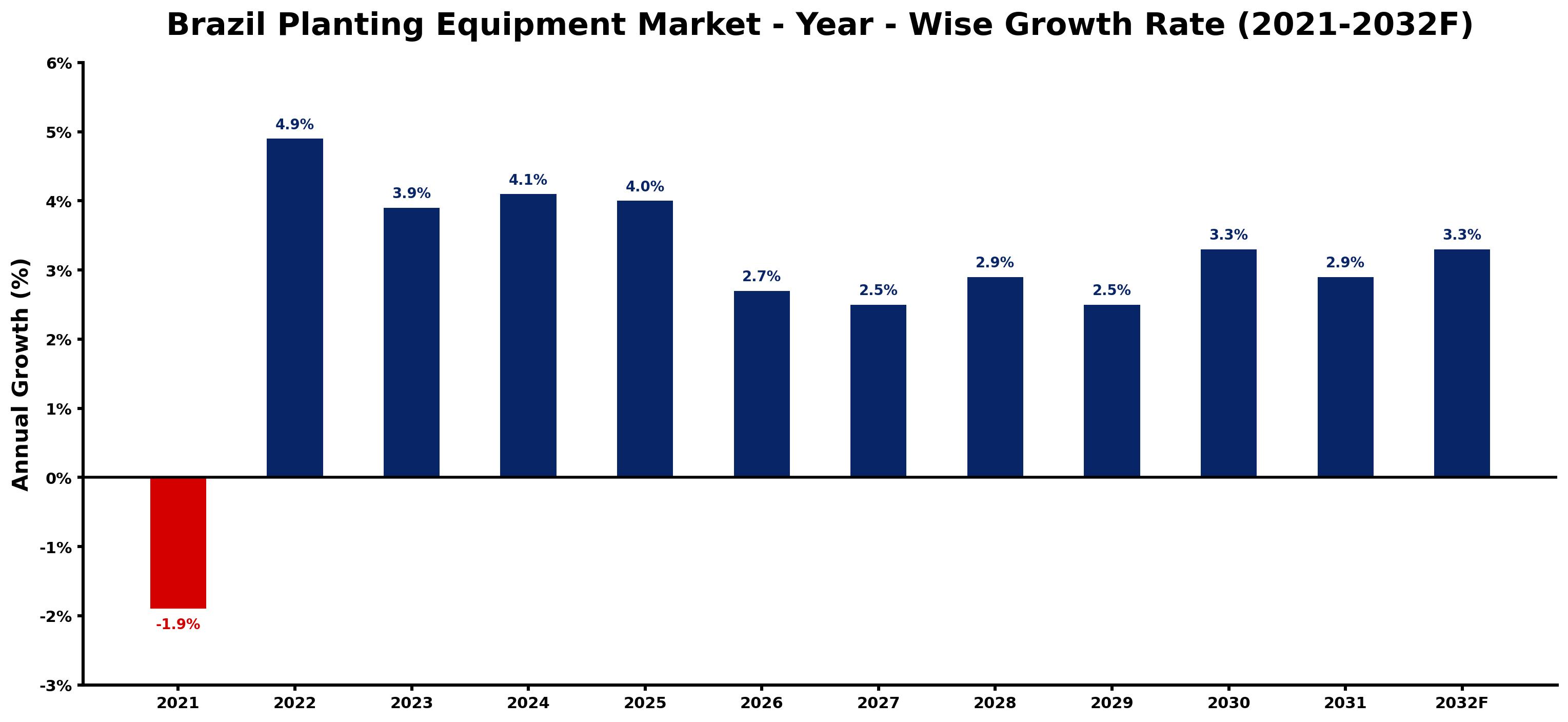
The table below presents the year‑wise growth rates along with the key drivers influencing the market
| Year | Growth Rate | Major Drivers |
| 2021 | -1.9% | Increasing industrial automation investments |
| 2022 | 4.9% | Rapid growth in telecom and data center sectors |
| 2023 | 3.9% | Increasing adoption of advanced technologies |
| 2024 | 4.1% | Rapid growth in telecom and data center sectors |
| 2025 | 4.0% | Increasing industrial automation investments |
| 2026 | 2.7% | Increasing smart city development projects |
| 2027 | 2.5% | Rising electricity demand across industries |
| 2028 | 2.9% | Rapid growth in telecom and data center sectors |
| 2029 | 2.5% | Government infrastructure modernization initiatives |
| 2030 | 3.3% | Growing urbanization and commercial development |
| 2031 | 2.9% | Government infrastructure modernization initiatives |
| 2032 | 3.3% | Increasing industrial infrastructure investments |
Note - Market size estimations and growth projections presented in this report are based on 6Wresearch's advanced forecasting approach, validated with industry datasets as of June 2026.
Brazil Planting Equipment Market Synopsis
While the Brazil Planting Equipment Market has recently gained momentum due to a surge in farm mechanization and technological innovations, the landscape is evolving. As farmers adapt to new methodologies, the demand for advanced planting technologies is set to escalate, pushing the market into a new growth phase.
Looking ahead, the market is likely to confront challenges related to rapid technological advancements and competition among manufacturers. As Brazilian farmers increasingly seek precision planting solutions and sustainability, companies will need to innovate continuously to meet these evolving demands and maintain their competitive edge.
Brazil Planting Equipment Market Key Takeaways
- The market is projected to grow steadily, reflecting Brazil's push towards agricultural modernization.
- Technological advancements are a key driver, with demand for precision agriculture tools on the rise.
- Fragmentation and competition characterize the market, emphasizing the need for product differentiation.
- Environmental sustainability is becoming a focal point for both farmers and equipment manufacturers.
- Government initiatives are supporting the adoption of modern planting equipment and practices.
Evaluation of Restraints in Brazil Planting Equipment Market
Despite the positive outlook, several restraints limit the growth of the Brazil Planting Equipment Market. The rapid pace of technological change can be challenging for farmers to keep up with, often leading to delays in adoption. Furthermore, the fragmented nature of the market can create price competition that squeezes margins for manufacturers. Many producers struggle to balance innovation with affordability, which is essential for a market composed largely of smaller farming operations. Lastly, increasing regulations around environmental impact add layers of complexity for manufacturers looking to meet both consumer demands and compliance standards.
Brazil Planting Equipment Market Trends
Several trends are currently shaping the Brazil Planting Equipment Market. The integration of digital technologies, such as GPS and precision planting solutions, is revolutionizing the way farmers approach planting. There's a growing emphasis on sustainable practices, driving demand for equipment that minimizes soil disruption and conserves resources. Additionally, the trend towards automation is becoming prominent, with farmers increasingly looking for equipment that can operate autonomously, thus enhancing operational efficiency.
Brazil Planting Equipment Market Opportunities
Opportunities for growth within the Brazil Planting Equipment Market are abundant, particularly in the realm of innovative technology development. Companies that focus on developing smart planting solutions, such as equipment that utilizes artificial intelligence for real-time decision-making, stand to benefit significantly. There's also potential in expanding the market for used or refurbished equipment, which can help smaller farmers access modern technologies without the high cost of new machines. Collaborative projects between manufacturers and agricultural researchers can further fuel advancements in this sector.
Government Initiatives in the Brazil Planting Equipment Market
Government policies are playing a crucial role in supporting the Brazil Planting Equipment Market. Initiatives aimed at agricultural modernization include financial incentives for farmers investing in new technologies and rigorous standards to ensure safety and environmental compliance. Furthermore, research and development programs funded by the government seek to enhance equipment performance and promote best practices in farming techniques. Technical assistance and training initiatives also help farmers transition to modern planting equipment and leverage advanced farming methodologies.
Future Insights of the Brazil Planting Equipment Market
Looking forward to the period between 2026 and 2032, the Brazil Planting Equipment Market is expected to continue its growth trajectory, propelled by the persistent push for efficiency and modernization in agriculture. As farmers become more tech-savvy and demand for sustainability rises, we anticipate increased adoption of cutting-edge planting technologies. Moreover, partnerships between technology firms and agricultural machinery manufacturers could lead to the development of even more innovative solutions tailored for Brazilian agriculture, thereby creating a robust market environment.
Brazil Planting Equipment Market Latest Developments (May 2025 - June 2026)
In the recent months, the Brazilian planting equipment industry has been experiencing a notable shift toward advanced technological integration. Manufacturers are actively engaging in research partnerships to enhance the capabilities of planting equipment, focusing on sustainability and efficiency. Furthermore, there has been a marked increase in government support for initiatives aimed at promoting best practices in agricultural equipment use, which is anticipated to facilitate broader adoption of modern machinery across various farming sectors.
Brazil Planting Equipment Market - Key Attractiveness of the Report
- 10 Years of Market Numbers
- Historical Data Starting from 2022 to 2025
- Base Year: 2025
- Forecast Data until 2032
- Key Performance Indicators Impacting the Market
- Major Upcoming Developments and Projects
Key Highlights of the Report:
- Brazil Planting Equipment Market Outlook
- Market Size of Brazil Planting Equipment Market, 2025
- Forecast of Brazil Planting Equipment Market, 2032
- Historical Data and Forecast of Brazil Planting Equipment Revenues & Volume for the Period 2022-2032F
- Brazil Planting Equipment Market Trend Evolution
- Brazil Planting Equipment Market Drivers and Challenges
- Brazil Planting Equipment Price Trends
- Brazil Planting Equipment Porter's Five Forces
- Brazil Planting Equipment Industry Life Cycle
- Historical Data and Forecast of Brazil Planting Equipment Market Revenues & Volume By Type for the Period 2022-2032F
- Historical Data and Forecast of Brazil Planting Equipment Market Revenues & Volume By Air seeders for the Period 2022-2032F
- Historical Data and Forecast of Brazil Planting Equipment Market Revenues & Volume By Seed drills for the Period 2022-2032F
- Historical Data and Forecast of Brazil Planting Equipment Market Revenues & Volume By Planters for the Period 2022-2032F
- Historical Data and Forecast of Brazil Planting Equipment Market Revenues & Volume By Others for the Period 2022-2032F
- Historical Data and Forecast of Brazil Planting Equipment Market Revenues & Volume By Design for the Period 2022-2032F
- Historical Data and Forecast of Brazil Planting Equipment Market Revenues & Volume By Mechanical for the Period 2022-2032F
- Historical Data and Forecast of Brazil Planting Equipment Market Revenues & Volume By Automatic for the Period 2022-2032F
- Historical Data and Forecast of Brazil Planting Equipment Market Revenues & Volume By Crop Type for the Period 2022-2032F
- Historical Data and Forecast of Brazil Planting Equipment Market Revenues & Volume By Cereals & grains for the Period 2022-2032F
- Historical Data and Forecast of Brazil Planting Equipment Market Revenues & Volume By Oilseeds & pulses for the Period 2022-2032F
- Historical Data and Forecast of Brazil Planting Equipment Market Revenues & Volume By Fruits & vegetables for the Period 2022-2032F
- Historical Data and Forecast of Brazil Planting Equipment Market Revenues & Volume By Others for the Period 2022-2032F
- Brazil Planting Equipment Import Export Trade Statistics
- Market Opportunity Assessment By Type
- Market Opportunity Assessment By Design
- Market Opportunity Assessment By Crop Type
- Brazil Planting Equipment Top Companies Market Share
- Brazil Planting Equipment Competitive Benchmarking By Technical and Operational Parameters
- Brazil Planting Equipment Company Profiles
- Brazil Planting Equipment Key Strategic Recommendations






































