Peru Planting Equipment Market Size, Share & Growth Rate
The Peru Planting Equipment Market was estimated at USD 212 Million in 2025 and is projected to reach USD 282 Million by 2032, growing at a CAGR of 4.2% from 2026 to 2032. This growth trajectory is primarily driven by the increasing mechanization of agriculture, fueled by the urgent need for higher crop yields and efficiency in farming practices. Additionally, government initiatives aimed at promoting modern agriculture are further propelling demand for advanced planting technologies.
Peru Planting Equipment Market Year-wise Growth Rate and Key Drivers
This graph highlights how the Peru Planting Equipment Market has steadily grown over the years, supported by major growth factors.
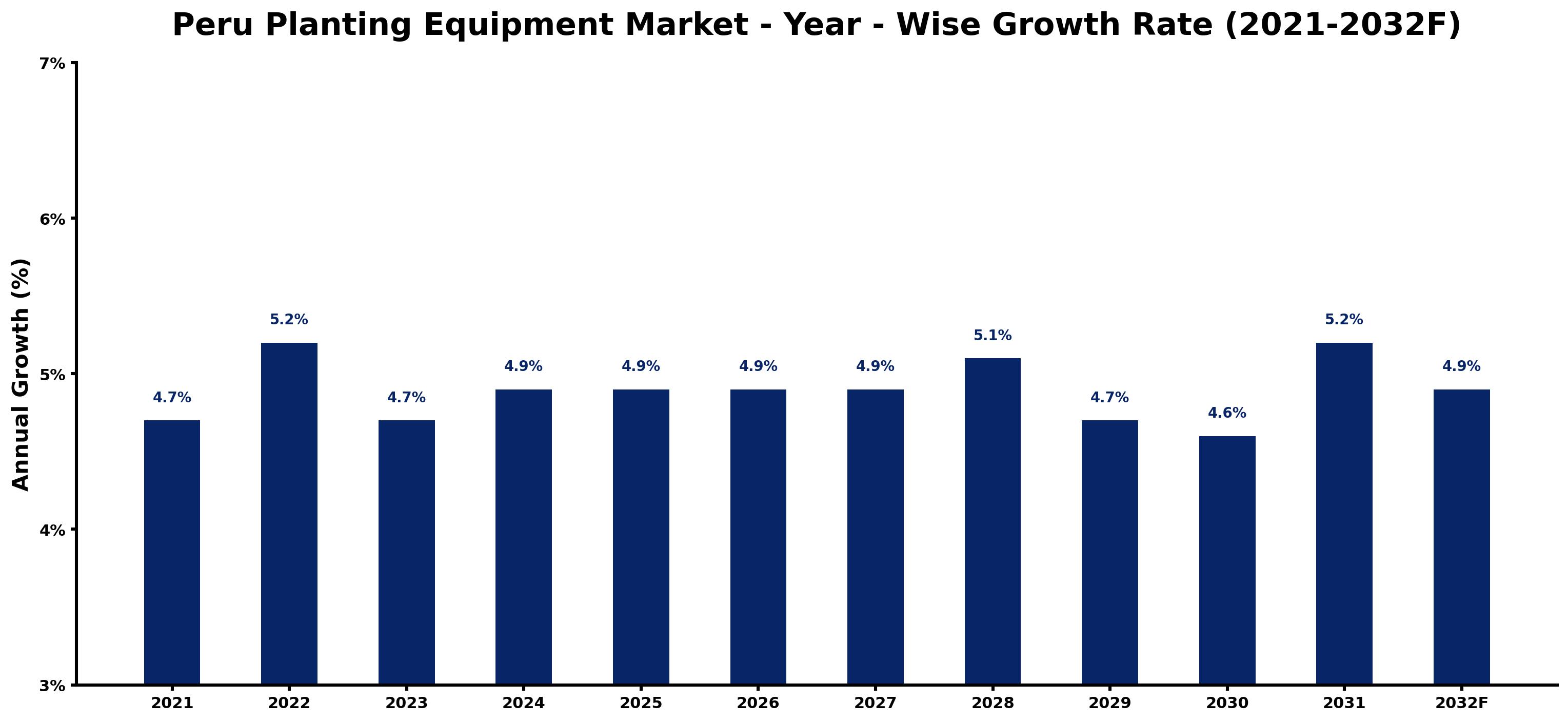
The table below presents the year‑wise growth rates along with the key drivers influencing the market
| Year | Growth Rate | Major Drivers |
| 2021 | 4.7% | Expansion of transportation and logistics networks |
| 2022 | 5.2% | Growing renewable energy integration projects |
| 2023 | 4.7% | Increasing smart city development projects |
| 2024 | 4.9% | Increasing adoption of advanced technologies |
| 2025 | 4.9% | Rapid growth in telecom and data center sectors |
| 2026 | 4.9% | Expansion of manufacturing activities |
| 2027 | 4.9% | Expansion of manufacturing activities |
| 2028 | 5.1% | Increasing adoption of advanced technologies |
| 2029 | 4.7% | Expansion of transportation and logistics networks |
| 2030 | 4.6% | Rapid growth in telecom and data center sectors |
| 2031 | 5.2% | Increasing adoption of advanced technologies |
| 2032 | 4.9% | Rising electricity demand across industries |
Note - Market size estimations and growth projections presented in this report are based on 6Wresearch's advanced forecasting approach, validated with industry datasets as of June 2026.
Peru Planting Equipment Market Synopsis
The strongest force shaping the Peru Planting Equipment Market today is the growing emphasis on sustainable farming practices. As farmers recognize the importance of efficiency and environmental impact, they are increasingly seeking precision planting solutions that align with their goals of enhanced productivity and reduced resource wastage.
Moreover, the diversity of crop types cultivated in Peru necessitates versatile planting equipment. This factor not only drives innovation among manufacturers but also encourages farmers to invest in advanced technologies that can handle varying planting conditions effectively.
Peru Planting Equipment Market Key Takeaways
- The market is shifting towards precision agriculture technologies that offer significant improvements in yield and sustainability.
- Investment opportunities exist in both manufacturing and distribution of advanced planting equipment.
- Government support through subsidies and financial incentives is boosting market growth.
- Challenges remain in accessibility for small-scale farmers, which could limit market penetration.
- Technological advancements are essential for enhancing overall efficiency in planting operations.
Evaluation of Restraints in Peru Planting Equipment Market
Despite its promising growth, the Peru Planting Equipment Market faces significant restraints that could hinder its expansion. High costs associated with advanced machinery often render small-scale farmers unable to adopt modern technologies. Furthermore, inadequate infrastructure in rural areas complicates the distribution and servicing of planting equipment, limiting farmers' access to essential resources. Climatic variability adds another layer of uncertainty, impacting farmers' decisions on equipment selection and planting schedules. Addressing these restraints is critical for enabling broader adoption of innovative agricultural practices.
Peru Planting Equipment Market Trends
Current trends within the Peru Planting Equipment Market indicate a significant shift towards precision agriculture technologies. Farmers are increasingly investing in advanced planting systems that integrate GPS and sensor technologies, optimizing the entire planting process from seed placement to depth. This trend is driven by a growing awareness of the financial and environmental benefits of precision planting, fostering a more sustainable agricultural landscape.
Additionally, there's a marked increase in demand for equipment capable of managing multiple crop types and conditions. This versatility ensures that farmers can adapt to the varied agricultural environment in Peru, thereby enhancing productivity and addressing the challenges posed by diverse climatic conditions.
Peru Planting Equipment Market Opportunities
The opportunities within the Peru Planting Equipment Market are ripe for investors and stakeholders looking to capitalize on the mechanization trend. As farmers increasingly seek to enhance productivity through advanced planting solutions, there is a growing market for precision seeders, planters, and transplanters. Moreover, partnerships with local agricultural organizations can facilitate the introduction of innovative planting technologies, further driving demand. Overall, the market represents a fertile ground for growth and investment expansion.
Government Initiatives in the Peru Planting Equipment Market
The Peruvian government has recognized the importance of modernizing its agricultural sector and has implemented various supportive measures. These initiatives include financial subsidies and incentives aimed at encouraging farmers to invest in advanced planting equipment. Moreover, the government actively promotes sustainable agricultural practices, which often necessitate specialized planting technologies. This regulatory framework aims to bolster food production and ensure environmental protection, ultimately enhancing the viability of the planting equipment market.
Future Insights of the Peru Planting Equipment Market
Looking ahead, the Peru Planting Equipment Market is set for a positive trajectory from 2026 to 2032. Key growth drivers will include the ongoing adoption of mechanization across the agriculture sector and increasing farmer awareness regarding the advantages of modern planting technologies. The continued support from the government to modernize farming practices will also play a crucial role in shaping the market's future. As agricultural modernization continues, opportunities for both local and international stakeholders to contribute to this evolving landscape will increase.
Peru Planting Equipment Market Latest Developments (May 2025 - June 2026)
Recent developments in the Peru Planting Equipment Market showcase a strong focus on technological advancements and innovation. There has been a notable increase in partnerships between equipment manufacturers and agricultural cooperatives, aimed at enhancing knowledge transfer regarding precision planting techniques. Furthermore, the market has seen a rise in the availability of financing options for farmers, enabling them to invest in modern equipment and technologies. These trends indicate a dynamic shift towards a more mechanized and efficient agricultural sector.
Peru Planting Equipment Market - Key Attractiveness of the Report
- 10 Years of Market Numbers
- Historical Data Starting from 2022 to 2025
- Base Year: 2025
- Forecast Data until 2032
- Key Performance Indicators Impacting the Market
- Major Upcoming Developments and Projects
Key Highlights of the Report:
- Peru Planting Equipment Market Outlook
- Market Size of Peru Planting Equipment Market, 2025
- Forecast of Peru Planting Equipment Market, 2032
- Historical Data and Forecast of Peru Planting Equipment Revenues & Volume for the Period 2022-2032F
- Peru Planting Equipment Market Trend Evolution
- Peru Planting Equipment Market Drivers and Challenges
- Peru Planting Equipment Price Trends
- Peru Planting Equipment Porter's Five Forces
- Peru Planting Equipment Industry Life Cycle
- Historical Data and Forecast of Peru Planting Equipment Market Revenues & Volume By Type for the Period 2022-2032F
- Historical Data and Forecast of Peru Planting Equipment Market Revenues & Volume By Air seeders for the Period 2022-2032F
- Historical Data and Forecast of Peru Planting Equipment Market Revenues & Volume By Seed drills for the Period 2022-2032F
- Historical Data and Forecast of Peru Planting Equipment Market Revenues & Volume By Planters for the Period 2022-2032F
- Historical Data and Forecast of Peru Planting Equipment Market Revenues & Volume By Others for the Period 2022-2032F
- Historical Data and Forecast of Peru Planting Equipment Market Revenues & Volume By Design for the Period 2022-2032F
- Historical Data and Forecast of Peru Planting Equipment Market Revenues & Volume By Mechanical for the Period 2022-2032F
- Historical Data and Forecast of Peru Planting Equipment Market Revenues & Volume By Automatic for the Period 2022-2032F
- Historical Data and Forecast of Peru Planting Equipment Market Revenues & Volume By Crop Type for the Period 2022-2032F
- Historical Data and Forecast of Peru Planting Equipment Market Revenues & Volume By Cereals & grains for the Period 2022-2032F
- Historical Data and Forecast of Peru Planting Equipment Market Revenues & Volume By Oilseeds & pulses for the Period 2022-2032F
- Historical Data and Forecast of Peru Planting Equipment Market Revenues & Volume By Fruits & vegetables for the Period 2022-2032F
- Historical Data and Forecast of Peru Planting Equipment Market Revenues & Volume By Others for the Period 2022-2032F
- Peru Planting Equipment Import Export Trade Statistics
- Market Opportunity Assessment By Type
- Market Opportunity Assessment By Design
- Market Opportunity Assessment By Crop Type
- Peru Planting Equipment Top Companies Market Share
- Peru Planting Equipment Competitive Benchmarking By Technical and Operational Parameters
- Peru Planting Equipment Company Profiles
- Peru Planting Equipment Key Strategic Recommendations






































