Brazil Propane Market Top 5 Importing Countries and Market Competition (HHI) Analysis
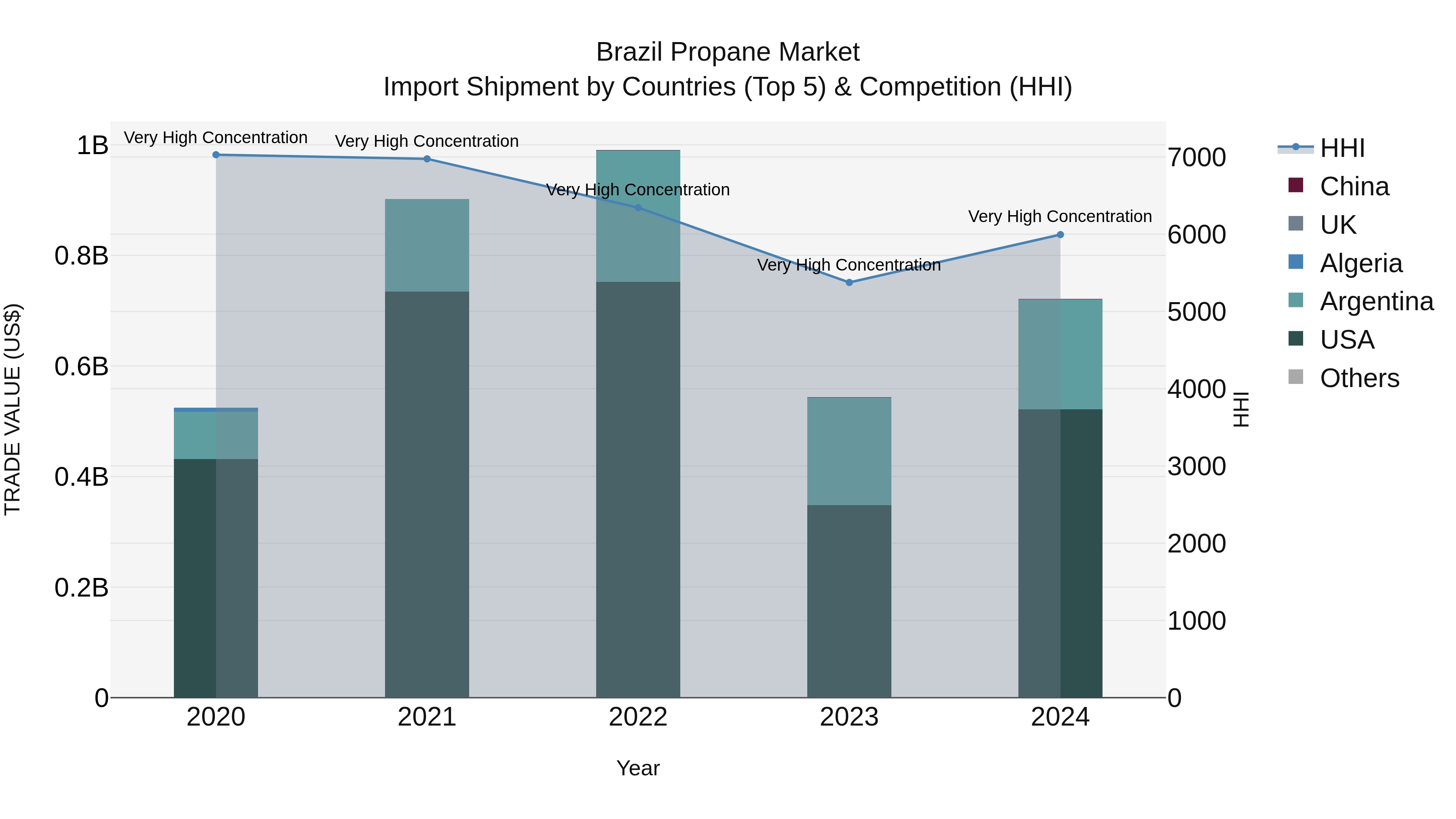
In 2024, Brazil`s propane import market continued to thrive, with top suppliers including the USA, Argentina, China, Italy, and South Korea. Despite high concentration levels indicated by the HHI, the market saw significant growth with a CAGR of 8.28% from 2020-24. The impressive growth rate of 32.74% from 2023-24 highlights the strong demand for propane in Brazil and the country`s reliance on these key exporting nations to meet its energy needs.
Brazil Propane Market Overview
The propane market in Brazil is a vital segment of the country`s energy landscape. As an alternative to traditional fuels, propane is gaining popularity due to its lower environmental impact and versatile applications. The market is witnessing growth in residential, industrial, and commercial sectors, with increased emphasis on clean energy solutions.
Drivers of the market
The propane market in Brazil is influenced by its diverse applications, including residential heating, industrial processes, and as an automotive fuel. The shift towards cleaner energy sources and the versatility of propane drive its demand. Government incentives and regulations promoting clean energy further support the growth of the propane market.
Challenges of the market
Challenges within the Brazil propane market include regulatory uncertainties and fluctuating global energy prices. Government policies and international market dynamics can influence the availability and pricing of propane, making it challenging for businesses to predict and plan effectively.
Government Policy of the market
In the context of energy diversification and environmental sustainability, Brazil has devised policies to foster the development of the propane market. Recognizing the role of propane as a clean and efficient energy source, the government has implemented measures to encourage its use across various sectors, including residential, commercial, and industrial applications. These policies encompass incentives for the adoption of propane-powered vehicles, subsidies for propane infrastructure development, and regulatory frameworks to ensure safety standards and emissions control.
Key Highlights of the Report:
- Brazil Propane Market Outlook
- Market Size of Brazil Propane Market, 2024
- Forecast of Brazil Propane Market, 2031
- Historical Data and Forecast of Brazil Propane Revenues & Volume for the Period 2021-2031
- Brazil Propane Market Trend Evolution
- Brazil Propane Market Drivers and Challenges
- Brazil Propane Price Trends
- Brazil Propane Porter's Five Forces
- Brazil Propane Industry Life Cycle
- Historical Data and Forecast of Brazil Propane Market Revenues & Volume By Applications for the Period 2021-2031
- Historical Data and Forecast of Brazil Propane Market Revenues & Volume By Industrial for the Period 2021-2031
- Historical Data and Forecast of Brazil Propane Market Revenues & Volume By Commercial for the Period 2021-2031
- Historical Data and Forecast of Brazil Propane Market Revenues & Volume By Residential for the Period 2021-2031
- Historical Data and Forecast of Brazil Propane Market Revenues & Volume By Transportation for the Period 2021-2031
- Historical Data and Forecast of Brazil Propane Market Revenues & Volume By Agriculture for the Period 2021-2031
- Historical Data and Forecast of Brazil Propane Market Revenues & Volume By Chemicals and Refineries for the Period 2021-2031
- Brazil Propane Import Export Trade Statistics
- Market Opportunity Assessment By Applications
- Brazil Propane Top Companies Market Share
- Brazil Propane Competitive Benchmarking By Technical and Operational Parameters
- Brazil Propane Company Profiles
- Brazil Propane Key Strategic Recommendations






































