Brazil Refined Petroleum Products Market Size, Share & Growth Rate
The Brazil Refined Petroleum Products Market was estimated at USD 185 Million in 2025 and is projected to reach USD 220 Million by 2032, growing at a CAGR of 2.5% from 2026 to 2032. This growth trajectory is largely driven by increasing domestic consumption patterns, spurred by economic development and enhanced transportation infrastructure. Additionally, fluctuations in global oil prices and shifts in energy policies significantly impact the refining sector, creating a dynamic landscape for industry stakeholders.
Brazil Refined Petroleum Products Market Year-wise Growth Rate and Key Drivers
This graph highlights how the Brazil Refined Petroleum Products Market has steadily grown over the years, supported by major growth factors.
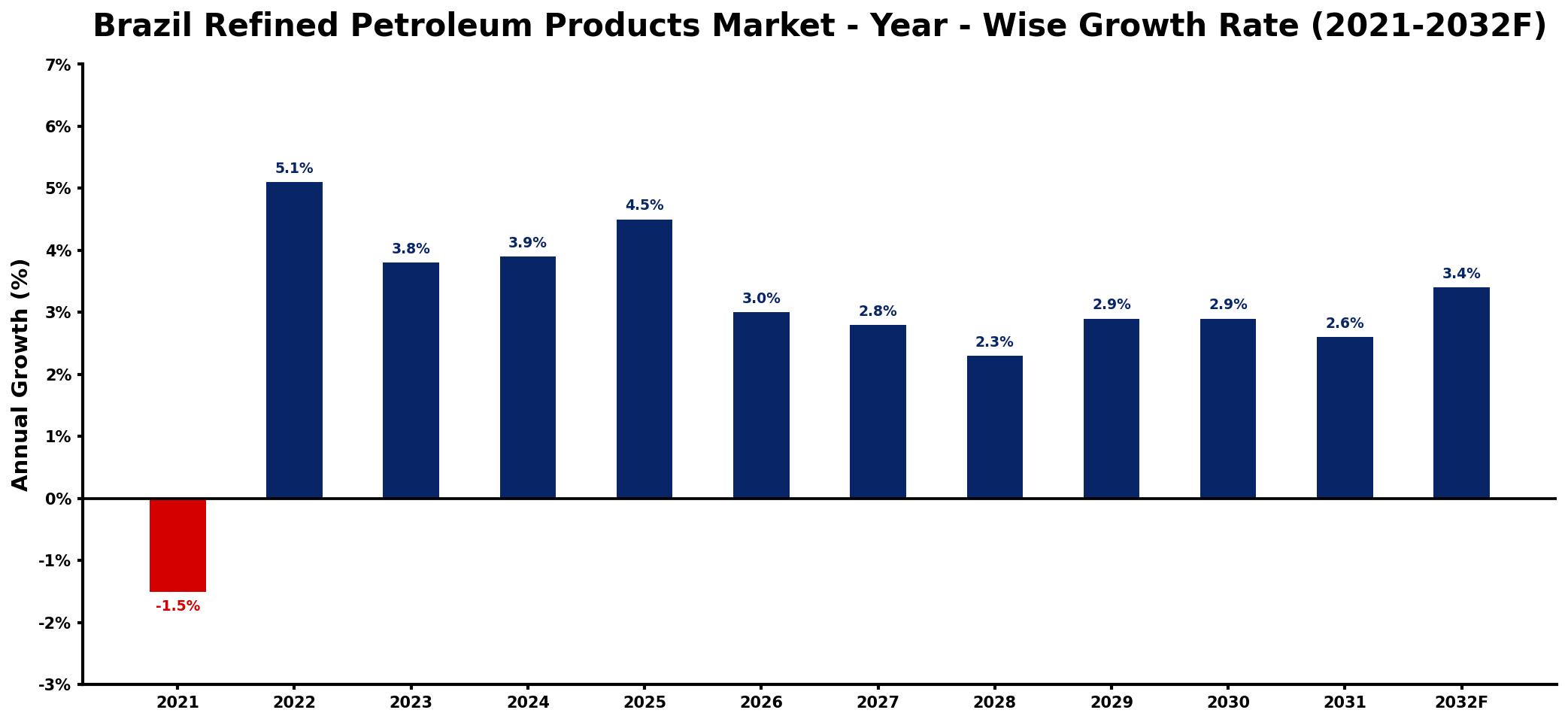
The table below presents the year‑wise growth rates along with the key drivers influencing the market
| Year | Growth Rate | Major Drivers |
| 2021 | -1.5% | Global energy demand declines significantly |
| 2022 | 5.1% | Renewable energy investments increase rapidly |
| 2023 | 3.8% | Industrial production ramps up substantially |
| 2024 | 3.9% | Transportation sector expands growth opportunities |
| 2025 | 4.5% | Consumer spending on energy rises |
| 2026 | 3.0% | Technological advancements enhance efficiency |
| 2027 | 2.8% | Infrastructure development projects gain momentum |
| 2028 | 2.3% | International trade agreements boost supply |
| 2029 | 2.9% | Market diversification strategies take shape |
| 2030 | 2.9% | Urbanization trends drive energy consumption |
| 2031 | 2.6% | Policy reforms encourage sustainable practices |
| 2032 | 3.4% | Research and development funding increases |
Note: Market size estimations and growth projections presented in this report are based on 6Wresearch's proprietary forecasting methodology, utilizing the latest available industry data, government publications, and primary research inputs.
Brazil Refined Petroleum Products Market Synopsis
The Brazilian refined petroleum products market is evolving amid changing consumption behaviors and international trade dynamics. With Brazil's status as a key player in the global energy sector, its refining capabilities are critical for satisfying both domestic and export needs.
Current government policies aimed at ensuring energy security and price stability are shaping the competitive landscape. Stakeholders are increasingly required to adapt their strategies in response to regulatory frameworks that prioritize both competition and environmental standards.
Brazil Refined Petroleum Products Market Key Takeaways
- The market is projected to grow from USD 185 Million in 2025 to USD 220 Million by 2032.
- Domestic consumption drives much of the demand, influenced by economic growth and transportation trends.
- Government policies focus on energy security while promoting environmental sustainability in refining processes.
- Price volatility remains a significant challenge, necessitating innovative strategies from market players.
- Stakeholders are increasingly investing in sustainable practices to meet evolving consumer expectations.
Evaluation of Restraints in Brazil Refined Petroleum Products Market
The Brazil refined petroleum products market faces notable restraints stemming from price volatility and a heightened awareness of environmental issues. The fluctuating global oil prices create uncertainty, forcing companies to constantly recalibrate their pricing strategies. Furthermore, increasing regulations aimed at minimizing environmental impacts compel industry participants to invest in cleaner technologies, often leading to substantial operational costs. These factors collectively challenge the market's ability to maintain stable growth while remaining competitive.
Brazil Refined Petroleum Products Market Trends
Emerging trends in the Brazil refined petroleum products market include a growing emphasis on alternative fuels and renewable energy sources. As global awareness of climate change rises, Brazilian refiners are exploring pathways to diversify their product offerings and integrate sustainable practices into their operations. Additionally, advancements in refining technologies are enhancing efficiency and reducing emissions, aligning with both regulatory demands and consumer preferences.
Brazil Refined Petroleum Products Market Opportunities
There are significant growth opportunities within Brazil's refined petroleum products market, particularly in developing biofuels and other renewable alternatives. As Brazil aims to bolster its energy independence, investments in new refining capacities and technology upgrades can offer substantial returns. Additionally, expanding transportation infrastructure presents a chance for increased product demand, thus enhancing the overall market landscape.
Government Initiatives in the Brazil Refined Petroleum Products Market
The Brazilian government has implemented various initiatives aimed at stabilizing the refined petroleum products market while ensuring environmental compliance. Programs to encourage competition within the sector are gaining traction, while investments in renewable energy are being supported through fiscal incentives. These initiatives are crucial for attracting private investments and fostering an environment conducive to sustainable growth.
Future Insights of the Brazil Refined Petroleum Products Market
Looking ahead to 2026-2032, the Brazil refined petroleum products market is expected to navigate a complex landscape shaped by both local and global influences. Continued growth in domestic consumption, coupled with potential shifts toward cleaner fuels, will be pivotal for market expansion. Companies that align their strategies with sustainable practices and technological advancements are likely to thrive, navigating the challenges posed by price volatility and regulatory compliance more effectively.
Brazil Refined Petroleum Products Market Latest Developments (2025 - 2026)
Recent developments indicate a strong push towards modernization within the Brazilian refining sector, with several initiatives focusing on sustainability and efficiency enhancements. Investments are being funneled into new technologies aimed at reducing emissions and optimizing output. Additionally, collaborative efforts between governmental bodies and private enterprises are fostering innovation, creating a proactive environment for addressing market demands.
Brazil Refined Petroleum Products Market - Key Attractiveness of the Report
- 10 Years of Market Numbers
- Historical Data Starting from 2022 to 2025
- Base Year: 2025
- Forecast Data until 2032
- Key Performance Indicators Impacting the Market
- Major Upcoming Developments and Projects
Key Highlights of the Report:
- Brazil Refined Petroleum Products Market Outlook
- Market Size of Brazil Refined Petroleum Products Market, 2025
- Forecast of Brazil Refined Petroleum Products Market, 2032
- Historical Data and Forecast of Brazil Refined Petroleum Products Revenues & Volume for the Period 2022-2032F
- Brazil Refined Petroleum Products Market Trend Evolution
- Brazil Refined Petroleum Products Market Drivers and Challenges
- Brazil Refined Petroleum Products Price Trends
- Brazil Refined Petroleum Products Porter's Five Forces
- Brazil Refined Petroleum Products Industry Life Cycle
- Historical Data and Forecast of Brazil Refined Petroleum Products Market Revenues & Volume By Product Type for the Period 2022-2032F
- Historical Data and Forecast of Brazil Refined Petroleum Products Market Revenues & Volume By Diesel for the Period 2022-2032F
- Historical Data and Forecast of Brazil Refined Petroleum Products Market Revenues & Volume By Gasoline for the Period 2022-2032F
- Historical Data and Forecast of Brazil Refined Petroleum Products Market Revenues & Volume By Fuel Oils for the Period 2022-2032F
- Historical Data and Forecast of Brazil Refined Petroleum Products Market Revenues & Volume By Kerosene for the Period 2022-2032F
- Historical Data and Forecast of Brazil Refined Petroleum Products Market Revenues & Volume By Others for the Period 2022-2032F
- Historical Data and Forecast of Brazil Refined Petroleum Products Market Revenues & Volume By Application for the Period 2022-2032F
- Historical Data and Forecast of Brazil Refined Petroleum Products Market Revenues & Volume By Fuel for the Period 2022-2032F
- Historical Data and Forecast of Brazil Refined Petroleum Products Market Revenues & Volume By Chemical for the Period 2022-2032F
- Historical Data and Forecast of Brazil Refined Petroleum Products Market Revenues & Volume By Others for the Period 2022-2032F
- Historical Data and Forecast of Brazil Refined Petroleum Products Market Revenues & Volume By Fraction for the Period 2022-2032F
- Historical Data and Forecast of Brazil Refined Petroleum Products Market Revenues & Volume By Light Distillates for the Period 2022-2032F
- Historical Data and Forecast of Brazil Refined Petroleum Products Market Revenues & Volume By Middle Distillates for the Period 2022-2032F
- Historical Data and Forecast of Brazil Refined Petroleum Products Market Revenues & Volume By Heavy Oils for the Period 2022-2032F
- Brazil Refined Petroleum Products Import Export Trade Statistics
- Market Opportunity Assessment By Product Type
- Market Opportunity Assessment By Application
- Market Opportunity Assessment By Fraction
- Brazil Refined Petroleum Products Top Companies Market Share
- Brazil Refined Petroleum Products Competitive Benchmarking By Technical and Operational Parameters
- Brazil Refined Petroleum Products Company Profiles
- Brazil Refined Petroleum Products Key Strategic Recommendations






































