Mexico Refined Petroleum Products Market Size, Share & Growth Rate
The Mexico Refined Petroleum Products Market was estimated at USD 184 Million in 2025 and is projected to reach USD 213 Million by 2032, growing at a CAGR of 2.1% from 2026 to 2032. This growth trajectory is driven by increasing industrial activity and a robust demand for transportation fuels, particularly as economic recovery post-pandemic strengthens consumer spending. Additionally, the ongoing government reforms aimed at modernizing energy infrastructure are expected to further accelerate market expansion.
Mexico Refined Petroleum Products Market Year-wise Growth Rate and Key Drivers
This graph highlights how the Mexico Refined Petroleum Products Market has steadily grown over the years, supported by major growth factors.
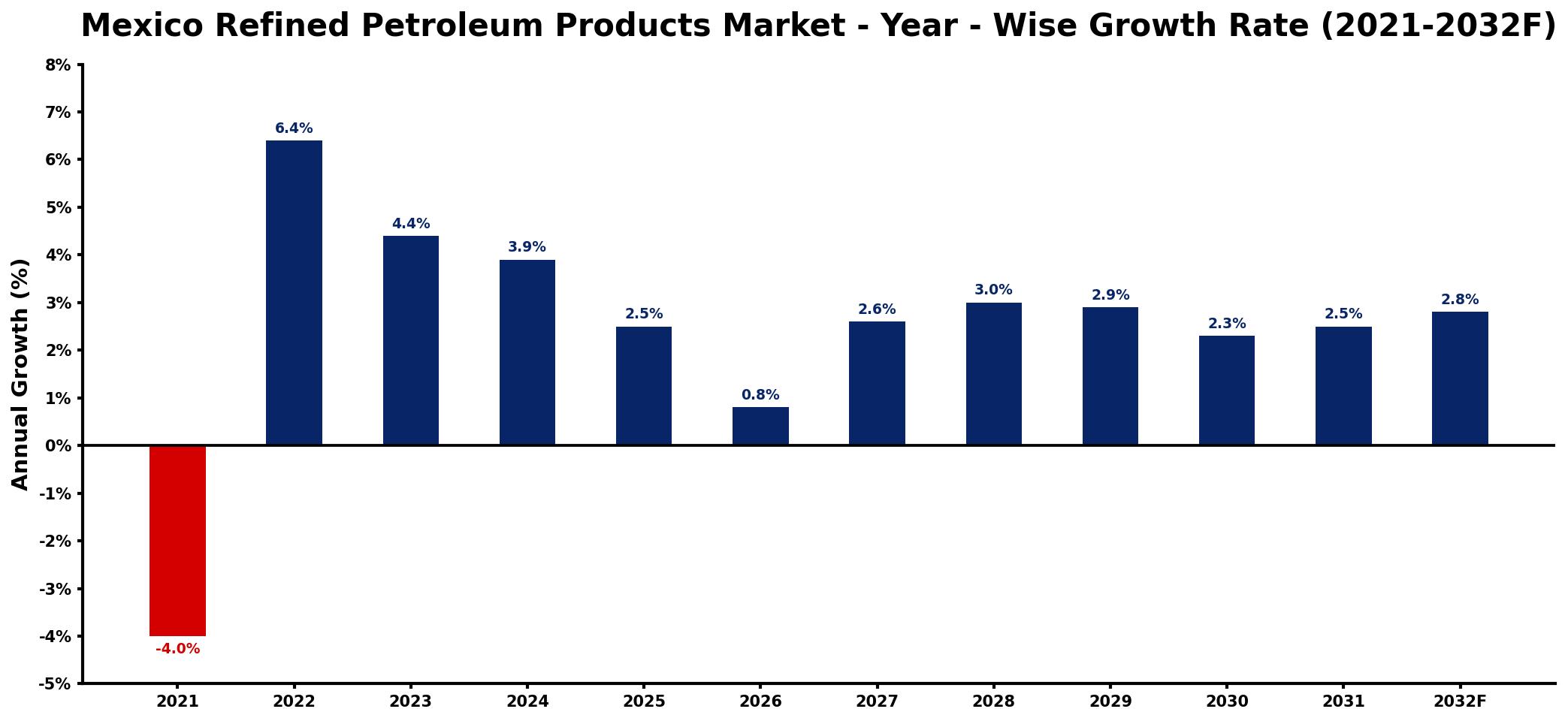
The table below presents the year‑wise growth rates along with the key drivers influencing the market
| Year | Growth Rate | Major Drivers |
| 2021 | -4.0% | decreased industrial energy consumption |
| 2022 | 6.4% | rising transportation sector demand |
| 2023 | 4.4% | increased investment in infrastructure |
| 2024 | 3.9% | growing urban population needs |
| 2025 | 2.5% | expansion of logistics networks |
| 2026 | 0.8% | increased automotive sales growth |
| 2027 | 2.6% | higher demand for cleaner fuels |
| 2028 | 3.0% | boost in construction activities |
| 2029 | 2.9% | surge in export opportunities |
| 2030 | 2.3% | enhanced energy efficiency initiatives |
| 2031 | 2.5% | growing renewable energy integration |
| 2032 | 2.8% | enhanced product quality standards |
Note: Market size estimations and growth projections presented in this report are based on 6Wresearch's proprietary forecasting methodology, utilizing the latest available industry data, government publications, and primary research inputs.
Mexico Refined Petroleum Products Market Synopsis
At the forefront of the Mexico Refined Petroleum Products Market is the growing need for cleaner and more efficient fuel alternatives. This shift is largely influenced by government initiatives focused on reducing greenhouse gas emissions and enhancing energy sustainability.
Moreover, Mexicos strategic positioning as a conduit for North American energy trade amplifies its importance in the refined petroleum sector. Key factors such as fluctuating global oil prices and the transition towards low-sulfur fuels further shape the dynamics of this evolving market.
Mexico Refined Petroleum Products Market Key Takeaways
- Government reforms are fostering competition and opening the market to private investments.
- Demand for high-quality refined products is increasing across various industries.
- Infrastructure upgrades are essential for enhancing distribution and refining capabilities.
- Emerging trends are tilting towards biofuels and alternative energy sources.
- Market resilience is tested by global oil price fluctuations and environmental regulations.
Evaluation of Restraints in Mexico Refined Petroleum Products Market
Despite its growth potential, the Mexico Refined Petroleum Products Market faces significant restraints. Government regulations can create uncertainties in pricing and market access, while fluctuating global oil prices add further volatility. Infrastructure limitations, particularly in storage and distribution, also pose challenges in efficiently meeting the rising demand for refined products. Moreover, the increasing focus on sustainability necessitates ongoing adaptation by industry players to align with evolving consumer expectations and regulatory requirements.
Mexico Refined Petroleum Products Market Trends
The market is currently witnessing a robust trend towards cleaner fuel options, driven by both consumer preferences and regulatory mandates. Investments in biofuels are rising as companies seek to align with sustainability goals. Additionally, advancements in refining technologies are promoting the production of low-sulfur fuels, which are gaining traction in response to environmental regulations. This focus on innovation and efficiency is crucial for meeting the diverse demands of the transportation and manufacturing sectors.
Mexico Refined Petroleum Products Market Opportunities
Investment opportunities in the Mexico Refined Petroleum Products Market are abundant, particularly in refining capacity expansion and the enhancement of distribution networks. As the government continues to promote energy sector reforms, private partnerships and joint ventures are expected to flourish. Furthermore, the increasing inclination towards sustainable practices opens up avenues for investments in renewable energy projects and the production of alternative fuels, promising lucrative returns for forward-thinking stakeholders.
Government Initiatives in the Mexico Refined Petroleum Products Market
The Mexican government has enacted a series of initiatives aimed at bolstering the refined petroleum products sector. These policies include deregulation to encourage competition and private investment, as well as infrastructure improvements to enhance the efficiency of petroleum product distribution. Environmental regulations are also a focal point, aimed at promoting cleaner fuels and reducing emissions in line with global sustainability trends. These actions underscore a commitment to energy security and market stability.
Future Insights of the Mexico Refined Petroleum Products Market
Looking ahead to 2026-2032, the Mexico Refined Petroleum Products Market is positioned for steady growth. Continued economic development and increasing population will drive demand across various sectors. Government initiatives to modernize energy infrastructure will likely foster investment and enhance operational efficiencies. Nevertheless, the market must navigate challenges such as global oil price volatility and competition from renewable energy sources, which will shape future dynamics.
Mexico Refined Petroleum Products Market Latest Developments (2025 - 2026)
Recent developments in the Mexico Refined Petroleum Products Market indicate a clear shift towards innovation and sustainability. Companies are increasingly focusing on enhancing refining processes to produce cleaner fuels and reduce emissions. Strategic partnerships are emerging as firms seek to improve distribution infrastructure, addressing current limitations. Additionally, the government continues to explore policies that facilitate investment in renewable energy alternatives, reflecting a broader commitment to sustainable growth in the sector.
Mexico Refined Petroleum Products Market - Key Attractiveness of the Report
- 10 Years of Market Numbers
- Historical Data Starting from 2022 to 2025
- Base Year: 2025
- Forecast Data until 2032
- Key Performance Indicators Impacting the Market
- Major Upcoming Developments and Projects
Key Highlights of the Report:
- Mexico Refined Petroleum Products Market Outlook
- Market Size of Mexico Refined Petroleum Products Market, 2025
- Forecast of Mexico Refined Petroleum Products Market, 2032
- Historical Data and Forecast of Mexico Refined Petroleum Products Revenues & Volume for the Period 2022-2032F
- Mexico Refined Petroleum Products Market Trend Evolution
- Mexico Refined Petroleum Products Market Drivers and Challenges
- Mexico Refined Petroleum Products Price Trends
- Mexico Refined Petroleum Products Porter's Five Forces
- Mexico Refined Petroleum Products Industry Life Cycle
- Historical Data and Forecast of Mexico Refined Petroleum Products Market Revenues & Volume By Product Type for the Period 2022-2032F
- Historical Data and Forecast of Mexico Refined Petroleum Products Market Revenues & Volume By Diesel for the Period 2022-2032F
- Historical Data and Forecast of Mexico Refined Petroleum Products Market Revenues & Volume By Gasoline for the Period 2022-2032F
- Historical Data and Forecast of Mexico Refined Petroleum Products Market Revenues & Volume By Fuel Oils for the Period 2022-2032F
- Historical Data and Forecast of Mexico Refined Petroleum Products Market Revenues & Volume By Kerosene for the Period 2022-2032F
- Historical Data and Forecast of Mexico Refined Petroleum Products Market Revenues & Volume By Others for the Period 2022-2032F
- Historical Data and Forecast of Mexico Refined Petroleum Products Market Revenues & Volume By Application for the Period 2022-2032F
- Historical Data and Forecast of Mexico Refined Petroleum Products Market Revenues & Volume By Fuel for the Period 2022-2032F
- Historical Data and Forecast of Mexico Refined Petroleum Products Market Revenues & Volume By Chemical for the Period 2022-2032F
- Historical Data and Forecast of Mexico Refined Petroleum Products Market Revenues & Volume By Others for the Period 2022-2032F
- Historical Data and Forecast of Mexico Refined Petroleum Products Market Revenues & Volume By Fraction for the Period 2022-2032F
- Historical Data and Forecast of Mexico Refined Petroleum Products Market Revenues & Volume By Light Distillates for the Period 2022-2032F
- Historical Data and Forecast of Mexico Refined Petroleum Products Market Revenues & Volume By Middle Distillates for the Period 2022-2032F
- Historical Data and Forecast of Mexico Refined Petroleum Products Market Revenues & Volume By Heavy Oils for the Period 2022-2032F
- Mexico Refined Petroleum Products Import Export Trade Statistics
- Market Opportunity Assessment By Product Type
- Market Opportunity Assessment By Application
- Market Opportunity Assessment By Fraction
- Mexico Refined Petroleum Products Top Companies Market Share
- Mexico Refined Petroleum Products Competitive Benchmarking By Technical and Operational Parameters
- Mexico Refined Petroleum Products Company Profiles
- Mexico Refined Petroleum Products Key Strategic Recommendations






































