Brazil Seafood Processing Market Size, Share & Growth Rate
The Brazil Seafood Processing Market was estimated at USD 107 Million in 2025 and is projected to reach USD 127 Million by 2032, growing at a CAGR of 2.5% from 2026 to 2032. This growth trajectory is largely driven by an increasing demand for processed seafood products, particularly among health-conscious consumers seeking high-protein and low-fat options. Additionally, advancements in processing technologies and a growing focus on sustainability are shaping the market landscape, pushing companies to innovate and enhance product offerings.
Brazil Seafood Processing Market Year-wise Growth Rate and Key Drivers
This graph highlights how the Brazil Seafood Processing Market has steadily grown over the years, supported by major growth factors.
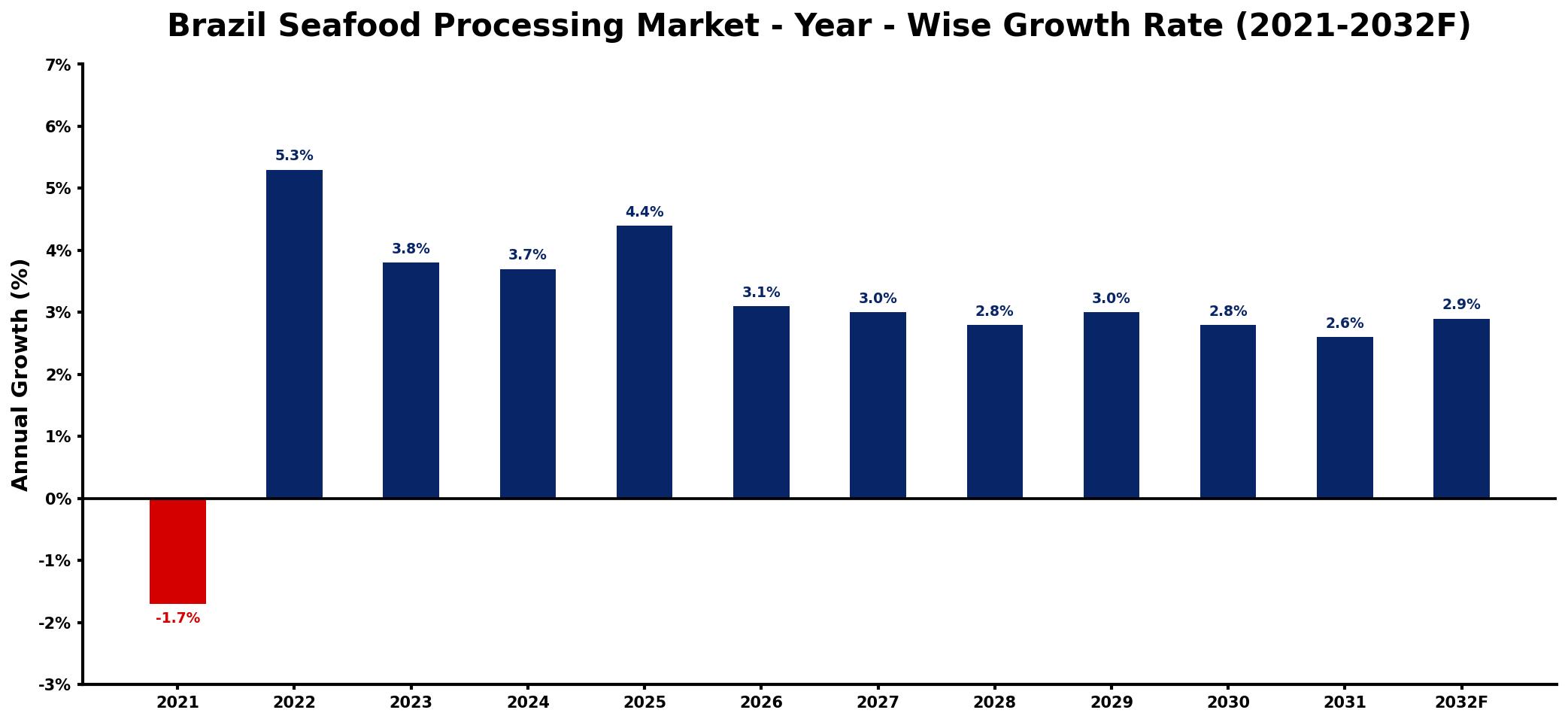
The table below presents the year‑wise growth rates along with the key drivers influencing the market
| Year | Growth Rate | Major Drivers |
| 2021 | -1.7% | Supply chain disruptions affecting operations |
| 2022 | 5.3% | Rising consumer health consciousness trends |
| 2023 | 3.8% | Increased demand for sustainable sourcing |
| 2024 | 3.7% | Growing export opportunities in markets |
| 2025 | 4.4% | Technological advancements enhancing efficiency |
| 2026 | 3.1% | Expansion of retail distribution channels |
| 2027 | 3.0% | growing downstream application demand |
| 2028 | 2.8% | Investment in cold chain logistics |
| 2029 | 3.0% | Emergence of plant-based alternatives popularity |
| 2030 | 2.8% | Growing interest in premium products |
| 2031 | 2.6% | Strengthening of local supply networks |
| 2032 | 2.9% | Focus on traceability and transparency |
Note: Market size estimations and growth projections presented in this report are based on 6Wresearch's proprietary forecasting methodology, utilizing the latest available industry data, government publications, and primary research inputs.
Brazil Seafood Processing Market Synopsis
Quality and safety regulations represent the strongest force currently shaping the Brazil Seafood Processing Market. As consumers become more discerning about food sourcing and safety, compliance with international standards has become a non-negotiable for processors. This is especially critical given Brazils global trade relationships and export aspirations, where reputation and adherence to best practices can significantly influence market dynamics.
Furthermore, the rise in consumer interest in specialty seafood products, such as smoked salmon, is also contributing to market expansion. Processors are focusing on product differentiation and unique branding strategies to appeal to niche markets. Educating consumers about the various attributes and culinary uses of processed seafood is essential to cultivating loyalty and driving sales.
Brazil Seafood Processing Market Key Takeaways
- The Brazil Seafood Processing Market is projected to grow steadily due to increasing consumer demand for processed seafood.
- Technological advancements are enhancing operational efficiency and product quality across the processing sector.
- Strict compliance with food safety regulations is crucial for maintaining market credibility and expanding into export markets.
- Emerging trends in sustainability and eco-friendly practices are influencing processing methods and consumer choices.
- Market players are focusing on branding and consumer education to capture niche market segments.
Evaluation of Restraints in Brazil Seafood Processing Market
The Brazil Seafood Processing Market faces notable restraints, chiefly the stringent quality control and safety standards mandated by both national and international regulatory bodies. Companies must allocate significant resources towards upgrading processing facilities and ensuring compliance, which can be a financial burden, particularly for smaller operators. Additionally, disruptions in the supply chain, whether due to environmental factors or global trade fluctuations, can compromise the availability of raw materials, further constraining operational capabilities.
Brazil Seafood Processing Market Trends
A key trend within the Brazil Seafood Processing Market is the growing demand for plant-based seafood alternatives. As flexitarian diets gain traction, processors are exploring innovative formulations that cater to both traditional seafood lovers and those looking for sustainable options. Moreover, advances in packaging technology that promote extended shelf life and enhance product freshness are becoming increasingly popular among processors.
Sustainability is another pivotal trend reshaping the market, with companies investing in eco-friendly practices and transparent sourcing. This shift aligns with consumers rising awareness and demand for responsibly sourced products, compelling businesses to adapt their practices to maintain a competitive edge.
Brazil Seafood Processing Market Opportunities
The Brazil Seafood Processing Market presents numerous growth opportunities, particularly in the premium product segment. With an increasing consumer focus on health and wellness, there is significant potential for processors to develop high-quality, value-added products that cater to this demographic. Additionally, tapping into export markets offers further avenues for growth, as Brazil's seafood products are well-positioned to meet global demand for quality and variety. Collaboration with local fisheries and sustainable practices can enhance product offerings while also contributing to local economies.
Government Initiatives in the Brazil Seafood Processing Market
The Brazilian government is actively involved in enhancing the seafood processing sector through various policies that focus on food safety standards and export regulations. Regulatory bodies monitor processing facilities to ensure compliance with hygiene and sanitation requirements, fostering a safer food supply chain. Additionally, support programs exist to assist seafood processors in navigating international market standards, thereby enhancing their competitiveness on a global scale.
Future Insights of the Brazil Seafood Processing Market
Looking forward to the period from 2026 to 2032, the Brazil Seafood Processing Market is expected to undergo significant transformation. As consumer preferences shift towards healthier and more sustainable options, businesses will need to adapt quickly to maintain relevance. The integration of advanced technologies, including automation and artificial intelligence, will likely streamline operations and enhance product quality. Additionally, ongoing government support and regulatory alignment will further pave the way for expanding export opportunities, making this an exciting period for stakeholders within the industry.
Brazil Seafood Processing Market Latest Developments (2025 - 2026)
Recent developments in the Brazil Seafood Processing Market indicate a growing commitment to sustainability and innovation. Companies are investing in advanced technologies to improve processing efficiency and reduce environmental impact. There is also an increasing emphasis on branding and marketing strategies that highlight the quality and sustainability of products. Partnerships among processors, local fisheries, and government entities are strengthening supply chains while enhancing compliance with international standards.
Brazil Seafood Processing Market - Key Attractiveness of the Report
- 10 Years of Market Numbers
- Historical Data Starting from 2022 to 2025
- Base Year: 2025
- Forecast Data until 2032
- Key Performance Indicators Impacting the Market
- Major Upcoming Developments and Projects
Key Highlights of the Report:
- Brazil Seafood Processing Market Outlook
- Market Size of Brazil Seafood Processing Market, 2025
- Forecast of Brazil Seafood Processing Market, 2032
- Historical Data and Forecast of Brazil Seafood Processing Revenues & Volume for the Period 2022-2032F
- Brazil Seafood Processing Market Trend Evolution
- Brazil Seafood Processing Market Drivers and Challenges
- Brazil Seafood Processing Price Trends
- Brazil Seafood Processing Porter's Five Forces
- Brazil Seafood Processing Industry Life Cycle
- Historical Data and Forecast of Brazil Seafood Processing Market Revenues & Volume By Equipment Type for the Period 2022-2032F
- Historical Data and Forecast of Brazil Seafood Processing Market Revenues & Volume By Gutting Equipment for the Period 2022-2032F
- Historical Data and Forecast of Brazil Seafood Processing Market Revenues & Volume By Sealing Equipment for the Period 2022-2032F
- Historical Data and Forecast of Brazil Seafood Processing Market Revenues & Volume By Filleting Equipment for the Period 2022-2032F
- Historical Data and Forecast of Brazil Seafood Processing Market Revenues & Volume By Deboning Equipment for the Period 2022-2032F
- Historical Data and Forecast of Brazil Seafood Processing Market Revenues & Volume By other Equipment for the Period 2022-2032F
- Historical Data and Forecast of Brazil Seafood Processing Market Revenues & Volume By Category for the Period 2022-2032F
- Historical Data and Forecast of Brazil Seafood Processing Market Revenues & Volume By Single-Function Equipment for the Period 2022-2032F
- Historical Data and Forecast of Brazil Seafood Processing Market Revenues & Volume By Multi-Function Equipment for the Period 2022-2032F
- Historical Data and Forecast of Brazil Seafood Processing Market Revenues & Volume By Seafood Type for the Period 2022-2032F
- Historical Data and Forecast of Brazil Seafood Processing Market Revenues & Volume By Fish for the Period 2022-2032F
- Historical Data and Forecast of Brazil Seafood Processing Market Revenues & Volume By Crustaceans for the Period 2022-2032F
- Historical Data and Forecast of Brazil Seafood Processing Market Revenues & Volume By Mollusks for the Period 2022-2032F
- Historical Data and Forecast of Brazil Seafood Processing Market Revenues & Volume By others for the Period 2022-2032F
- Brazil Seafood Processing Import Export Trade Statistics
- Market Opportunity Assessment By Equipment Type
- Market Opportunity Assessment By Category
- Market Opportunity Assessment By Seafood Type
- Brazil Seafood Processing Top Companies Market Share
- Brazil Seafood Processing Competitive Benchmarking By Technical and Operational Parameters
- Brazil Seafood Processing Company Profiles
- Brazil Seafood Processing Key Strategic Recommendations






































