Mexico Seafood Processing Market Size, Share & Growth Rate
The Mexico Seafood Processing Market was estimated at USD 218 Million in 2025 and is projected to reach USD 254 Million by 2032, growing at a CAGR of 2.2% from 2026 to 2032. This steady growth trajectory is fueled by an increasing consumer preference for convenient, healthy food options, as well as rising disposable incomes that allow consumers to explore higher-quality seafood products. Additionally, the influence of Western dietary habits is reshaping consumer choices, paving the way for innovative and value-added seafood products.
Mexico Seafood Processing Market Year-wise Growth Rate and Key Drivers
This graph highlights how the Mexico Seafood Processing Market has steadily grown over the years, supported by major growth factors.
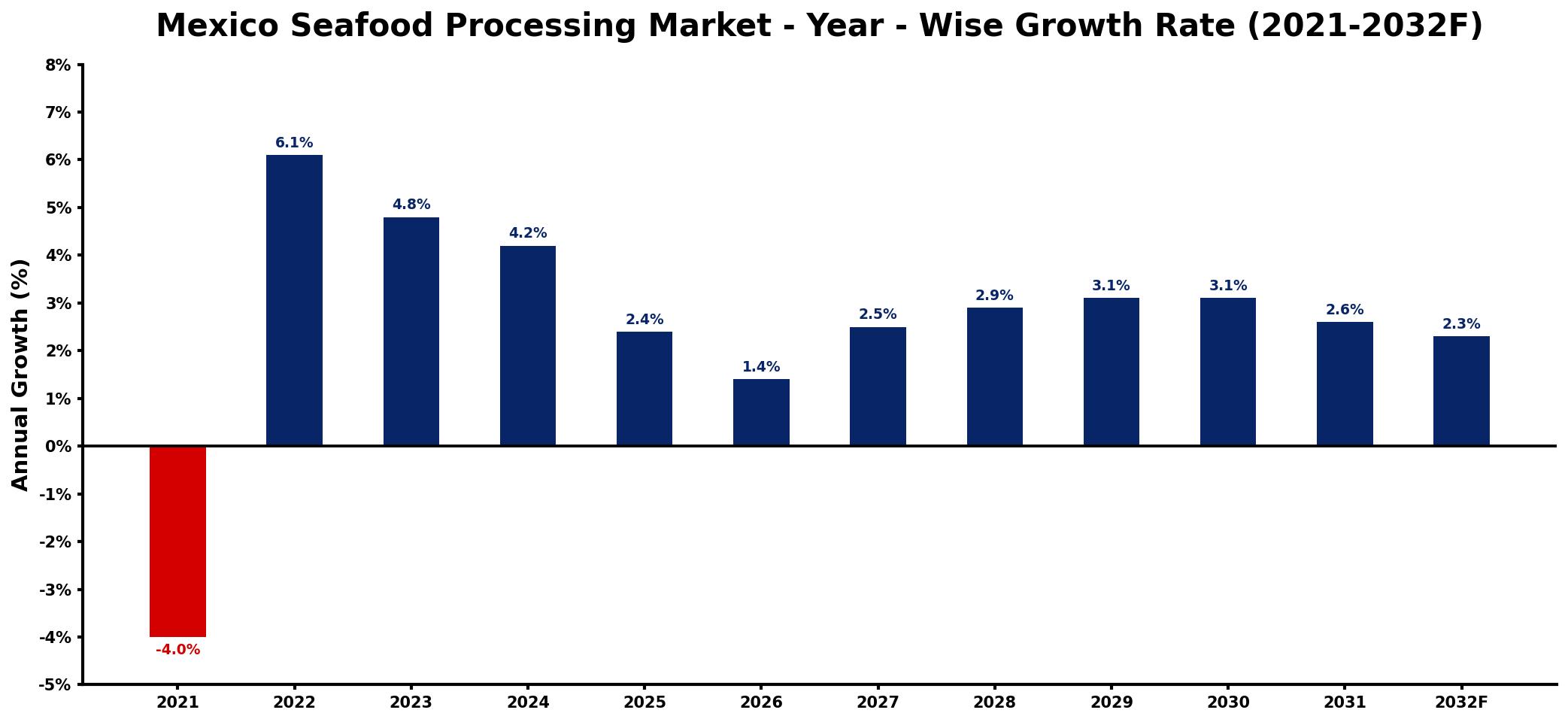
The table below presents the year‑wise growth rates along with the key drivers influencing the market
| Year | Growth Rate | Major Drivers |
| 2021 | -4.0% | decreased consumer demand for imports |
| 2022 | 6.1% | increased domestic consumption patterns |
| 2023 | 4.8% | expansion of export markets access |
| 2024 | 4.2% | growing investment in technology |
| 2025 | 2.4% | rising popularity of sustainable practices |
| 2026 | 1.4% | enhanced distribution network efficiency |
| 2027 | 2.5% | increased global trade partnerships |
| 2028 | 2.9% | growth in health-conscious consumers |
| 2029 | 3.1% | expanding manufacturing base activity |
| 2030 | 3.1% | increased focus on quality standards |
| 2031 | 2.6% | growing demand for convenience products |
| 2032 | 2.3% | strengthening international trade flows |
Note: Market size estimations and growth projections presented in this report are based on 6Wresearch's proprietary forecasting methodology, utilizing the latest available industry data, government publications, and primary research inputs.
Mexico Seafood Processing Market Synopsis
Currently, the Mexico Seafood Processing Market is experiencing a surge in demand for processed seafood products. The shift towards healthier eating habits, coupled with busy lifestyles, has prompted consumers to seek convenient and ready-to-eat seafood options. This dynamic is driving innovation within the industry, as companies strive to meet evolving consumer preferences.
Moreover, sustainability is at the forefront of consumer concerns, leading to a marked increase in responsibly sourced seafood. As a result, many processing firms are adopting certifications from reputable organizations, enhancing their market position and responding to consumer demands for transparency in sourcing and production practices.
Mexico Seafood Processing Market Key Takeaways
- The market is driven by rising disposable incomes and changing dietary preferences.
- Sustainability is becoming a core focus, with certifications boosting consumer trust.
- Technological advancements are enhancing processing efficiency and product quality.
- Government initiatives are supportive of sustainable seafood practices and industry growth.
- Value-added products are gaining traction, particularly among busy consumers seeking convenience.
Evaluation of Restraints in Mexico Seafood Processing Market
Despite the positive growth outlook, the Mexico Seafood Processing Market faces several substantial restraints. Stringent regulations and compliance requirements regarding food safety and sustainability add complexity and operational costs for processors. Additionally, fluctuating prices of raw materials can create challenges in maintaining competitive pricing, especially in the face of increasing competition from imported seafood products. Access to advanced technology remains limited in certain regions, particularly rural areas, hindering overall efficiency and quality control in processing facilities. The necessity for sustainable practices also means processors must continuously adapt to growing consumer expectations and regulatory pressures concerning environmental impact.
Mexico Seafood Processing Market Trends
The Mexico Seafood Processing Market is seeing several influential trends shaping its landscape. A significant movement towards sustainable sourcing is being observed, with consumers increasingly opting for seafood products that carry certifications such as MSC and ASC. The popularity of value-added seafood, including ready-to-eat meals and snacks, is on the rise, driven by modern consumers' busy lifestyles.
Technological advancements in seafood processing equipment are enhancing the overall efficiency, quality, and safety of products, aligning with consumer demands for transparency and traceability. These trends are shaping the strategies of companies in the market as they navigate a competitive landscape while prioritizing innovation and sustainability.
Mexico Seafood Processing Market Opportunities
Investment opportunities in the Mexico Seafood Processing Market are robust, propelled by the countrys vast marine resources and increasing domestic and international demand for seafood. With access to a diverse array of fish and shellfish species along its extensive coastline, Mexico holds a strategic advantage for seafood processing operations. Modernizing processing facilities, focusing on sustainable practices, and broadening product lines to cater to evolving consumer preferences can unlock considerable potential for growth.
Additionally, capitalizing on Mexico's favorable trade agreements can enhance market competitiveness, making it an attractive region for investment in seafood processing. This proactive approach not only positions companies for future profitability but also allows them to contribute positively to the local economy and sustainability initiatives.
Government Initiatives in the Mexico Seafood Processing Market
The Mexican government has undertaken various initiatives to bolster the seafood processing market. These include regulations to promote sustainable fishing practices, financial incentives for processors who adhere to food safety standards, and support programs to enhance the technological capabilities of seafood processing facilities. Furthermore, trade agreements facilitated by the government aim to strengthen export opportunities for Mexican seafood, ensuring that local processors can remain competitive on the global stage. Such initiatives are crucial for fostering industry growth and safeguarding marine resources.
Future Insights of the Mexico Seafood Processing Market
Looking ahead to 2026-2032, the Mexico Seafood Processing Market is set for consistent growth, driven by the continuing demand for healthy and sustainably sourced seafood products. As consumer interest in transparency and traceability intensifies, the industry will need to adopt rigorous quality control measures and sustainable sourcing practices. Additionally, advancements in technology will play a critical role in enhancing operational efficiency and product quality. Overall, the market is well-positioned to capitalize on these trends, ensuring its growth trajectory remains robust in the coming years.
Mexico Seafood Processing Market Latest Developments (2025 - 2026)
Recent developments in the Mexico Seafood Processing Market indicate a strong move towards sustainability and innovation. Companies are increasingly focusing on integrating advanced technology to streamline processing operations, improve safety standards, and enhance product quality. Meanwhile, consumer demand for transparency in sourcing practices is prompting more firms to pursue eco-certifications, thereby gaining a competitive edge. Additionally, industry collaborations aimed at tackling overfishing and environmental impacts are becoming more prevalent, highlighting a collective commitment to sustainable seafood practices.
Mexico Seafood Processing Market - Key Attractiveness of the Report
- 10 Years of Market Numbers
- Historical Data Starting from 2022 to 2025
- Base Year: 2025
- Forecast Data until 2032
- Key Performance Indicators Impacting the Market
- Major Upcoming Developments and Projects
Key Highlights of the Report:
- Mexico Seafood Processing Market Outlook
- Market Size of Mexico Seafood Processing Market, 2025
- Forecast of Mexico Seafood Processing Market, 2032
- Historical Data and Forecast of Mexico Seafood Processing Revenues & Volume for the Period 2022-2032F
- Mexico Seafood Processing Market Trend Evolution
- Mexico Seafood Processing Market Drivers and Challenges
- Mexico Seafood Processing Price Trends
- Mexico Seafood Processing Porter's Five Forces
- Mexico Seafood Processing Industry Life Cycle
- Historical Data and Forecast of Mexico Seafood Processing Market Revenues & Volume By Equipment Type for the Period 2022-2032F
- Historical Data and Forecast of Mexico Seafood Processing Market Revenues & Volume By Gutting Equipment for the Period 2022-2032F
- Historical Data and Forecast of Mexico Seafood Processing Market Revenues & Volume By Sealing Equipment for the Period 2022-2032F
- Historical Data and Forecast of Mexico Seafood Processing Market Revenues & Volume By Filleting Equipment for the Period 2022-2032F
- Historical Data and Forecast of Mexico Seafood Processing Market Revenues & Volume By Deboning Equipment for the Period 2022-2032F
- Historical Data and Forecast of Mexico Seafood Processing Market Revenues & Volume By other Equipment for the Period 2022-2032F
- Historical Data and Forecast of Mexico Seafood Processing Market Revenues & Volume By Category for the Period 2022-2032F
- Historical Data and Forecast of Mexico Seafood Processing Market Revenues & Volume By Single-Function Equipment for the Period 2022-2032F
- Historical Data and Forecast of Mexico Seafood Processing Market Revenues & Volume By Multi-Function Equipment for the Period 2022-2032F
- Historical Data and Forecast of Mexico Seafood Processing Market Revenues & Volume By Seafood Type for the Period 2022-2032F
- Historical Data and Forecast of Mexico Seafood Processing Market Revenues & Volume By Fish for the Period 2022-2032F
- Historical Data and Forecast of Mexico Seafood Processing Market Revenues & Volume By Crustaceans for the Period 2022-2032F
- Historical Data and Forecast of Mexico Seafood Processing Market Revenues & Volume By Mollusks for the Period 2022-2032F
- Historical Data and Forecast of Mexico Seafood Processing Market Revenues & Volume By others for the Period 2022-2032F
- Mexico Seafood Processing Import Export Trade Statistics
- Market Opportunity Assessment By Equipment Type
- Market Opportunity Assessment By Category
- Market Opportunity Assessment By Seafood Type
- Mexico Seafood Processing Top Companies Market Share
- Mexico Seafood Processing Competitive Benchmarking By Technical and Operational Parameters
- Mexico Seafood Processing Company Profiles
- Mexico Seafood Processing Key Strategic Recommendations






































