France Seafood Processing Market Size, Share & Growth Rate
The France Seafood Processing Market was estimated at USD 142 Million in 2025 and is projected to reach USD 158 Million by 2032, growing at a CAGR of 1.5% from 2026 to 2032. This growth trajectory is primarily fueled by increasing consumer demand for convenient and healthy seafood options. Moreover, advancements in processing technologies and a heightened focus on sustainability are positioning the industry for significant expansion in the coming years.
France Seafood Processing Market Year-wise Growth Rate and Key Drivers
This graph highlights how the France Seafood Processing Market has steadily grown over the years, supported by major growth factors.
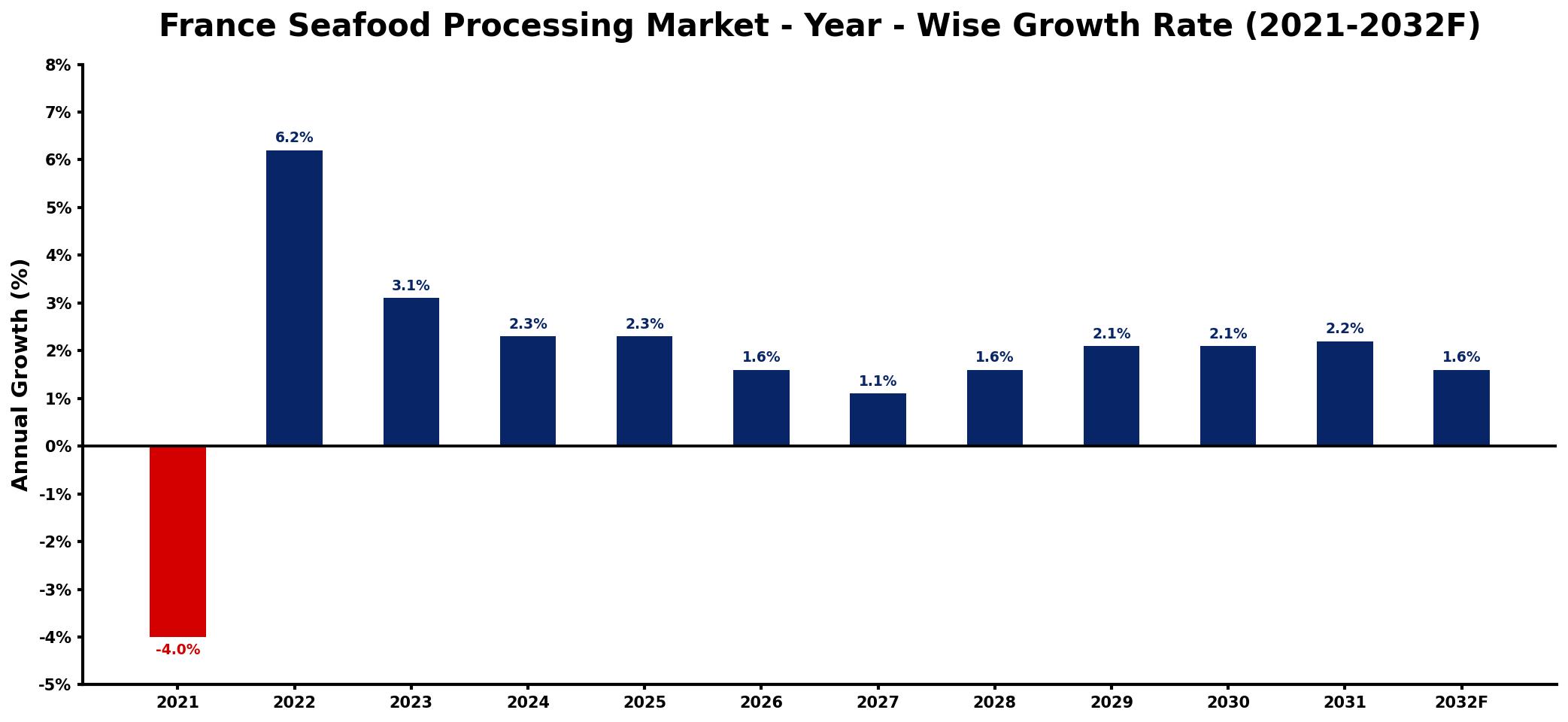
The table below presents the year‑wise growth rates along with the key drivers influencing the market
| Year | Growth Rate | Major Drivers |
| 2021 | -4.0% | global supply chain disruptions impact |
| 2022 | 6.2% | increased consumer health consciousness rise |
| 2023 | 3.1% | sustainability initiatives driving investments |
| 2024 | 2.3% | expansion of export markets opportunities |
| 2025 | 2.3% | technological advancements enhancing efficiency |
| 2026 | 1.6% | growing demand for premium products |
| 2027 | 1.1% | increased restaurant and hospitality recovery |
| 2028 | 1.6% | rising popularity of alternative proteins |
| 2029 | 2.1% | innovation in packaging solutions adoption |
| 2030 | 2.1% | enhanced distribution networks development |
| 2031 | 2.2% | government support for industry growth |
| 2032 | 1.6% | global culinary trends influencing preferences |
Note: Market size estimations and growth projections presented in this report are based on 6Wresearch's proprietary forecasting methodology, utilizing the latest available industry data, government publications, and primary research inputs.
France Seafood Processing Market Synopsis
Sustainability is the strongest force currently shaping the France Seafood Processing Market. As consumers become more environmentally conscious, they increasingly demand seafood that is sustainably sourced, prompting industry stakeholders to adopt eco-friendly practices.
Additionally, France's rich culinary heritage and evolving consumer preferences for ready-to-eat and convenience seafood products are driving innovation within the sector. This blend of tradition and modernity not only enhances product offerings but also ensures the market remains competitive on a global scale.
France Seafood Processing Market Key Takeaways
- The market is driven by increasing consumer demand for health-focused and sustainable seafood products.
- Technological advancements in processing methods are enhancing efficiency and product quality.
- Rising competition from imported seafood is challenging domestic processors to innovate.
- Government regulations ensure quality and sustainability, affecting operational practices across the industry.
- Investment opportunities are present in expanding processing capacities and diversifying product offerings.
Evaluation of Restraints in France Seafood Processing Market
Despite the positive outlook, the France Seafood Processing Market faces significant restraints that could hinder growth. Stringent regulations regarding food safety and traceability impose operational burdens on processing companies. Furthermore, rising competition from imported seafood may threaten local producers, particularly as fluctuating raw material prices and increasing operational costs challenge profitability. Issues related to maintaining a skilled workforce and adapting to rapid technological advancements further complicate the landscape. Navigating these challenges requires strategic foresight and commitment to innovation.
France Seafood Processing Market Trends
The market is currently characterized by a strong trend toward sustainable seafood sourcing, with certifications like MSC gaining importance among consumers. Additionally, convenience is a driving force, prompting an increase in ready-to-eat and frozen seafood products. Health and wellness trends further influence consumer preferences, emphasizing the benefits of omega-3 fatty acids and nutritional value. Innovations in packaging and processing techniques are also emerging to enhance shelf life and meet consumer demands for convenience.
France Seafood Processing Market Opportunities
Investment opportunities within the France Seafood Processing Market are abundant, particularly in the realm of sustainable seafood processing methods. As consumer awareness around environmental issues grows, companies can capitalize on developing innovative practices. The adoption of advanced technology and automation provides avenues for enhancing operational efficiencies. Furthermore, the potential to diversify product offerings and expand distribution channels positions investors to meet growing domestic and export demands for high-quality seafood.
Government Initiatives in the France Seafood Processing Market
The regulatory framework surrounding the France Seafood Processing Market is guided by various government policies aimed at ensuring food safety and promoting sustainability. The European Union's Common Fisheries Policy establishes guidelines for managing fish stocks, while the Ministry of Agriculture and Food in France oversees standards and inspections for seafood processing. Compliance with labeling, traceability, and environmental sustainability regulations is crucial for operators in this market. These government initiatives play a vital role in maintaining a responsible seafood processing sector that prioritizes both consumer health and environmental preservation.
Future Insights of the France Seafood Processing Market
Looking ahead to 2026-2032, the France Seafood Processing Market is anticipated to continue its upward trajectory. Factors such as rising consumer demand for healthy options and a strong emphasis on sustainability will drive growth. Companies are expected to invest in product innovation and quality assurance, ensuring they meet evolving consumer preferences. The trend towards convenience, particularly with ready-to-eat products, will likely gain momentum, presenting ample opportunities for growth. While challenges such as regulatory pressures and competition from alternative proteins remain, the overall future of the market looks promising.
France Seafood Processing Market Latest Developments (2025 - 2026)
Recent developments in the France Seafood Processing Market indicate a strong focus on sustainable practices and product innovation. Companies are increasingly adopting eco-friendly processing techniques and exploring collaborations to enhance traceability. Additionally, advancements in technology are being embraced to streamline operations and improve product quality. The market is also witnessing a surge in consumer interest in locally sourced seafood, leading processors to adapt their supply chains to meet this demand. Overall, these trends are setting the stage for a dynamic period ahead.
France Seafood Processing Market - Key Attractiveness of the Report
- 10 Years of Market Numbers
- Historical Data Starting from 2022 to 2025
- Base Year: 2025
- Forecast Data until 2032
- Key Performance Indicators Impacting the Market
- Major Upcoming Developments and Projects
Key Highlights of the Report:
- France Seafood Processing Market Outlook
- Market Size of France Seafood Processing Market, 2025
- Forecast of France Seafood Processing Market, 2032
- Historical Data and Forecast of France Seafood Processing Revenues & Volume for the Period 2022-2032F
- France Seafood Processing Market Trend Evolution
- France Seafood Processing Market Drivers and Challenges
- France Seafood Processing Price Trends
- France Seafood Processing Porter's Five Forces
- France Seafood Processing Industry Life Cycle
- Historical Data and Forecast of France Seafood Processing Market Revenues & Volume By Equipment Type for the Period 2022-2032F
- Historical Data and Forecast of France Seafood Processing Market Revenues & Volume By Gutting Equipment for the Period 2022-2032F
- Historical Data and Forecast of France Seafood Processing Market Revenues & Volume By Sealing Equipment for the Period 2022-2032F
- Historical Data and Forecast of France Seafood Processing Market Revenues & Volume By Filleting Equipment for the Period 2022-2032F
- Historical Data and Forecast of France Seafood Processing Market Revenues & Volume By Deboning Equipment for the Period 2022-2032F
- Historical Data and Forecast of France Seafood Processing Market Revenues & Volume By other Equipment for the Period 2022-2032F
- Historical Data and Forecast of France Seafood Processing Market Revenues & Volume By Category for the Period 2022-2032F
- Historical Data and Forecast of France Seafood Processing Market Revenues & Volume By Single-Function Equipment for the Period 2022-2032F
- Historical Data and Forecast of France Seafood Processing Market Revenues & Volume By Multi-Function Equipment for the Period 2022-2032F
- Historical Data and Forecast of France Seafood Processing Market Revenues & Volume By Seafood Type for the Period 2022-2032F
- Historical Data and Forecast of France Seafood Processing Market Revenues & Volume By Fish for the Period 2022-2032F
- Historical Data and Forecast of France Seafood Processing Market Revenues & Volume By Crustaceans for the Period 2022-2032F
- Historical Data and Forecast of France Seafood Processing Market Revenues & Volume By Mollusks for the Period 2022-2032F
- Historical Data and Forecast of France Seafood Processing Market Revenues & Volume By others for the Period 2022-2032F
- France Seafood Processing Import Export Trade Statistics
- Market Opportunity Assessment By Equipment Type
- Market Opportunity Assessment By Category
- Market Opportunity Assessment By Seafood Type
- France Seafood Processing Top Companies Market Share
- France Seafood Processing Competitive Benchmarking By Technical and Operational Parameters
- France Seafood Processing Company Profiles
- France Seafood Processing Key Strategic Recommendations






































