Colombia Seafood Processing Market Size, Share & Growth Rate
The Colombia Seafood Processing Market was estimated at USD 448 Million in 2025 and is projected to reach USD 616 Million by 2032, growing at a CAGR of 4.7% from 2026 to 2032. This growth is fueled by an increasing appetite for seafood products among consumers and rising export opportunities, particularly to major markets in the United States and Europe. Coupled with advancements in processing technologies and a heightened focus on sustainable practices, the market is poised for significant expansion.
Colombia Seafood Processing Market Year-wise Growth Rate and Key Drivers
This graph highlights how the Colombia Seafood Processing Market has steadily grown over the years, supported by major growth factors.
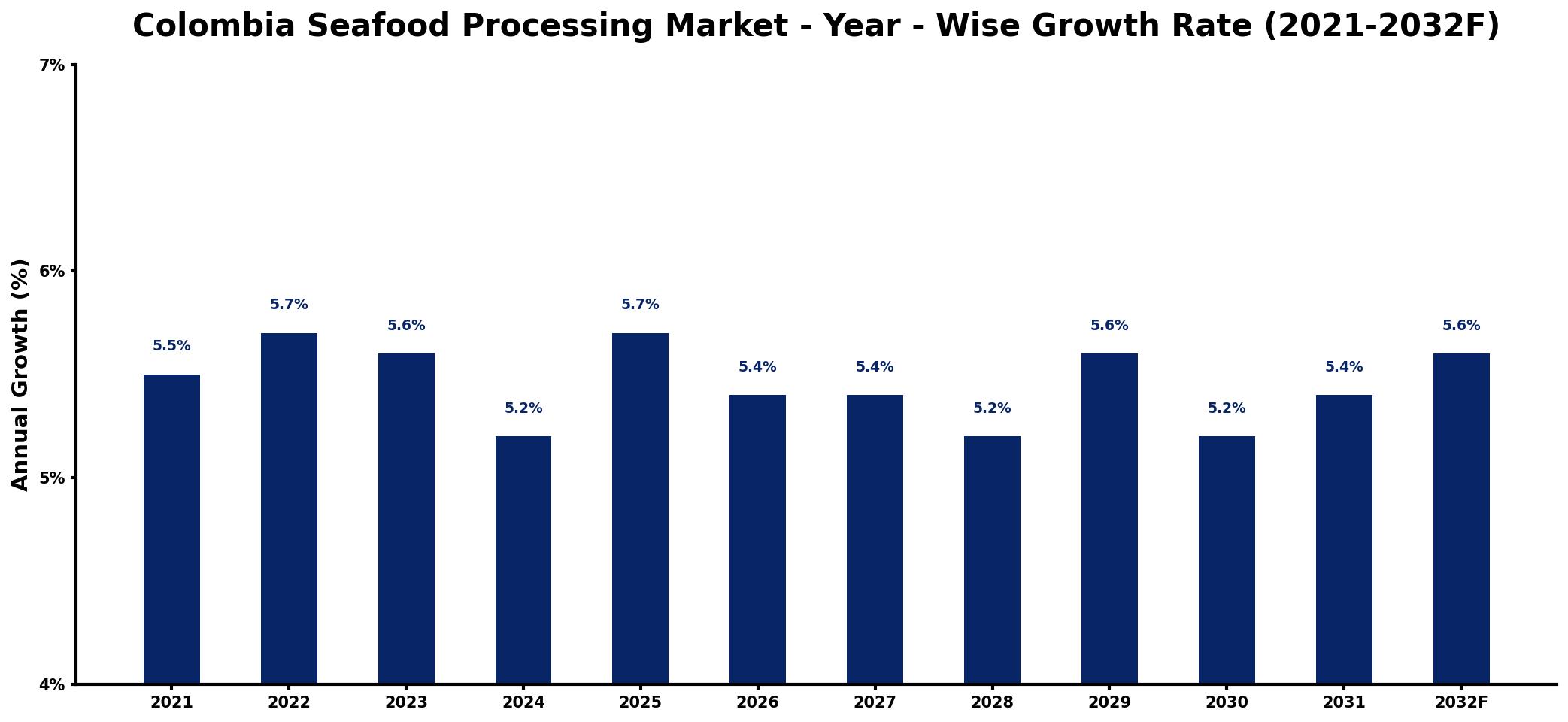
The table below presents the year‑wise growth rates along with the key drivers influencing the market
| Year | Growth Rate | Major Drivers |
| 2021 | 5.5% | Increased export market opportunities |
| 2022 | 5.7% | Rising consumer health awareness |
| 2023 | 5.6% | Technological advancements in logistics |
| 2024 | 5.2% | Growing demand for sustainable practices |
| 2025 | 5.7% | Expansion of international trade agreements |
| 2026 | 5.4% | Surge in local restaurant openings |
| 2027 | 5.4% | Increase in domestic consumption trends |
| 2028 | 5.2% | Emergence of new culinary innovations |
| 2029 | 5.6% | Investment in infrastructure development |
| 2030 | 5.2% | Strengthening of supply chain networks |
| 2031 | 5.4% | Enhanced regulatory support initiatives |
| 2032 | 5.6% | Focus on premium product offerings |
Note: Market size estimations and growth projections presented in this report are based on 6Wresearch's proprietary forecasting methodology, utilizing the latest available industry data, government publications, and primary research inputs.
Colombia Seafood Processing Market Synopsis
The Colombia seafood processing market has gained momentum in recent years, driven by a combination of rich marine resources and favorable trade conditions. However, as consumer preferences shift toward sustainably sourced products, the market is evolving to meet these demands. The increasing focus on quality assurance and environmental impact is reshaping industry standards and practices.
Looking ahead, the market is on a trajectory that prioritizes innovation and sustainability. As processors modernize their operations and adopt advanced technologies, they are enhancing both efficiency and product quality. The interplay between domestic consumption and export potential will further define the future landscape of the Colombia seafood processing market.
Colombia Seafood Processing Market Key Takeaways
- Strong growth projected, reaching USD 616 Million by 2032, supported by rising consumer demand.
- Increasing focus on sustainable seafood practices is reshaping market dynamics.
- Technological advancements are enhancing processing efficiency and product quality.
- Major export markets include the United States and various European nations.
- Government policies are aimed at promoting sustainability and improving industry standards.
Evaluation of Restraints in Colombia Seafood Processing Market
The Colombia seafood processing market faces several constraints that can impede its growth trajectory. Challenges related to sustainability and the potential overfishing of marine resources are of particular concern. Additionally, fluctuating prices for seafood and intense competition from imported products can create pressure on local processors. Ensuring compliance with stringent regulations and maintaining high quality standards adds further complexity. Addressing these issues will require strategic investments in technology, innovation, and sustainable practices.
Colombia Seafood Processing Market Trends
A significant trend emerging within the Colombia seafood processing market is the increasing demand for traceable and sustainably sourced seafood products. As consumers become more environmentally conscious, certifications like MSC and ASC are gaining traction. Furthermore, the rise of value-added seafood products, such as ready-to-eat meals and pre-marinated options, is catering to changing consumer lifestyles. Innovations in processing methods continue to enhance operational efficiency, further aligning with consumer preferences.
Colombia Seafood Processing Market Opportunities
The Colombia seafood processing market is ripe with investment opportunities due to the countrys rich marine biodiversity and strategic geographic position. With increasing global demand for high-quality seafood, there is substantial potential for growth. Opportunities lie in developing modern processing facilities and leveraging technology to meet both local and export demands. Additionally, the push toward sustainable fishing practices opens new avenues for products that resonate with environmentally conscious consumers.
Government Initiatives in the Colombia Seafood Processing Market
The Colombian government has established several initiatives to enhance the seafood processing market. These efforts focus on promoting sustainable fishing practices, ensuring food safety, and improving overall quality standards in the industry. Various programs aim to support local seafood processors through incentives and subsidies, fostering a competitive environment. Additionally, regulations are in place to protect marine biodiversity and monitor fishing activities, aiming to mitigate overfishing and illegal practices.
Future Insights of the Colombia Seafood Processing Market
The outlook for the Colombia seafood processing market from 2026 to 2032 appears robust, with significant opportunities driven by global demand for high-quality, sustainably sourced seafood. Technological advancements are expected to revolutionize processing techniques, enhancing efficiency and product integrity. As consumer preferences continue to lean towards health-conscious options rich in omega-3 fatty acids, the demand for processed seafood products is anticipated to increase. The market is well-positioned for steady growth, encouraging innovation and diversification.
Colombia Seafood Processing Market Latest Developments (2025 - 2026)
In recent months, the Colombia seafood processing market has been evolving to meet the increasing global demand for sustainably sourced products. Several industry stakeholders are making significant investments in upgrading their facilities to comply with higher environmental and quality standards. Moreover, initiatives aimed at improving supply chain transparency and product traceability are gaining momentum, aligning with consumer expectations. These developments signify a positive shift towards greater sustainability and product innovation in the sector.
Colombia Seafood Processing Market - Key Attractiveness of the Report
- 10 Years of Market Numbers
- Historical Data Starting from 2022 to 2025
- Base Year: 2025
- Forecast Data until 2032
- Key Performance Indicators Impacting the Market
- Major Upcoming Developments and Projects
Key Highlights of the Report:
- Colombia Seafood Processing Market Outlook
- Market Size of Colombia Seafood Processing Market, 2025
- Forecast of Colombia Seafood Processing Market, 2032
- Historical Data and Forecast of Colombia Seafood Processing Revenues & Volume for the Period 2022-2032F
- Colombia Seafood Processing Market Trend Evolution
- Colombia Seafood Processing Market Drivers and Challenges
- Colombia Seafood Processing Price Trends
- Colombia Seafood Processing Porter's Five Forces
- Colombia Seafood Processing Industry Life Cycle
- Historical Data and Forecast of Colombia Seafood Processing Market Revenues & Volume By Equipment Type for the Period 2022-2032F
- Historical Data and Forecast of Colombia Seafood Processing Market Revenues & Volume By Gutting Equipment for the Period 2022-2032F
- Historical Data and Forecast of Colombia Seafood Processing Market Revenues & Volume By Sealing Equipment for the Period 2022-2032F
- Historical Data and Forecast of Colombia Seafood Processing Market Revenues & Volume By Filleting Equipment for the Period 2022-2032F
- Historical Data and Forecast of Colombia Seafood Processing Market Revenues & Volume By Deboning Equipment for the Period 2022-2032F
- Historical Data and Forecast of Colombia Seafood Processing Market Revenues & Volume By other Equipment for the Period 2022-2032F
- Historical Data and Forecast of Colombia Seafood Processing Market Revenues & Volume By Category for the Period 2022-2032F
- Historical Data and Forecast of Colombia Seafood Processing Market Revenues & Volume By Single-Function Equipment for the Period 2022-2032F
- Historical Data and Forecast of Colombia Seafood Processing Market Revenues & Volume By Multi-Function Equipment for the Period 2022-2032F
- Historical Data and Forecast of Colombia Seafood Processing Market Revenues & Volume By Seafood Type for the Period 2022-2032F
- Historical Data and Forecast of Colombia Seafood Processing Market Revenues & Volume By Fish for the Period 2022-2032F
- Historical Data and Forecast of Colombia Seafood Processing Market Revenues & Volume By Crustaceans for the Period 2022-2032F
- Historical Data and Forecast of Colombia Seafood Processing Market Revenues & Volume By Mollusks for the Period 2022-2032F
- Historical Data and Forecast of Colombia Seafood Processing Market Revenues & Volume By others for the Period 2022-2032F
- Colombia Seafood Processing Import Export Trade Statistics
- Market Opportunity Assessment By Equipment Type
- Market Opportunity Assessment By Category
- Market Opportunity Assessment By Seafood Type
- Colombia Seafood Processing Top Companies Market Share
- Colombia Seafood Processing Competitive Benchmarking By Technical and Operational Parameters
- Colombia Seafood Processing Company Profiles
- Colombia Seafood Processing Key Strategic Recommendations






































