Brazil Trolley Market Size, Share & Growth Rate
The Brazil Trolley Market was estimated at USD 102 Million in 2025 and is projected to reach USD 120 Million by 2032, growing at a CAGR of 2.3% from 2026 to 2032. This growth trajectory is primarily driven by the increasing demand for urban mobility solutions, as cities seek efficient and environmentally friendly public transportation options. Moreover, the expansion of e-commerce and retail logistics further fuels the need for lightweight, versatile trolleys across various industries.
Brazil Trolley Market Year-wise Growth Rate and Key Drivers
This graph highlights how the Brazil Trolley Market has steadily grown over the years, supported by major growth factors.
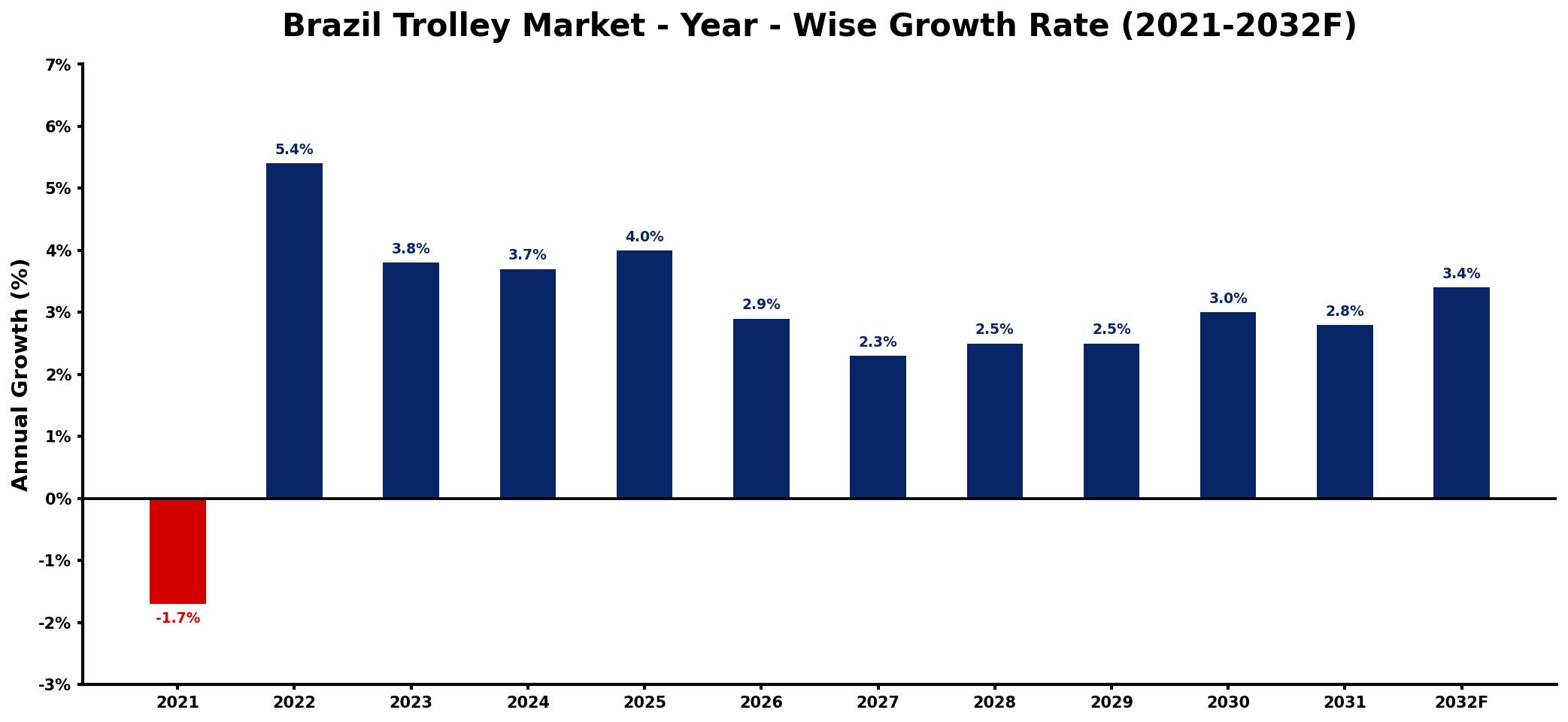
The table below presents the year‑wise growth rates along with the key drivers influencing the market
| Year | Growth Rate | Major Drivers |
| 2021 | -1.7% | decreased consumer spending on transportation |
| 2022 | 5.4% | increased investments in logistics infrastructure |
| 2023 | 3.8% | growing e-commerce delivery requirements |
| 2024 | 3.7% | increased overall sector activity |
| 2025 | 4.0% | expansion of retail distribution networks |
| 2026 | 2.9% | increased focus on sustainability initiatives |
| 2027 | 2.3% | increased production capacity utilization |
| 2028 | 2.5% | enhanced technological innovations in transportation |
| 2029 | 2.5% | growing automotive sector requirements |
| 2030 | 3.0% | increased urban population density growth |
| 2031 | 2.8% | rising procurement volume requirements |
| 2032 | 3.4% | expanding manufacturing base activity |
Note: Market size estimations and growth projections presented in this report are based on 6Wresearch's proprietary forecasting methodology, utilizing the latest available industry data, government publications, and primary research inputs.
Brazil Trolley Market Synopsis
The Brazil trolley market is witnessing a significant evolution, characterized by a shift towards electric mobility solutions. Trolleys, particularly trolleybuses, are emerging as a viable option in the urban transportation landscape, offering cleaner transit alternatives that align with sustainability goals. Cities are increasingly prioritizing efficient public transport systems, and trolleys play a crucial role in this transformation.
In the retail and logistics sectors, demand for trolleys has surged due to heightened e-commerce activity and urbanization. Trolleys are not only essential for transporting goods within warehouses and supermarkets but also serve as ergonomic tools that enhance operational efficiency. As these sectors expand, the trolley market is set to capitalize on the need for innovative handling solutions.
Brazil Trolley Market Key Takeaways
- The market is driven by urbanization trends and a shift towards sustainable transport solutions.
- Retail logistics demand is propelling the growth of lightweight and maneuverable trolley systems.
- Government regulations play a pivotal role in shaping trolley design and operational standards.
- Challenges include market saturation and the need for continuous product innovation.
- Opportunities for growth lie in customization and enhancements in trolley durability and efficiency.
Evaluation of Restraints in Brazil Trolley Market
The Brazil trolley market faces significant restraints that may hinder its growth. Fluctuations in retail and logistics activities can lead to uncertainties in demand, affecting manufacturers' production strategies. Additionally, stringent regulatory compliance requirements related to safety and environmental standards often complicate market entry for new players. Moreover, the rapid pace of technological advancements necessitates continuous innovation in trolley design and functionality, which can be resource-intensive. Competition from alternative material handling solutions further intensifies these challenges, making it crucial for companies to adopt effective strategies to maintain their market presence.
Brazil Trolley Market Trends
Several key trends are shaping the Brazil trolley market. Firstly, there is a growing emphasis on sustainable designs, with an increasing number of trolleys being developed to utilize renewable energy sources. Secondly, the integration of smart technology in trolleys is on the rise, offering features that enhance user experience, such as GPS tracking and load optimization. Lastly, the trend towards customization is gaining momentum, as businesses seek tailored solutions to meet their specific operational needs.
Brazil Trolley Market Opportunities
The Brazil trolley market presents numerous growth opportunities, particularly in sectors where efficient logistics are critical. Investment in smart trolley technologies could revolutionize operations in warehouses and retail spaces, significantly enhancing productivity. Additionally, as Brazilian cities prioritize modernization and sustainability in public transport, the development of eco-friendly trolley solutions could align well with government initiatives, providing a compelling avenue for market players to expand their offerings.
Government Initiatives in the Brazil Trolley Market
Government policies significantly influence the Brazil trolley market, particularly through regulations that promote urban transportation sustainability and consumer safety. There are ongoing initiatives aimed at enhancing public transit infrastructure, including investments in clean energy solutions for trolley systems. Additionally, regulations concerning emissions standards and safety features ensure that new trolley designs meet stringent environmental guidelines, further supporting the market's shift toward eco-friendly transportation options.
Future Insights of the Brazil Trolley Market
Looking ahead to 2026-2032, the Brazil trolley market is poised for gradual yet steady growth, fueled by ongoing urbanization and a commitment to cleaner public transport solutions. As cities expand and transit needs evolve, the market will likely see an increasing adoption of electric trolley systems and smart technologies. Additionally, with a focus on enhancing customer experiences through innovation and customization, the market is expected to align closely with broader trends in sustainability and efficiency.
Brazil Trolley Market Latest Developments (2025 - 2026)
In the period from & to June 2026, the Brazil trolley market has experienced noteworthy developments with a strong emphasis on technological advancements and sustainability. Companies have begun to unveil new trolley designs incorporating eco-friendly materials and smart features to enhance usability. Furthermore, several urban transit projects have been initiated, showcasing the government's commitment to modernizing public transportation systems and increasing the accessibility of trolley services across major cities.
Brazil Trolley Market - Key Attractiveness of the Report
- 10 Years of Market Numbers
- Historical Data Starting from 2022 to 2025
- Base Year: 2025
- Forecast Data until 2032
- Key Performance Indicators Impacting the Market
- Major Upcoming Developments and Projects
Key Highlights of the Report:
- Brazil Trolley Market Outlook
- Market Size of Brazil Trolley Market, 2025
- Forecast of Brazil Trolley Market, 2032
- Historical Data and Forecast of Brazil Trolley Revenues & Volume for the Period 2022-2032F
- Brazil Trolley Market Trend Evolution
- Brazil Trolley Market Drivers and Challenges
- Brazil Trolley Price Trends
- Brazil Trolley Porter's Five Forces
- Brazil Trolley Industry Life Cycle
- Historical Data and Forecast of Brazil Trolley Market Revenues & Volume By Product for the Period 2022-2032F
- Historical Data and Forecast of Brazil Trolley Market Revenues & Volume By Manual for the Period 2022-2032F
- Historical Data and Forecast of Brazil Trolley Market Revenues & Volume By Electric for the Period 2022-2032F
- Historical Data and Forecast of Brazil Trolley Market Revenues & Volume By Application for the Period 2022-2032F
- Historical Data and Forecast of Brazil Trolley Market Revenues & Volume By Commercial for the Period 2022-2032F
- Historical Data and Forecast of Brazil Trolley Market Revenues & Volume By Non-commercial for the Period 2022-2032F
- Historical Data and Forecast of Brazil Trolley Market Revenues & Volume By Distribution for the Period 2022-2032F
- Historical Data and Forecast of Brazil Trolley Market Revenues & Volume By Offline for the Period 2022-2032F
- Historical Data and Forecast of Brazil Trolley Market Revenues & Volume By Online for the Period 2022-2032F
- Brazil Trolley Import Export Trade Statistics
- Market Opportunity Assessment By Product
- Market Opportunity Assessment By Application
- Market Opportunity Assessment By Distribution
- Brazil Trolley Top Companies Market Share
- Brazil Trolley Competitive Benchmarking By Technical and Operational Parameters
- Brazil Trolley Company Profiles
- Brazil Trolley Key Strategic Recommendations






































