Peru Trolley Market Size, Share & Growth Rate
The Peru Trolley Market was estimated at USD 396 Million in 2025 and is projected to reach USD 559 Million by 2032, growing at a CAGR of 5.0% from 2026 to 2032. This growth trajectory is being propelled by urbanization, an increase in disposable income among consumers, and a burgeoning tourism sector that enhances the demand for convenient transportation solutions. As cities expand and the population becomes more mobile, the reliance on trolleys—particularly in crowded urban settings—will only intensify.
Peru Trolley Market Year-wise Growth Rate and Key Drivers
This graph highlights how the Peru Trolley Market has steadily grown over the years, supported by major growth factors.
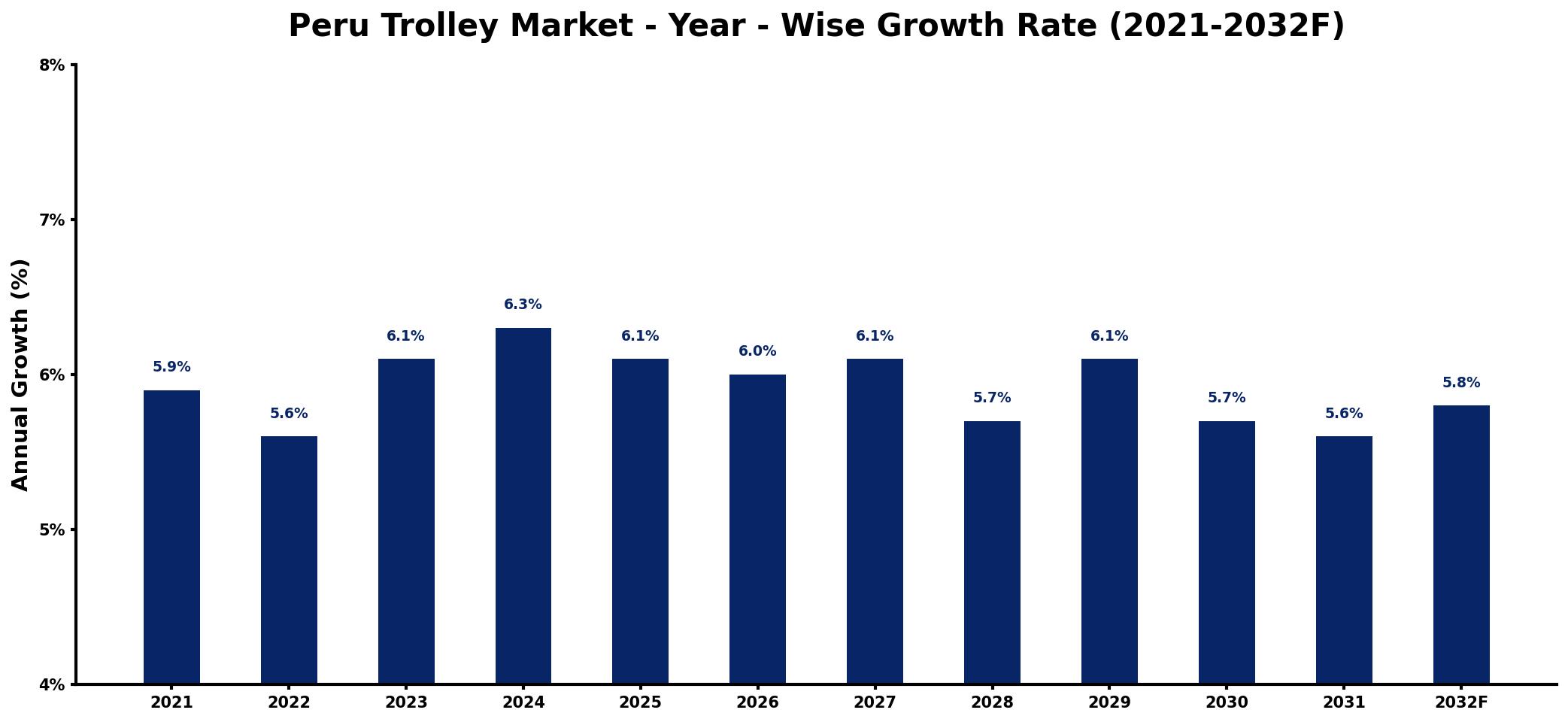
The table below presents the year‑wise growth rates along with the key drivers influencing the market
| Year | Growth Rate | Major Drivers |
| 2021 | 5.9% | Rising consumer spending trends |
| 2022 | 5.6% | Expansion of urban transportation networks |
| 2023 | 6.1% | Increased investment in infrastructure |
| 2024 | 6.3% | Growing demand for eco-friendly solutions |
| 2025 | 6.1% | Technological advancements in manufacturing |
| 2026 | 6.0% | Surge in tourism activities |
| 2027 | 6.1% | Enhanced government transportation initiatives |
| 2028 | 5.7% | Increased urban population density |
| 2029 | 6.1% | Rising popularity of public transit |
| 2030 | 5.7% | Innovations in logistics solutions |
| 2031 | 5.6% | Growth in e-commerce delivery services |
| 2032 | 5.8% | Development of smart city projects |
Note: Market size estimations and growth projections presented in this report are based on 6Wresearch's proprietary forecasting methodology, utilizing the latest available industry data, government publications, and primary research inputs.
Peru Trolley Market Synopsis
The Peru trolley market has seen robust activity recently, largely fueled by growing urbanization and an emphasis on convenience. Moving forward, the trajectory points toward sustained expansion as both consumer preferences and infrastructural developments align with the need for versatile transport options.
With a diverse array of trolley types—ranging from shopping to luggage and industrial variants—the market is catering to varied consumer needs. As the focus shifts towards sustainability, there is also an increasing demand for eco-friendly designs, indicating a transformation in consumer priorities.
Peru Trolley Market Key Takeaways
- The market is transitioning toward more sustainable and eco-friendly trolley solutions.
- Growing urban centers are creating heightened demand for compact and easily maneuverable trolleys.
- Technological advancements are leading to the development of smart trolleys equipped with innovative features.
- Investors are exploring opportunities linked to government initiatives promoting sustainable transportation.
- Consumer preferences are shifting toward ergonomic designs and lightweight materials.
Evaluation of Restraints in Peru Trolley Market
While the Peru trolley market displays considerable potential, it grapples with significant restraints that could hinder its growth. The competition among local and international manufacturers is fierce, often leading to price wars that can negatively impact margins. Fluctuating raw material prices create additional uncertainties in production costs. Furthermore, the region's economic instability and regulatory challenges related to imports can complicate market dynamics. Infrastructure limitations, particularly in urban areas with narrow streets and insufficient storage, further impede the effective distribution and utilization of trolleys.
Peru Trolley Market Trends
Several trends are shaping the Peru trolley market, chief among them being the growing consumer preference for lightweight and compact trolleys that facilitate ease of mobility. Ergonomic designs and added features, such as foldable handles and adjustable heights, are becoming increasingly sought after. Additionally, the market is witnessing a shift towards eco-friendly trolleys crafted from recycled materials, aligning with broader global sustainability movements. The introduction of smart technology, including GPS tracking and digital payment systems, marks a significant innovation aimed at enhancing user experience and convenience.
Peru Trolley Market Opportunities
The Peru trolley market presents enticing investment opportunities, especially as urban areas increasingly prioritize sustainable transportation solutions. The burgeoning interest in electric trolleys aligns well with governmental pushes for greener initiatives. There is also ample potential for developing infrastructure that supports trolley systems, such as charging stations and maintenance facilities. Collaborations with local authorities to establish trolley routes could prove to be lucrative partnerships, making the market ripe for innovation and investment.
Government Initiatives in the Peru Trolley Market
The Peruvian government is actively promoting initiatives aimed at enhancing sustainable transportation solutions, which directly benefit the trolley market. By offering incentives for trolley operators and investing in infrastructural improvements, the government seeks to bolster the safety and efficiency of trolley operations. Furthermore, regulations ensure adherence to safety standards, while efforts to encourage the adoption of electric trolleys reflect a commitment to reducing environmental impact. Overall, these initiatives create a supportive framework for the growth and development of the trolley market in Peru.
Future Insights of the Peru Trolley Market
The future of the Peru trolley market looks promising as factors like increasing urbanization and disposable income continue to rise. The emphasis on eco-friendly transportation solutions is likely to position trolleys as an attractive option for both consumers and businesses. As public transportation infrastructure evolves and environmental concerns gain traction, trolleys are expected to play a pivotal role in addressing urban mobility challenges. In the coming years, manufacturers and investors who adapt to these trends will be well-positioned for success in this dynamic market.
Peru Trolley Market Latest Developments (2025 - 2026)
Recent developments in the Peru trolley market indicate a growing focus on innovation and sustainability. Manufacturers are increasingly investing in research and development to introduce advanced trolley designs that incorporate lightweight materials and smart technology features. Alongside these advancements, partnerships between public and private sectors are emerging to facilitate infrastructure improvements, further enhancing trolley operations. Overall, the market is witnessing a dynamic evolution as stakeholders adapt to changing consumer needs and technological advancements.
Peru Trolley Market - Key Attractiveness of the Report
- 10 Years of Market Numbers
- Historical Data Starting from 2022 to 2025
- Base Year: 2025
- Forecast Data until 2032
- Key Performance Indicators Impacting the Market
- Major Upcoming Developments and Projects
Key Highlights of the Report:
- Peru Trolley Market Outlook
- Market Size of Peru Trolley Market, 2025
- Forecast of Peru Trolley Market, 2032
- Historical Data and Forecast of Peru Trolley Revenues & Volume for the Period 2022-2032F
- Peru Trolley Market Trend Evolution
- Peru Trolley Market Drivers and Challenges
- Peru Trolley Price Trends
- Peru Trolley Porter's Five Forces
- Peru Trolley Industry Life Cycle
- Historical Data and Forecast of Peru Trolley Market Revenues & Volume By Product for the Period 2022-2032F
- Historical Data and Forecast of Peru Trolley Market Revenues & Volume By Manual for the Period 2022-2032F
- Historical Data and Forecast of Peru Trolley Market Revenues & Volume By Electric for the Period 2022-2032F
- Historical Data and Forecast of Peru Trolley Market Revenues & Volume By Application for the Period 2022-2032F
- Historical Data and Forecast of Peru Trolley Market Revenues & Volume By Commercial for the Period 2022-2032F
- Historical Data and Forecast of Peru Trolley Market Revenues & Volume By Non-commercial for the Period 2022-2032F
- Historical Data and Forecast of Peru Trolley Market Revenues & Volume By Distribution for the Period 2022-2032F
- Historical Data and Forecast of Peru Trolley Market Revenues & Volume By Offline for the Period 2022-2032F
- Historical Data and Forecast of Peru Trolley Market Revenues & Volume By Online for the Period 2022-2032F
- Peru Trolley Import Export Trade Statistics
- Market Opportunity Assessment By Product
- Market Opportunity Assessment By Application
- Market Opportunity Assessment By Distribution
- Peru Trolley Top Companies Market Share
- Peru Trolley Competitive Benchmarking By Technical and Operational Parameters
- Peru Trolley Company Profiles
- Peru Trolley Key Strategic Recommendations






































