Brazil Typewriter Market Size, Share & Growth Rate
The Brazil Typewriter Market was estimated at USD 333 Million in 2025 and is projected to reach USD 398 Million by 2032, growing at a CAGR of 2.6% from 2026 to 2032. This growth trajectory is bolstered by a renewed interest in vintage typewriters, with consumers seeking the unique tactile experience they offer. The market thrives on a blend of nostalgia and the aesthetic appeal of typewriters, catering to specific niches such as collectors and professionals in creative fields.
Brazil Typewriter Market Year-wise Growth Rate and Key Drivers
This graph highlights how the Brazil Typewriter Market has steadily grown over the years, supported by major growth factors.
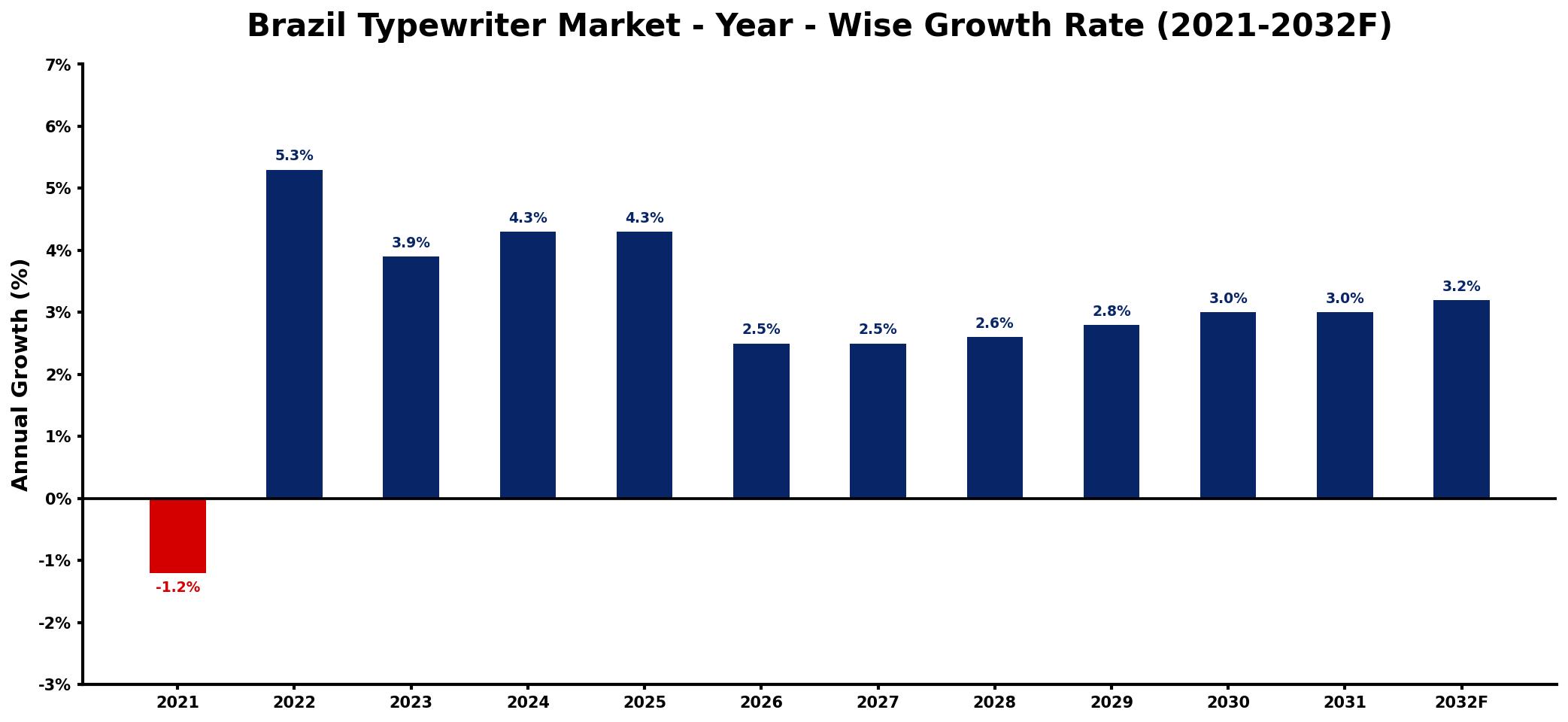
The table below presents the year‑wise growth rates along with the key drivers influencing the market
| Year | Growth Rate | Major Drivers |
| 2021 | -1.2% | Shift towards digital communication |
| 2022 | 5.3% | Revival of nostalgia in consumers |
| 2023 | 3.9% | Increased interest in retro products |
| 2024 | 4.3% | Growth in small business sector |
| 2025 | 4.3% | Expansion of artisan markets |
| 2026 | 2.5% | Rising popularity of vintage aesthetics |
| 2027 | 2.5% | Surge in educational tool adoption |
| 2028 | 2.6% | Boost in creative writing communities |
| 2029 | 2.8% | Growth of DIY culture |
| 2030 | 3.0% | Increase in home office setups |
| 2031 | 3.0% | stronger distribution network expansion |
| 2032 | 3.2% | Rising trend of personalized gifts |
Note: Market size estimations and growth projections presented in this report are based on 6Wresearch's proprietary forecasting methodology, utilizing the latest available industry data, government publications, and primary research inputs.
Brazil Typewriter Market Synopsis
Nostalgia serves as the strongest force shaping the Brazil Typewriter Market today. Many consumers are drawn to typewriters not only for their functionality but also as a means of connecting with a bygone era. This emotional connection drives a dedicated segment of enthusiasts who appreciate the art of typing as an experience.
Additionally, the creative industries in Brazil are increasingly adopting typewriters as a tool for artistic expression. Writers, poets, and artists are utilizing these machines to create works that resonate with authenticity and craftsmanship, further sustaining demand within this niche market.
Brazil Typewriter Market Key Takeaways
- The market capitalizes on nostalgia and collector interest, providing an appealing alternative to digital devices.
- Typewriters continue to find applications in creative professions, reinforcing their relevance in certain professional settings.
- Regulatory policies play a pivotal role in maintaining quality and safety standards for typewriter production.
- The aesthetic charm of vintage typewriters contributes to their sustained popularity among enthusiasts.
- As digital technologies evolve, typewriters maintain a unique niche, appealing to a loyal consumer base.
Evaluation of Restraints in Brazil Typewriter Market
While the Brazil Typewriter Market enjoys a distinct position, it faces limitations largely due to the rapid digitalization of communication. As modern office equipment increasingly leans towards high-tech solutions, typewriters risk being overshadowed. Furthermore, the limited production of new models and components may stifle market growth. The challenge for manufacturers is to remain relevant while appealing to a niche market that values traditional craftsmanship alongside modern functionalities.
Brazil Typewriter Market Trends
Current trends indicate a growing fascination with retro and vintage aesthetics, resulting in a revival of interest in typewriters. This resurgence is supported by social media platforms where enthusiasts share their typing experiences, leading to increased visibility for typewriters. Additionally, a trend towards sustainability and authenticity in the creative sector encourages professionals to choose typewriters as a sustainable and unique means of production.
Brazil Typewriter Market Opportunities
Opportunities for growth within the Brazil Typewriter Market are rich. As more creative professionals seek to differentiate their work, typewriters can offer a unique selling point in the literary and artistic communities. Furthermore, manufacturers can explore limited-edition releases or collaborations with artists to stimulate interest. The expanding collector community presents additional avenues for investment and product development.
Government Initiatives in the Brazil Typewriter Market
Government policies in Brazil relating to the typewriter market include regulations on quality and safety standards, which are crucial in ensuring consumer trust. Additionally, import/export regulations are in place to manage the trade of components, affecting the supply chain. Environmental policies encouraging recycling of electronic and mechanical devices also play a role in how typewriters are produced and disposed of, ensuring responsible practices within the industry.
Future Insights of the Brazil Typewriter Market
Looking ahead to 2026-2032, the Brazil Typewriter Market is poised to navigate a complex landscape shaped by ongoing digital advancements. However, its appeal is likely to remain intact, driven by a steadfast community of users and collectors who cherish the unique qualities of typewriters. As market players innovate and adapt, opportunities to merge vintage aesthetics with contemporary functionality could emerge, offering new pathways for growth in this nostalgic segment.
Brazil Typewriter Market Latest Developments (2025 - 2026)
Recent developments in the Brazil Typewriter Market suggest a concerted effort to tap into the vintage appeal of typewriters. Industry players are exploring collaborations with local artists to create limited-edition models that cater to collectors. Additionally, exhibitions and workshops are being organized to promote typewriting as a form of artistic expression, attracting both enthusiasts and new users. These initiatives reflect a growing recognition of the typewriter's role in the cultural landscape of Brazil.
Brazil Typewriter Market - Key Attractiveness of the Report
- 10 Years of Market Numbers
- Historical Data Starting from 2022 to 2025
- Base Year: 2025
- Forecast Data until 2032
- Key Performance Indicators Impacting the Market
- Major Upcoming Developments and Projects
Key Highlights of the Report:
- Brazil Typewriter Market Outlook
- Market Size of Brazil Typewriter Market, 2025
- Forecast of Brazil Typewriter Market, 2032
- Historical Data and Forecast of Brazil Typewriter Revenues & Volume for the Period 2022-2032F
- Brazil Typewriter Market Trend Evolution
- Brazil Typewriter Market Drivers and Challenges
- Brazil Typewriter Price Trends
- Brazil Typewriter Porter's Five Forces
- Brazil Typewriter Industry Life Cycle
- Historical Data and Forecast of Brazil Typewriter Market Revenues & Volume By Type for the Period 2022-2032F
- Historical Data and Forecast of Brazil Typewriter Market Revenues & Volume By Standard Typewriter for the Period 2022-2032F
- Historical Data and Forecast of Brazil Typewriter Market Revenues & Volume By Portable Typewriter for the Period 2022-2032F
- Historical Data and Forecast of Brazil Typewriter Market Revenues & Volume By Noiseless Typewriter for the Period 2022-2032F
- Historical Data and Forecast of Brazil Typewriter Market Revenues & Volume By Electric Typewriter for the Period 2022-2032F
- Historical Data and Forecast of Brazil Typewriter Market Revenues & Volume By Variable Typewriter for the Period 2022-2032F
- Historical Data and Forecast of Brazil Typewriter Market Revenues & Volume By Automatic Typewriter for the Period 2022-2032F
- Historical Data and Forecast of Brazil Typewriter Market Revenues & Volume By Electronic Typewriter for the Period 2022-2032F
- Historical Data and Forecast of Brazil Standard Typewriter Typewriter Market Revenues & Volume By Typewriter with Additional Attachments for the Period 2022-2032F
- Historical Data and Forecast of Brazil Typewriter Market Revenues & Volume By Application for the Period 2022-2032F
- Historical Data and Forecast of Brazil Typewriter Market Revenues & Volume By Commerical for the Period 2022-2032F
- Historical Data and Forecast of Brazil Typewriter Market Revenues & Volume By Industrial for the Period 2022-2032F
- Historical Data and Forecast of Brazil Typewriter Market Revenues & Volume By Others for the Period 2022-2032F
- Brazil Typewriter Import Export Trade Statistics
- Market Opportunity Assessment By Type
- Market Opportunity Assessment By Application
- Brazil Typewriter Top Companies Market Share
- Brazil Typewriter Competitive Benchmarking By Technical and Operational Parameters
- Brazil Typewriter Company Profiles
- Brazil Typewriter Key Strategic Recommendations






































