Brazil Urodynamic Equipment Market Size, Share & Growth Rate
The Brazil Urodynamic Equipment Market was estimated at USD 237 Million in 2025 and is projected to reach USD 282 Million by 2032, growing at a CAGR of 2.5% from 2026 to 2032. This growth trajectory is primarily driven by the rising prevalence of urological disorders, including urinary incontinence and voiding dysfunction, particularly among the aging population. Additionally, advancements in diagnostic technologies and an increasing focus on urological health awareness are key factors propelling market expansion in the region.
Brazil Urodynamic Equipment Market Year-wise Growth Rate and Key Drivers
This graph highlights how the Brazil Urodynamic Equipment Market has steadily grown over the years, supported by major growth factors.
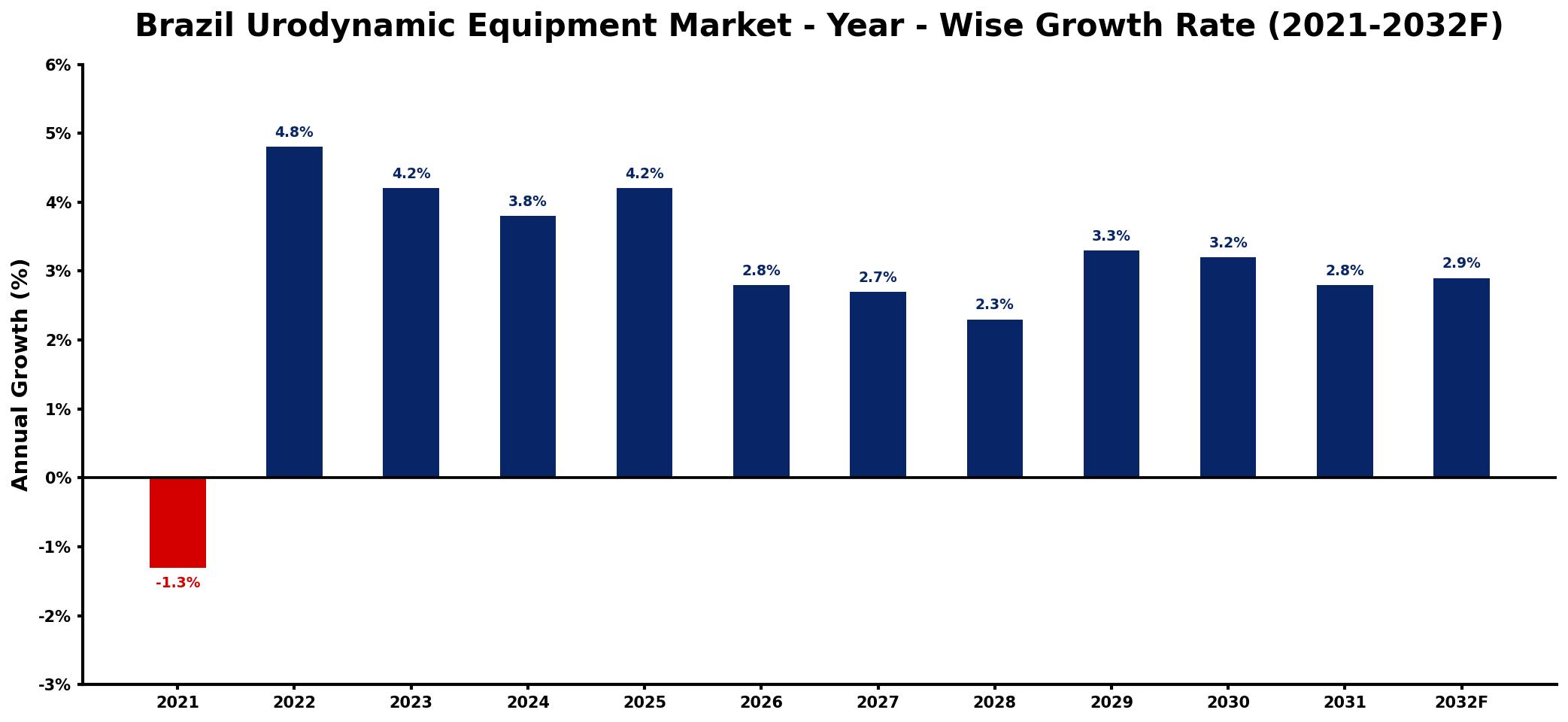
The table below presents the year‑wise growth rates along with the key drivers influencing the market
| Year | Growth Rate | Major Drivers |
| 2021 | -1.3% | decreased investment in healthcare infrastructure |
| 2022 | 4.8% | increased awareness of bladder disorders |
| 2023 | 4.2% | growth in healthcare expenditure allocations |
| 2024 | 3.8% | rising elderly population requiring services |
| 2025 | 4.2% | expansion of diagnostic service offerings |
| 2026 | 2.8% | advancements in medical technology adoption |
| 2027 | 2.7% | increased demand for outpatient procedures |
| 2028 | 2.3% | growing regional consumption patterns |
| 2029 | 3.3% | rising prevalence of chronic conditions |
| 2030 | 3.2% | expanding manufacturing base activity |
| 2031 | 2.8% | increased focus on preventive healthcare |
| 2032 | 2.9% | strengthening underlying market demand |
Note: Market size estimations and growth projections presented in this report are based on 6Wresearch's proprietary forecasting methodology, utilizing the latest available industry data, government publications, and primary research inputs.
Brazil Urodynamic Equipment Market Synopsis
In Brazil, the demand for urodynamic equipment is significantly influenced by the growing elderly demographic, which often presents a higher incidence of urological conditions. Enhanced access to healthcare facilities and diagnostic tools further fosters the uptake of advanced urodynamic systems across various regions.
Moreover, the market is seeing an influx of innovations that improve the accuracy and usability of diagnostic processes, making it easier for healthcare professionals to monitor patient conditions effectively. The amalgamation of these factors is setting the stage for a robust growth environment within the Brazil urodynamic equipment market.
Brazil Urodynamic Equipment Market Key Takeaways
- The market is supported by a demographic shift towards an aging population prone to urological disorders.
- Technological advancements are enhancing the effectiveness of urodynamic diagnostics.
- Increased healthcare infrastructure is facilitating wider access to essential urodynamic equipment.
- Regulatory compliance enhances quality assurance but adds complexity to market entry.
- Awareness campaigns are driving public understanding and demand for urological health solutions.
Evaluation of Restraints in Brazil Urodynamic Equipment Market
The Brazil urodynamic equipment market faces several restraints that may hinder its full potential. A significant barrier includes the rapid pace of technological advancement, which necessitates constant innovation and adaptation by manufacturers. Moreover, the healthcare infrastructure, particularly in remote areas, may not support the widespread adoption of advanced diagnostic systems. Variances in regional healthcare access, economic disparities, and different reimbursement policies add layers of complexity to market demand, compelling companies to craft tailored strategies that address these challenges.
Brazil Urodynamic Equipment Market Trends
Current trends in the Brazil urodynamic equipment market highlight a shift towards minimally invasive diagnostic techniques and user-friendly interfaces. These developments not only improve patient comfort but also enhance the accuracy of results, leading to better clinical outcomes. Additionally, the integration of telemedicine and digital health platforms is emerging as a significant trend, allowing for remote monitoring and enhanced patient engagement.
Brazil Urodynamic Equipment Market Opportunities
The market presents genuine growth opportunities through investment in educational initiatives aimed at healthcare professionals to improve diagnostic and treatment capabilities. Furthermore, potential partnerships between healthcare providers and equipment manufacturers could streamline the introduction of innovative solutions into clinical settings. Exploring collaborations can enhance product offerings and broaden distribution channels, ultimately strengthening market presence.
Government Initiatives in the Brazil Urodynamic Equipment Market
The Brazilian government plays a vital role in shaping the urodynamic equipment market through regulatory frameworks that ensure the quality and reliability of diagnostic tools. Significant investments in healthcare infrastructure and training programs have been initiated to promote the adoption of cutting-edge urodynamic technologies. These policies are aimed at improving patient care standards and fostering a conducive environment for market growth.
Future Insights of the Brazil Urodynamic Equipment Market
Looking ahead to 2026-2032, the Brazil urodynamic equipment market is anticipated to continue its growth, bolstered by ongoing advancements in technology and increasing healthcare access. The emphasis on preventative care and early diagnosis is likely to drive further demand for urodynamic solutions. As the regulatory environment evolves, companies that adapt quickly to these changes while aligning with healthcare professionals' needs will find significant opportunities for market penetration and expansion.
Brazil Urodynamic Equipment Market Latest Developments (2025 - 2026)
Recent developments in the Brazil urodynamic equipment market indicate a strong focus on integrating advanced technologies such as artificial intelligence and machine learning into diagnostic processes. Additionally, various healthcare institutions are exploring telehealth solutions to facilitate remote diagnostics and consultations, reflecting a shift in how patient care is delivered. Continuous dialogue between manufacturers and healthcare professionals is driving improvements in equipment usability and efficiency.
Brazil Urodynamic Equipment Market - Key Attractiveness of the Report
- 10 Years of Market Numbers
- Historical Data Starting from 2022 to 2025
- Base Year: 2025
- Forecast Data until 2032
- Key Performance Indicators Impacting the Market
- Major Upcoming Developments and Projects
Key Highlights of the Report:
- Brazil Urodynamic Equipment Market Outlook
- Market Size of Brazil Urodynamic Equipment Market, 2025
- Forecast of Brazil Urodynamic Equipment Market, 2032
- Historical Data and Forecast of Brazil Urodynamic Equipment Revenues & Volume for the Period 2022-2032F
- Brazil Urodynamic Equipment Market Trend Evolution
- Brazil Urodynamic Equipment Market Drivers and Challenges
- Brazil Urodynamic Equipment Price Trends
- Brazil Urodynamic Equipment Porter's Five Forces
- Brazil Urodynamic Equipment Industry Life Cycle
- Historical Data and Forecast of Brazil Urodynamic Equipment Market Revenues & Volume By Product Type for the Period 2022-2032F
- Historical Data and Forecast of Brazil Urodynamic Equipment Market Revenues & Volume By Urodynamic Equipment for the Period 2022-2032F
- Historical Data and Forecast of Brazil Urodynamic Equipment Market Revenues & Volume By Urodynamic Consumables for the Period 2022-2032F
- Historical Data and Forecast of Brazil Urodynamic Equipment Market Revenues & Volume By End User for the Period 2022-2032F
- Historical Data and Forecast of Brazil Urodynamic Equipment Market Revenues & Volume By Hospitals for the Period 2022-2032F
- Historical Data and Forecast of Brazil Urodynamic Equipment Market Revenues & Volume By Ambulatory Centers for the Period 2022-2032F
- Historical Data and Forecast of Brazil Urodynamic Equipment Market Revenues & Volume By Diagnostic Centers for the Period 2022-2032F
- Historical Data and Forecast of Brazil Urodynamic Equipment Market Revenues & Volume By Others for the Period 2022-2032F
- Brazil Urodynamic Equipment Import Export Trade Statistics
- Market Opportunity Assessment By Product Type
- Market Opportunity Assessment By End User
- Brazil Urodynamic Equipment Top Companies Market Share
- Brazil Urodynamic Equipment Competitive Benchmarking By Technical and Operational Parameters
- Brazil Urodynamic Equipment Company Profiles
- Brazil Urodynamic Equipment Key Strategic Recommendations






































