Brazil Vetiver Oil Market Size, Share & Growth Rate
The Brazil Vetiver Oil Market was estimated at USD 162 Million in 2025 and is projected to reach USD 192 Million by 2032, growing at a CAGR of 2.5% from 2026 to 2032. This growth trajectory is primarily driven by the increasing demand for natural fragrances and essential oils across cosmetic and aromatherapy sectors. The countrys favorable climatic conditions and extensive land suitable for vetiver grass cultivation further bolster Brazil's potential as a leader in the global vetiver oil market.
Brazil Vetiver Oil Market Year-wise Growth Rate and Key Drivers
This graph highlights how the Brazil Vetiver Oil Market has steadily grown over the years, supported by major growth factors.
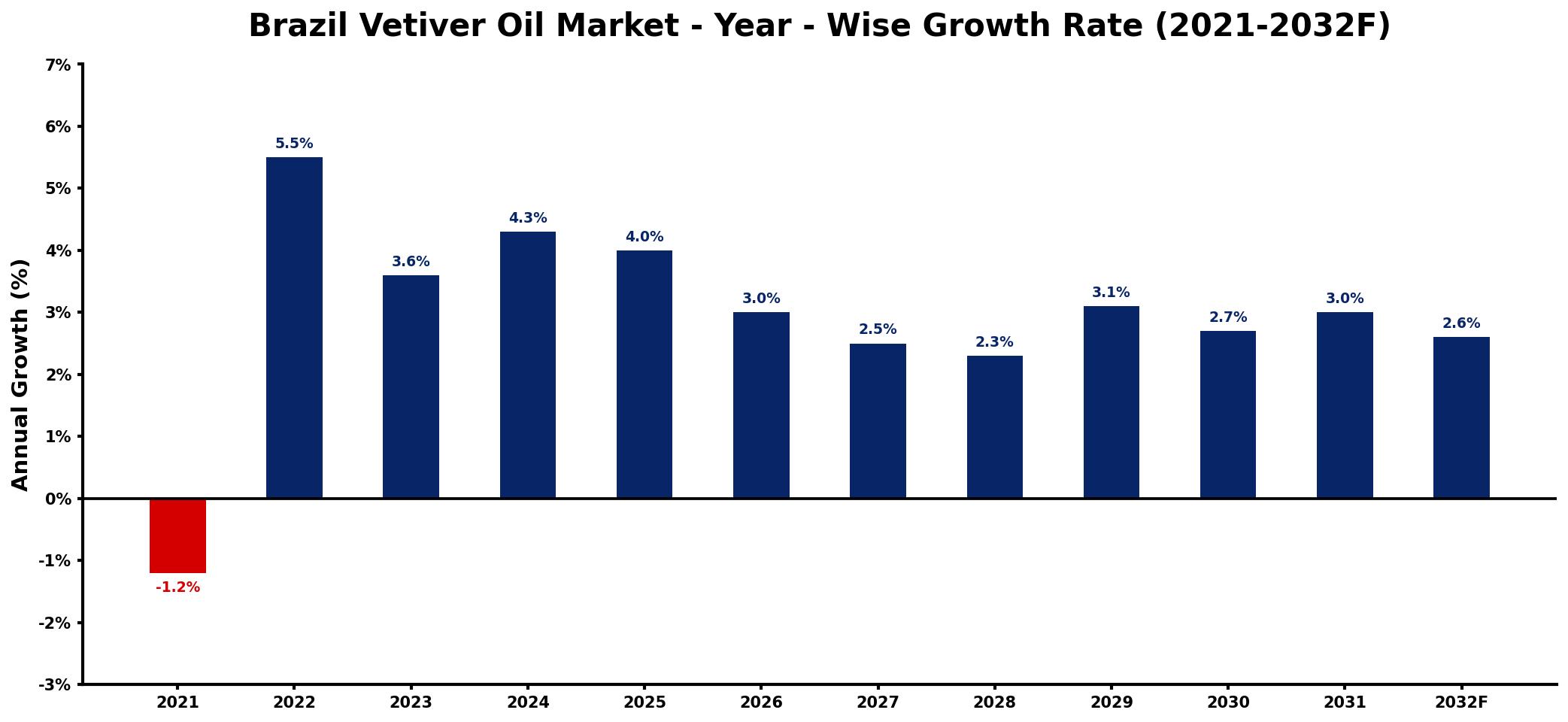
The table below presents the year‑wise growth rates along with the key drivers influencing the market
| Year | Growth Rate | Major Drivers |
| 2021 | -1.2% | decreased consumer interest in fragrances |
| 2022 | 5.5% | growing demand for natural ingredients |
| 2023 | 3.6% | increased market penetration strategies |
| 2024 | 4.3% | expansion of aromatherapy applications |
| 2025 | 4.0% | rise in eco-friendly product offerings |
| 2026 | 3.0% | increased investments in sustainable sourcing |
| 2027 | 2.5% | growing popularity in wellness industry |
| 2028 | 2.3% | enhanced distribution network efficiency |
| 2029 | 3.1% | expansion into new international markets |
| 2030 | 2.7% | increased collaboration with cosmetic brands |
| 2031 | 3.0% | growth in organic product preferences |
| 2032 | 2.6% | rising consumer awareness of sustainability |
Note: Market size estimations and growth projections presented in this report are based on 6Wresearch's proprietary forecasting methodology, utilizing the latest available industry data, government publications, and primary research inputs.
Brazil Vetiver Oil Market Synopsis
Recently, the Brazil vetiver oil market has experienced significant momentum, driven by the rising consumer preference for sustainable and natural products. As more industries prioritize eco-friendly ingredients, the market is poised for continued growth, although challenges surrounding sustainable practices and price volatility remain. Looking ahead, the demand for high-quality vetiver oil is expected to rise, particularly in luxury perfumes and skincare formulations, reflecting an evolving market landscape.
As producers adapt to these changes, they must navigate the intricate balance between quality assurance and sustainable farming practices. The forecast period promises to reveal a landscape where innovation and tradition converge, making Brazil an increasingly influential player in the global vetiver oil scene.
Brazil Vetiver Oil Market Key Takeaways
- The market is projected to reach USD 192 Million by 2032, indicating solid growth prospects.
- Natural fragrances and essential oils drive demand, particularly within cosmetics and aromatherapy.
- Brazil's unique climatic advantages support large-scale vetiver grass cultivation.
- Sustainable cultivation practices are essential for maintaining competitive quality standards.
- Global demand for eco-friendly products continues to shape market dynamics.
Evaluation of Restraints in Brazil Vetiver Oil Market
Despite the growth potential, the Brazil vetiver oil market faces several restraints. The reliance on traditional cultivation methods can hinder production efficiency and sustainability. Additionally, market price fluctuations can significantly affect producers, making it challenging to maintain profitability. Quality consistency is another pressing issue, as producers often face difficulty ensuring that their products meet the escalating global standards while coping with environmental factors. These restraints necessitate strategic focus on sustainable practices and innovation within the sector.
Brazil Vetiver Oil Market Trends
Several key trends are shaping the Brazil vetiver oil market. The shift towards organic and eco-conscious products is gaining traction, with consumers becoming more aware of the ingredients in their favorite perfumes and skincare items. Additionally, technological advancements in extraction methods are enhancing the efficiency and quality of vetiver oil production. The burgeoning aromatherapy industry also plays a significant role, as more consumers integrate essential oils into their wellness routines.
Brazil Vetiver Oil Market Opportunities
The Brazil vetiver oil market presents numerous opportunities for growth and investment. As demand rises for natural ingredients in luxury goods, companies can capitalize on Brazil's rich agricultural resources. Furthermore, establishing partnerships with local farmers can foster sustainable practices while enhancing product quality. Expanding into international markets can also provide substantial avenues for revenue growth, particularly in regions where the demand for vetiver oil continues to rise.
Government Initiatives in the Brazil Vetiver Oil Market
The Brazilian government is actively implementing initiatives aimed at promoting sustainable agricultural practices within the vetiver oil market. Policies are being designed to protect natural habitats while enhancing the livelihoods of local communities involved in vetiver cultivation. By fostering partnerships and supporting ethical sourcing, the government aims to ensure that both producers and consumers benefit from environmentally responsible practices. Such initiatives are crucial for the long-term viability of the vetiver oil industry in Brazil.
Future Insights of the Brazil Vetiver Oil Market
Looking ahead to 2026-2032, the Brazil vetiver oil market is poised for a transformative phase. As global consumer trends increasingly favor natural and sustainably sourced products, Brazil's position as a leading supplier will be fortified. Continuous innovation in cultivation and extraction techniques will be paramount to meeting this growing demand while navigating challenges related to quality and sustainability. Overall, the future holds promise for a robust and dynamic vetiver oil market in Brazil.
Brazil Vetiver Oil Market Latest Developments (2025 - 2026)
Recent developments in the Brazil vetiver oil market indicate a strategic pivot towards sustainability, with various stakeholders intensifying their focus on eco-friendly practices. Innovative extraction techniques have emerged, aiming to enhance product quality and reduce environmental impact. Additionally, there is a noticeable trend of collaborations among farmers, government bodies, and private enterprises, further promoting sustainable development within the vetiver oil supply chain.
Brazil Vetiver Oil Market - Key Attractiveness of the Report
- 10 Years of Market Numbers
- Historical Data Starting from 2022 to 2025
- Base Year: 2025
- Forecast Data until 2032
- Key Performance Indicators Impacting the Market
- Major Upcoming Developments and Projects
Key Highlights of the Report:
- Brazil Vetiver Oil Market Outlook
- Market Size of Brazil Vetiver Oil Market, 2025
- Forecast of Brazil Vetiver Oil Market, 2032
- Historical Data and Forecast of Brazil Vetiver Oil Revenues & Volume for the Period 2022-2032F
- Brazil Vetiver Oil Market Trend Evolution
- Brazil Vetiver Oil Market Drivers and Challenges
- Brazil Vetiver Oil Price Trends
- Brazil Vetiver Oil Porter's Five Forces
- Brazil Vetiver Oil Industry Life Cycle
- Historical Data and Forecast of Brazil Vetiver Oil Market Revenues & Volume By Application for the Period 2022-2032F
- Historical Data and Forecast of Brazil Vetiver Oil Market Revenues & Volume By Medical for the Period 2022-2032F
- Historical Data and Forecast of Brazil Vetiver Oil Market Revenues & Volume By Food & Beverage for the Period 2022-2032F
- Historical Data and Forecast of Brazil Vetiver Oil Market Revenues & Volume By Spa & Relaxation for the Period 2022-2032F
- Brazil Vetiver Oil Import Export Trade Statistics
- Market Opportunity Assessment By Application
- Brazil Vetiver Oil Top Companies Market Share
- Brazil Vetiver Oil Competitive Benchmarking By Technical and Operational Parameters
- Brazil Vetiver Oil Company Profiles
- Brazil Vetiver Oil Key Strategic Recommendations






































