Mexico Vetiver Oil Market Size, Share & Growth Rate
The Mexico Vetiver Oil Market was estimated at USD 178 Million in 2025 and is projected to reach USD 206 Million by 2032, growing at a CAGR of 2.1% from 2026 to 2032. This growth trajectory is primarily driven by an increasing demand for natural ingredients in fragrances and personal care products, alongside the rising popularity of aromatherapy practices. As consumers lean towards products that offer both aesthetic and therapeutic benefits, vetiver oil is positioned to meet these evolving market preferences.
Mexico Vetiver Oil Market Year-wise Growth Rate and Key Drivers
This graph highlights how the Mexico Vetiver Oil Market has steadily grown over the years, supported by major growth factors.
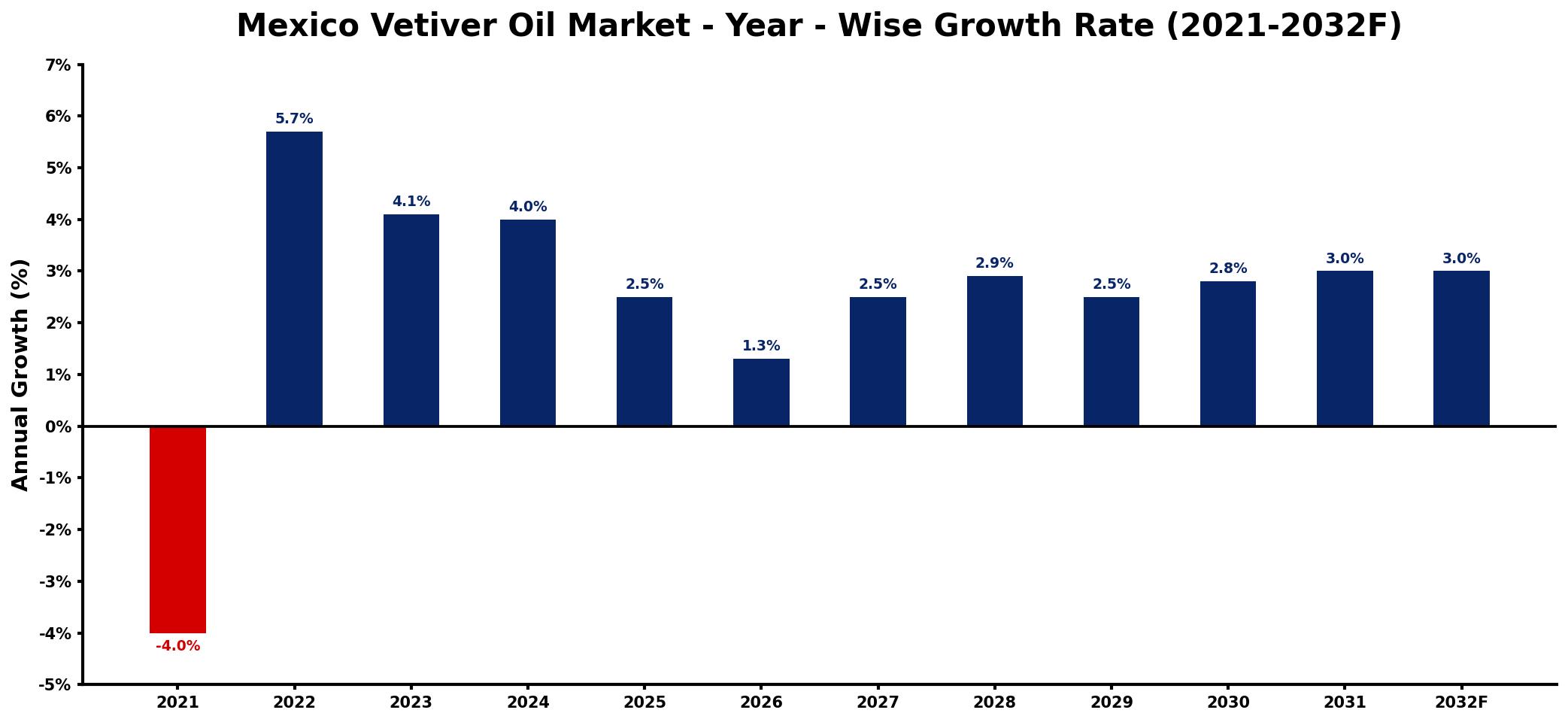
The table below presents the year‑wise growth rates along with the key drivers influencing the market
| Year | Growth Rate | Major Drivers |
| 2021 | -4.0% | decreased consumer interest in fragrances |
| 2022 | 5.7% | rising demand for natural ingredients |
| 2023 | 4.1% | expansion of aromatherapy market segments |
| 2024 | 4.0% | increased investment in sustainable sourcing |
| 2025 | 2.5% | growing popularity of wellness products |
| 2026 | 1.3% | emerging trends in organic cosmetics |
| 2027 | 2.5% | increased use in personal care |
| 2028 | 2.9% | rising applications in home fragrances |
| 2029 | 2.5% | enhanced focus on eco-friendly packaging |
| 2030 | 2.8% | growing automotive sector requirements |
| 2031 | 3.0% | growing regional consumption patterns |
| 2032 | 3.0% | increased awareness of scent benefits |
Note: Market size estimations and growth projections presented in this report are based on 6Wresearch's proprietary forecasting methodology, utilizing the latest available industry data, government publications, and primary research inputs.
Mexico Vetiver Oil Market Synopsis
In Mexico, the vetiver oil market is experiencing a notable surge, particularly in sectors such as cosmetics and perfumery. The earthy and woody scent of vetiver oil makes it a key ingredient in a variety of personal care formulations, appealing to a demographic that values both luxury and natural products.
Additionally, the therapeutic benefits of vetiver oil are driving its adoption in the wellness industry, especially within aromatherapy. Consumers are increasingly aware of the calming and grounding effects associated with vetiver, further propelling its market presence.
Mexico Vetiver Oil Market Key Takeaways
- The market is influenced by growing consumer preferences for natural and organic ingredients.
- Vetiver oil is increasingly utilized in aromatherapy, enhancing its market appeal.
- Fragrance and cosmetic industries are major drivers of vetiver oil demand in Mexico.
- Sustainable sourcing and quality assurance are essential for maintaining market competitiveness.
- Government agricultural policies play a crucial role in vetiver oil production and regulation.
Evaluation of Restraints in Mexico Vetiver Oil Market
Despite the positive growth outlook, several restraints hinder the progress of the Mexico vetiver oil market. Supply chain disruptions, particularly those affecting the cultivation and harvesting of vetiver grass, can lead to fluctuations in availability. Additionally, concerns regarding environmental sustainability and the impact of agricultural practices on local ecosystems pose challenges for producers. Ensuring that vetiver oil meets stringent quality and purity standards is also critical, as consumer trust hinges on the integrity of the product. Addressing these issues will be vital for the sustained growth of the market.
Mexico Vetiver Oil Market Trends
Current trends in the Mexico vetiver oil market indicate a robust shift toward sustainable sourcing practices. As consumers become increasingly eco-conscious, the demand for ethically harvested and produced vetiver oil continues to rise. Furthermore, technological advancements in extraction processes are enhancing the efficiency and purity of oil production. The integration of vetiver oil in innovative product formulations within the wellness and personal care sectors is also emerging, driven by a broader trend towards holistic health solutions.
Mexico Vetiver Oil Market Opportunities
The Mexican vetiver oil market is ripe with opportunities, particularly in the context of growing international demand for natural products. There is potential for expanded export markets, particularly to regions with strong trends toward organic and natural ingredients. Additionally, product innovation in niches such as mood-enhancing and therapeutic applications provides avenues for brands to differentiate themselves. Investing in sustainable cultivation and extraction practices can also position companies favorably as consumers prioritize environmental responsibility.
Government Initiatives in the Mexico Vetiver Oil Market
Government policies and regulations significantly influence the vetiver oil market in Mexico. Initiatives aimed at promoting sustainable agricultural practices support the cultivation of vetiver plants, ensuring that producers meet environmental standards. Regulatory frameworks that enforce quality assurance for essential oils play a critical role in maintaining product integrity and enhancing export capabilities. Additionally, government support programs may provide funding or incentives for farmers to invest in more efficient and eco-friendly production methods.
Future Insights of the Mexico Vetiver Oil Market
Looking ahead to 2026-2032, the Mexico vetiver oil market is poised for steady growth, largely propelled by evolving consumer preferences. The ongoing transition towards natural and sustainable products is expected to strengthen demand across various sectors. Innovations in extraction technology and product formulation will further enhance the competitive landscape. As awareness of the therapeutic benefits of vetiver oil expands, the market is likely to see increased incorporation of vetiver in health and wellness applications, further solidifying its market position.
Mexico Vetiver Oil Market Latest Developments (2025 - 2026)
Recent industry developments suggest a growing focus on the quality and sustainability of vetiver oil production in Mexico. Companies are increasingly adopting eco-friendly practices, from cultivation to extraction, to align with consumer demand for responsible sourcing. Concurrently, collaborations within the fragrance and wellness industries are emerging, highlighting the versatility of vetiver oil in new product launches. This trend reflects a broader commitment to innovation and quality in a rapidly evolving market.
Mexico Vetiver Oil Market - Key Attractiveness of the Report
- 10 Years of Market Numbers
- Historical Data Starting from 2022 to 2025
- Base Year: 2025
- Forecast Data until 2032
- Key Performance Indicators Impacting the Market
- Major Upcoming Developments and Projects
Key Highlights of the Report:
- Mexico Vetiver Oil Market Outlook
- Market Size of Mexico Vetiver Oil Market, 2025
- Forecast of Mexico Vetiver Oil Market, 2032
- Historical Data and Forecast of Mexico Vetiver Oil Revenues & Volume for the Period 2022-2032F
- Mexico Vetiver Oil Market Trend Evolution
- Mexico Vetiver Oil Market Drivers and Challenges
- Mexico Vetiver Oil Price Trends
- Mexico Vetiver Oil Porter's Five Forces
- Mexico Vetiver Oil Industry Life Cycle
- Historical Data and Forecast of Mexico Vetiver Oil Market Revenues & Volume By Application for the Period 2022-2032F
- Historical Data and Forecast of Mexico Vetiver Oil Market Revenues & Volume By Medical for the Period 2022-2032F
- Historical Data and Forecast of Mexico Vetiver Oil Market Revenues & Volume By Food & Beverage for the Period 2022-2032F
- Historical Data and Forecast of Mexico Vetiver Oil Market Revenues & Volume By Spa & Relaxation for the Period 2022-2032F
- Mexico Vetiver Oil Import Export Trade Statistics
- Market Opportunity Assessment By Application
- Mexico Vetiver Oil Top Companies Market Share
- Mexico Vetiver Oil Competitive Benchmarking By Technical and Operational Parameters
- Mexico Vetiver Oil Company Profiles
- Mexico Vetiver Oil Key Strategic Recommendations






































