Bulgaria Table Olives Market Top 5 Importing Countries and Market Competition (HHI) Analysis
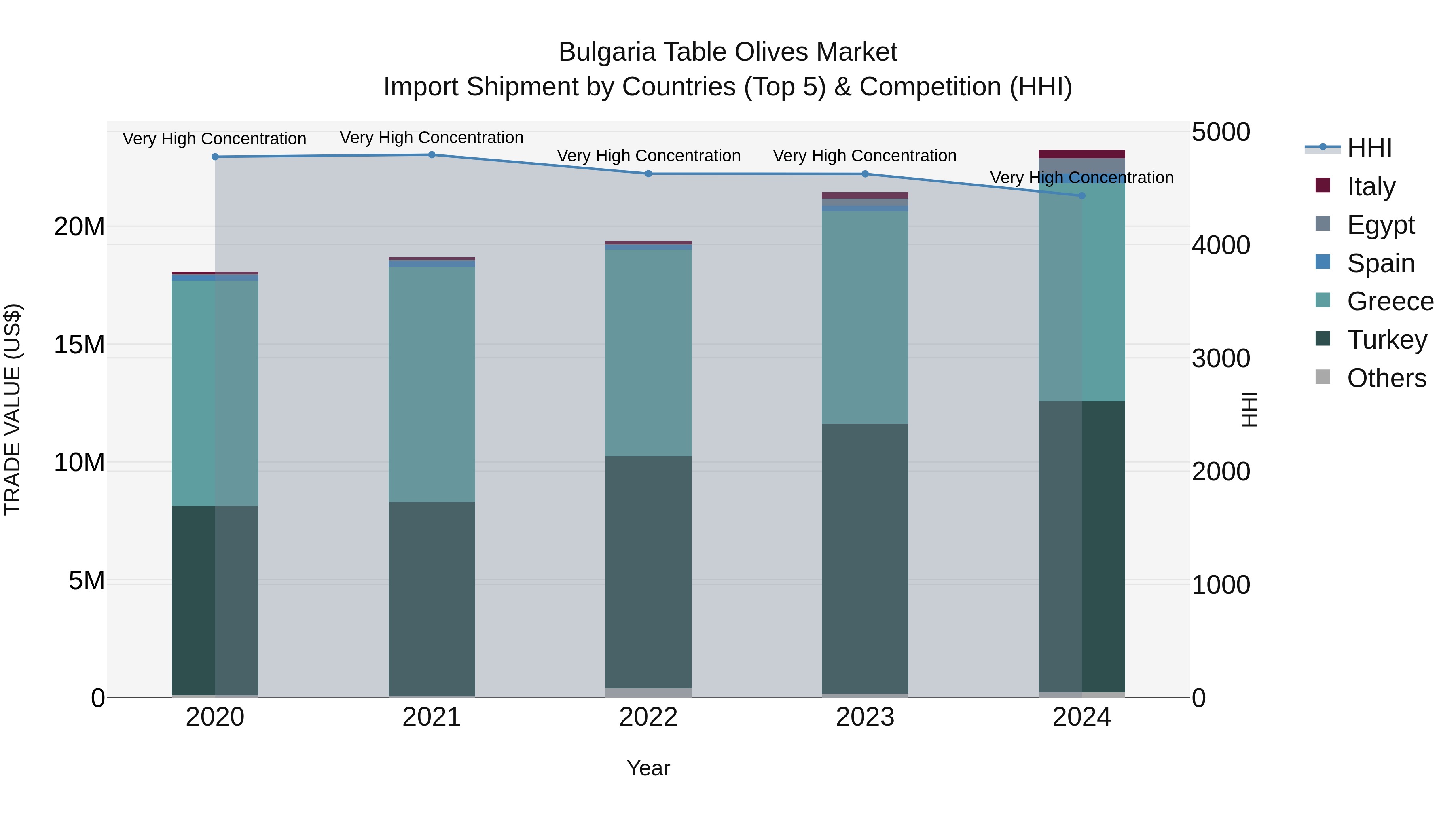
Bulgaria continued to see a strong demand for table olives in 2024, with top suppliers being Turkey, Greece, Egypt, Spain, and Italy. The high Herfindahl-Hirschman Index (HHI) indicates a concentrated Market Top 5 Importing Countries and Market Competition (HHI) Analysis , suggesting limited competition. The compound annual growth rate (CAGR) from 2020 to 2024 stood at a healthy 6.48%, with a notable growth rate of 8.34% from 2023 to 2024. This data suggests a sustained interest in imported table olives in Bulgaria, with potential opportunities for Market Top 5 Importing Countries and Market Competition (HHI) Analysis expansion and diversification in the coming years.
Bulgaria Table Olives Market Synopsis
The Bulgaria Table Olives Market is experiencing steady growth driven by increasing consumer demand for healthy and natural food products. The market is characterized by a wide variety of table olive products, including green and black olives, stuffed olives, and marinated olives, catering to diverse consumer preferences. Local production of table olives in Bulgaria is significant, with a focus on traditional cultivation methods and organic farming practices. The market also sees imports of table olives from countries like Greece, Spain, and Italy, offering consumers a range of options to choose from. Key factors influencing market growth include rising awareness of the health benefits of table olives, changing consumer lifestyles, and expanding distribution channels through supermarkets, specialty stores, and online platforms. Overall, the Bulgaria Table Olives Market presents opportunities for both domestic producers and international suppliers to capitalize on the growing demand for high-quality olive products in the country.
Bulgaria Table Olives Market Trends
The Bulgaria Table Olives Market is witnessing a growing trend towards healthier snacking options, driving demand for olives as a nutritious and flavorful choice. Consumers are increasingly seeking natural and organic products, leading to opportunities for producers to offer premium quality table olives. There is also a rising interest in Mediterranean cuisine, where olives play a key role, further boosting the market growth. Additionally, the increasing awareness about the health benefits of olives, such as being a good source of antioxidants and healthy fats, is expanding the consumer base. To capitalize on these trends, market players can focus on product innovation, sustainable practices, and effective marketing strategies to cater to the evolving preferences of consumers in Bulgaria.
Bulgaria Table Olives Market Challenges
In the Bulgaria Table Olives Market, one of the major challenges faced is the competition from imported olives, which often come from countries with lower production costs. This can make it difficult for local producers to compete on price. Additionally, fluctuations in olive production due to weather conditions and pests can impact the availability and pricing of table olives in the market. Another challenge is the lack of awareness and promotion of locally produced table olives, which can hinder their market penetration and consumer preference. Furthermore, the fragmented nature of the market and limited distribution channels can make it challenging for smaller producers to reach a wider consumer base and compete effectively with larger players. Overall, addressing these challenges will be crucial for the growth and sustainability of the Bulgaria Table Olives Market.
Bulgaria Table Olives Market Investment Opportunities
The Bulgaria Table Olives Market is primarily driven by factors such as increasing consumer awareness about the health benefits of olives, rising demand for Mediterranean cuisine, and growing preference for organic and natural food products. The trend of healthy eating habits and the perception of olives as a nutritious and versatile ingredient in various dishes have contributed to the market growth. Additionally, the expanding retail sector, improved distribution channels, and innovative product offerings are further propelling the consumption of table olives in Bulgaria. The market is also influenced by factors like changing consumer preferences, rising disposable income levels, and the availability of a wide range of flavored and specialty table olives, contributing to the overall growth and competitiveness of the market.
Bulgaria Table Olives Market Government Polices
Government policies related to the Bulgaria Table Olives Market primarily focus on ensuring food safety, quality standards, and promoting sustainable agricultural practices. The Ministry of Agriculture and Food in Bulgaria oversees regulations for the production, processing, and labeling of table olives to meet EU standards. This includes monitoring pesticide use, irrigation practices, and proper storage facilities to maintain product quality. In addition, the government provides support to olive farmers through subsidies, technical assistance, and market access programs to enhance competitiveness in the global market. Overall, government policies in Bulgaria aim to foster a thriving table olives industry that prioritizes consumer health, environmental sustainability, and economic growth.
Bulgaria Table Olives Market Future Outlook
The Bulgaria Table Olives Market is expected to experience steady growth in the coming years, driven by increasing consumer awareness of the health benefits associated with olives and a growing demand for Mediterranean cuisine. With a strong focus on quality and sustainability, Bulgarian olive producers are well-positioned to cater to both domestic and international markets. The rise in disposable income levels and changing dietary preferences towards healthier food options are also contributing to the market`s positive outlook. Furthermore, advancements in technology and improved agricultural practices are enhancing olive production efficiency, ensuring a consistent supply of high-quality table olives. Overall, the Bulgaria Table Olives Market is poised for expansion, with potential for increased market penetration and product diversification to meet evolving consumer preferences.
Key Highlights of the Report:
- Bulgaria Table Olives Market Outlook
- Market Size of Bulgaria Table Olives Market, 2024
- Forecast of Bulgaria Table Olives Market, 2031
- Historical Data and Forecast of Bulgaria Table Olives Revenues & Volume for the Period 2021- 2031
- Bulgaria Table Olives Market Trend Evolution
- Bulgaria Table Olives Market Drivers and Challenges
- Bulgaria Table Olives Price Trends
- Bulgaria Table Olives Porter's Five Forces
- Bulgaria Table Olives Industry Life Cycle
- Historical Data and Forecast of Bulgaria Table Olives Market Revenues & Volume By Type for the Period 2021- 2031
- Historical Data and Forecast of Bulgaria Table Olives Market Revenues & Volume By Black Olive for the Period 2021- 2031
- Historical Data and Forecast of Bulgaria Table Olives Market Revenues & Volume By Green Olive for the Period 2021- 2031
- Historical Data and Forecast of Bulgaria Table Olives Market Revenues & Volume By Application for the Period 2021- 2031
- Historical Data and Forecast of Bulgaria Table Olives Market Revenues & Volume By Online Store for the Period 2021- 2031
- Historical Data and Forecast of Bulgaria Table Olives Market Revenues & Volume By Supermarket for the Period 2021- 2031
- Historical Data and Forecast of Bulgaria Table Olives Market Revenues & Volume By Convenience Store for the Period 2021- 2031
- Historical Data and Forecast of Bulgaria Table Olives Market Revenues & Volume By Other for the Period 2021- 2031
- Bulgaria Table Olives Import Export Trade Statistics
- Market Opportunity Assessment By Type
- Market Opportunity Assessment By Application
- Bulgaria Table Olives Top Companies Market Share
- Bulgaria Table Olives Competitive Benchmarking By Technical and Operational Parameters
- Bulgaria Table Olives Company Profiles
- Bulgaria Table Olives Key Strategic Recommendations






































