Cambodia Energy Efficient Lighting Market Size, Share & Growth Rate
The Cambodia Energy Efficient Lighting Market was estimated at USD 338 Million in 2025 and is projected to reach USD 488 Million by 2032, growing at a CAGR of 5.4% from 2026 to 2032. This growth trajectory is fueled by rising urbanization, increased disposable income, and heightened awareness regarding sustainability. The government's concerted efforts to promote energy-efficient lighting, particularly LEDs, are pivotal in driving adoption across various sectors.
Cambodia Energy Efficient Lighting Market Year-wise Growth Rate and Key Drivers
This graph highlights how the Cambodia Energy Efficient Lighting Market has steadily grown over the years, supported by major growth factors.
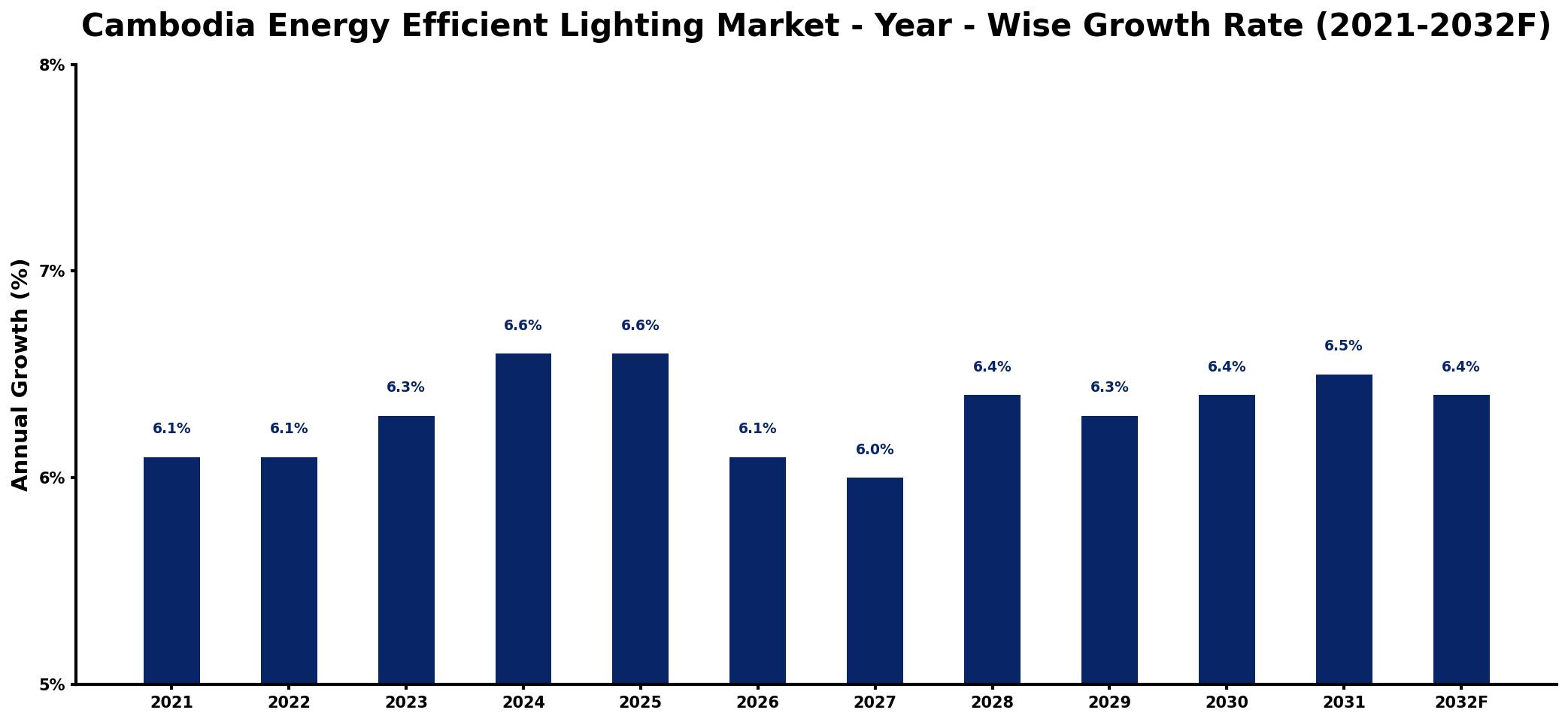
The table below presents the year‑wise growth rates along with the key drivers influencing the market
| Year | Growth Rate | Major Drivers |
| 2021 | 6.1% | Increased residential sector investments |
| 2022 | 6.1% | Growing awareness of sustainability practices |
| 2023 | 6.3% | rising infrastructure development spending |
| 2024 | 6.6% | Rising government incentives programs |
| 2025 | 6.6% | Higher urban infrastructure developments |
| 2026 | 6.1% | Increased commercial sector adoption |
| 2027 | 6.0% | Strengthened regulatory frameworks established |
| 2028 | 6.4% | Growing demand for smart technologies |
| 2029 | 6.3% | Surge in public-private partnerships |
| 2030 | 6.4% | Enhanced focus on environmental policies |
| 2031 | 6.5% | Growing interest in green certifications |
| 2032 | 6.4% | Increased participation in global initiatives |
Note: Market size estimations and growth projections presented in this report are based on 6Wresearch's proprietary forecasting methodology, utilizing the latest available industry data, government publications, and primary research inputs.
Cambodia Energy Efficient Lighting Market Synopsis
The most influential force shaping the Cambodia Energy Efficient Lighting Market is the growing preference for LED technology. These solutions not only offer significant energy savings but also boast a longer lifespan, making them an attractive choice for both consumers and businesses.
As urbanization accelerates and the standard of living improves, the demand for energy-efficient lighting solutions continues to rise. Government initiatives further bolster market dynamics, encouraging households and commercial entities to transition towards more sustainable lighting technologies.
Cambodia Energy Efficient Lighting Market Key Takeaways
- The market is increasingly leaning towards LED lighting due to its cost-effectiveness and sustainability benefits.
- Government policies are actively promoting energy-efficient practices, further driving market growth.
- Urbanization and rising incomes are contributing to a surge in demand across various sectors.
- Smart lighting solutions are emerging as a significant trend in the energy-efficient lighting landscape.
- Investment opportunities are abundant, particularly in energy auditing and retrofitting services.
Evaluation of Restraints in Cambodia Energy Efficient Lighting Market
Despite the market's growth, several constraints persist. Limited consumer awareness regarding the advantages of energy-efficient lighting technologies often results in slow adoption rates. Furthermore, the absence of standardized quality regulations hampers consumer confidence in these products. High initial costs can deter investment, as many consumers seek clear, tangible returns on their expenditure. Additionally, rural areas face significant limitations in accessing affordable energy-efficient lighting solutions, which restricts the market's overall reach and growth potential.
Cambodia Energy Efficient Lighting Market Trends
The shift towards LED products is paramount, spurred by their efficiency and longevity. Increasingly, both consumers and businesses are recognizing the benefits of reduced electricity costs and environmental impact. There is also a marked rise in interest towards smart lighting solutions, enabling remote control and better energy management capabilities. Furthermore, the focus on reducing carbon emissions and adopting sustainable practices is reshaping the landscape of Cambodia's lighting sector.
Cambodia Energy Efficient Lighting Market Opportunities
The Cambodia Energy Efficient Lighting Market is ripe with investment opportunities. There is a burgeoning demand for innovative LED lighting products, along with a pressing need for energy audits and retrofitting services within residential and commercial spaces. Collaborations with local utilities and government entities can further enhance the market's appeal, allowing for the promotion of energy-efficient technologies and practices. Such initiatives not only contribute to reducing energy consumption but also present the potential for substantial long-term returns.
Government Initiatives in the Cambodia Energy Efficient Lighting Market
The Cambodian government has established various policies aimed at promoting energy-efficient lighting. The Energy Efficiency and Conservation Master Plan highlights the commitment to increasing the utilization of energy-efficient technologies, such as LED lighting. This includes public awareness campaigns and incentives designed to encourage consumers and businesses alike to transition from incandescent bulbs to more efficient alternatives. Such measures align with Cambodias sustainable development goals while also targeting reduced energy costs for households.
Future Insights of the Cambodia Energy Efficient Lighting Market
Looking ahead to 2026-2032, the Cambodia Energy Efficient Lighting Market is set to thrive, propelled by government incentives and an increasing societal focus on sustainability. As infrastructure continues to develop and urban centers expand, the demand for energy-efficient lighting solutions will intensify across all sectors. Additionally, the integration of IoT technologies into lighting systems represents a critical future trend, further driving innovations and efficiencies in energy use within the Cambodian market.
Cambodia Energy Efficient Lighting Market Latest Developments (2025 - 2026)
In recent months, the Cambodia Energy Efficient Lighting Market has seen significant movement towards adopting smarter lighting solutions. The emphasis has shifted towards integrating technology that allows for enhanced energy management and user convenience. Simultaneously, several local initiatives are focusing on raising consumer awareness about the benefits of energy-efficient lighting, aiming to bridge the knowledge gap and encourage widespread adoption.
Cambodia Energy Efficient Lighting Market - Key Attractiveness of the Report
- 10 Years of Market Numbers
- Historical Data Starting from 2022 to 2025
- Base Year: 2025
- Forecast Data until 2032
- Key Performance Indicators Impacting the Market
- Major Upcoming Developments and Projects
Key Highlights of the Report:
- Cambodia Energy Efficient Lighting Market Outlook
- Market Size of Cambodia Energy Efficient Lighting Market, 2025
- Forecast of Cambodia Energy Efficient Lighting Market, 2032
- Historical Data and Forecast of Cambodia Energy Efficient Lighting Revenues & Volume for the Period 2022-2032F
- Cambodia Energy Efficient Lighting Market Trend Evolution
- Cambodia Energy Efficient Lighting Market Drivers and Challenges
- Cambodia Energy Efficient Lighting Price Trends
- Cambodia Energy Efficient Lighting Porter's Five Forces
- Cambodia Energy Efficient Lighting Industry Life Cycle
- Historical Data and Forecast of Cambodia Energy Efficient Lighting Market Revenues & Volume By Product Type for the Period 2022-2032F
- Historical Data and Forecast of Cambodia Energy Efficient Lighting Market Revenues & Volume By Incandescent Lamp for the Period 2022-2032F
- Historical Data and Forecast of Cambodia Energy Efficient Lighting Market Revenues & Volume By Light Emitting Diode for the Period 2022-2032F
- Historical Data and Forecast of Cambodia Energy Efficient Lighting Market Revenues & Volume By Arc Lamp for the Period 2022-2032F
- Historical Data and Forecast of Cambodia Energy Efficient Lighting Market Revenues & Volume By Gas Discharge Lamps for the Period 2022-2032F
- Historical Data and Forecast of Cambodia Energy Efficient Lighting Market Revenues & Volume By Application for the Period 2022-2032F
- Historical Data and Forecast of Cambodia Energy Efficient Lighting Market Revenues & Volume By Commercial for the Period 2022-2032F
- Historical Data and Forecast of Cambodia Energy Efficient Lighting Market Revenues & Volume By Residential for the Period 2022-2032F
- Historical Data and Forecast of Cambodia Energy Efficient Lighting Market Revenues & Volume By Government for the Period 2022-2032F
- Historical Data and Forecast of Cambodia Energy Efficient Lighting Market Revenues & Volume By Correlated Color Temperature for the Period 2022-2032F
- Historical Data and Forecast of Cambodia Energy Efficient Lighting Market Revenues & Volume By 2700K-3000K for the Period 2022-2032F
- Historical Data and Forecast of Cambodia Energy Efficient Lighting Market Revenues & Volume By 3500K??4000K for the Period 2022-2032F
- Historical Data and Forecast of Cambodia Energy Efficient Lighting Market Revenues & Volume By 4000K-5000K for the Period 2022-2032F
- Historical Data and Forecast of Cambodia Energy Efficient Lighting Market Revenues & Volume By 5000K-6500K for the Period 2022-2032F
- Historical Data and Forecast of Cambodia Energy Efficient Lighting Market Revenues & Volume By More Than 6500K for the Period 2022-2032F
- Cambodia Energy Efficient Lighting Import Export Trade Statistics
- Market Opportunity Assessment By Product Type
- Market Opportunity Assessment By Application
- Market Opportunity Assessment By Correlated Color Temperature
- Cambodia Energy Efficient Lighting Top Companies Market Share
- Cambodia Energy Efficient Lighting Competitive Benchmarking By Technical and Operational Parameters
- Cambodia Energy Efficient Lighting Company Profiles
- Cambodia Energy Efficient Lighting Key Strategic Recommendations






































