Cameroon Carbonated Beverages Market: Top 5 Importing Countries and Market Competition (HHI) Analysis
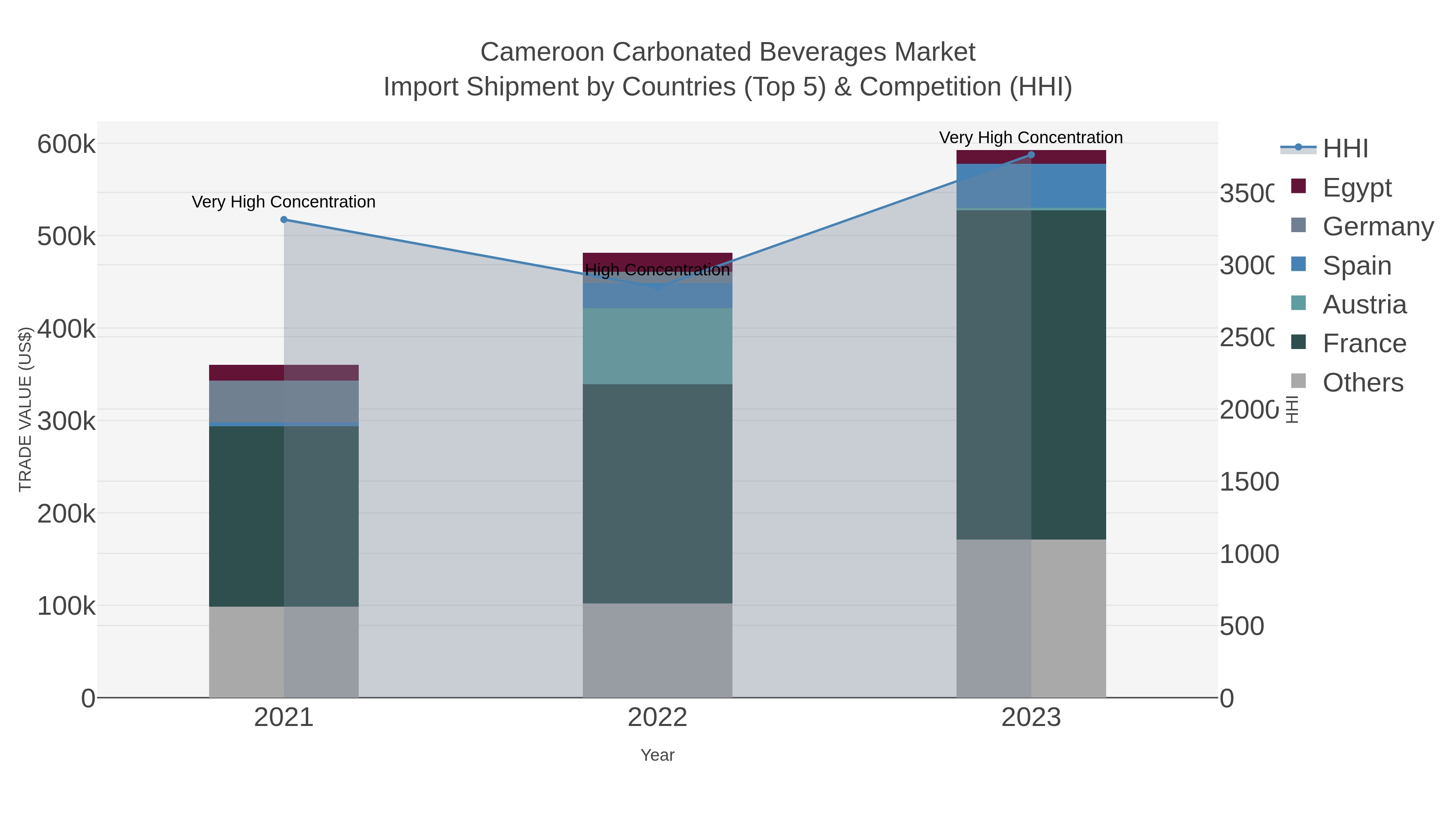
The carbonated beverages import market in Cameroon saw a significant increase in concentration in 2023, with top exporters such as France, Spain, and Brazil dominating the market. This shift towards very high concentration indicates a more competitive landscape among key players. The impressive Compound Annual Growth Rate (CAGR) of 28.23% and growth rate of 23.07% further highlight the strong demand for carbonated beverages in Cameroon. As the market continues to evolve, it will be crucial for both domestic and international suppliers to adapt to the changing preferences and consumption patterns of Cameroonian consumers.
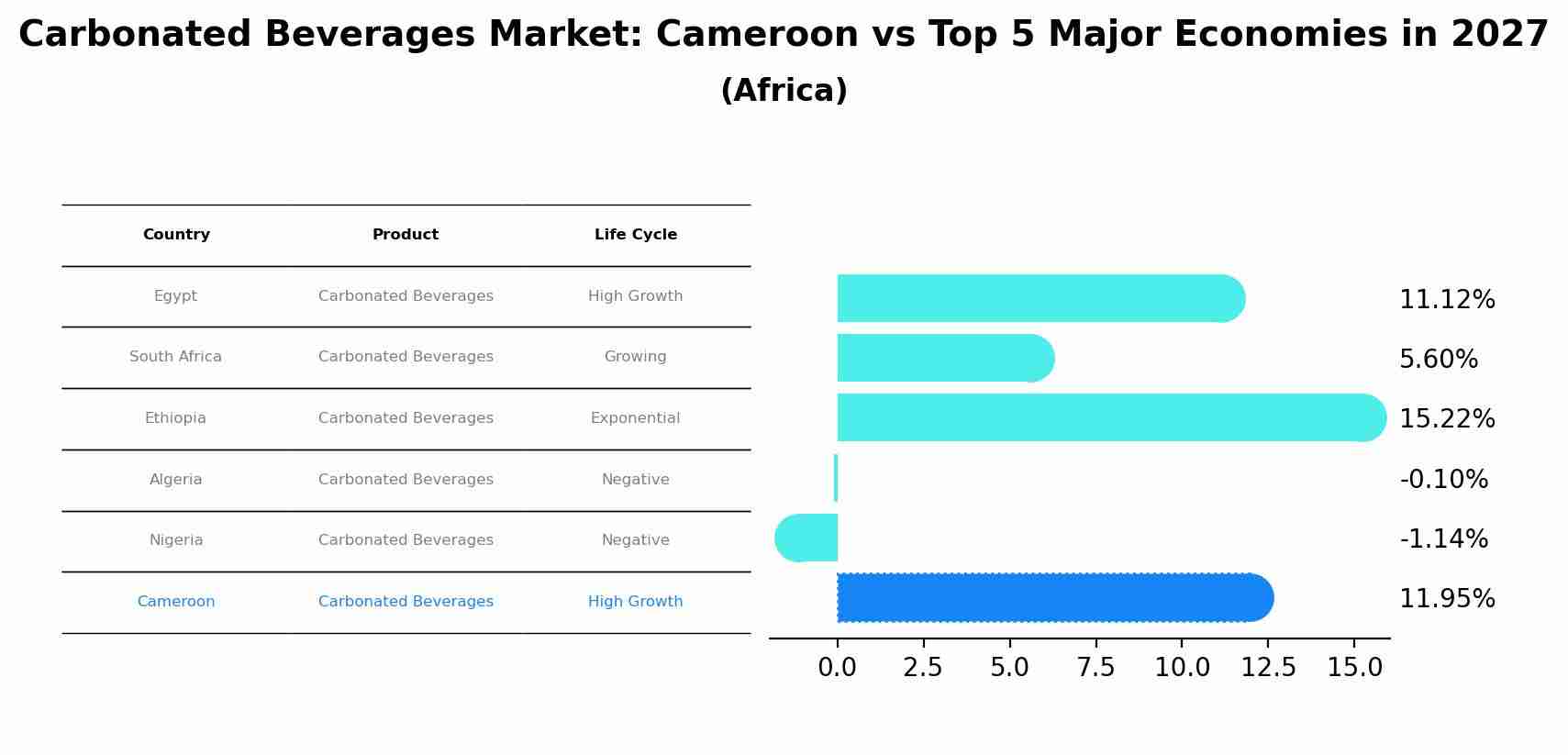
Carbonated Beverages Market: Cameroon vs Top 5 Major Economies in 2027 (Africa)
By 2027, Cameroon's Carbonated Beverages market is forecasted to achieve a high growth rate of 11.95%, with Egypt leading the Africa region, followed by South Africa, Ethiopia, Algeria and Nigeria.
Cameroon Carbonated Beverages Market Overview
The carbonated beverages market in Cameroon is experiencing growth due to changing consumer preferences and a rising middle class. Carbonated drinks, including soft drinks and sparkling waters, are gaining popularity for their taste and refreshment qualities. The market`s expansion is supported by the growth of the beverage industry, increasing disposable incomes, and the introduction of new product varieties.
Drivers of the market
The Cameroon carbonated beverages market is driven by the increasing consumption of soft drinks and sparkling water among consumers. The rising popularity of carbonated beverages is supported by innovations in flavor offerings and packaging. Additionally, the expansion of the beverage industry and the growth of distribution channels contribute to market growth. The increasing focus on marketing and promotional activities by beverage companies further drives consumer demand for carbonated drinks.
Challenges of the market
Challenges in the Cameroon carbonated beverages market include limited consumer purchasing power and competition from cheaper, non-carbonated alternatives. Economic constraints affect consumer spending on premium carbonated beverages. Additionally, the market faces issues related to distribution and supply chain inefficiencies.
Government Policy of the market
In the carbonated beverages market, the government has established regulations to ensure product safety and quality. Policies support the industry through incentives for local production and innovation in beverage formulation. The government also promotes public health initiatives to address concerns related to the consumption of carbonated beverages and encourage the production of healthier options.
Key Highlights of the Report:
- Cameroon Carbonated Beverages Market Outlook
- Market Size of Cameroon Carbonated Beverages Market, 2024
- Forecast of Cameroon Carbonated Beverages Market, 2031
- Historical Data and Forecast of Cameroon Carbonated Beverages Revenues & Volume for the Period 2021-2031
- Cameroon Carbonated Beverages Market Trend Evolution
- Cameroon Carbonated Beverages Market Drivers and Challenges
- Cameroon Carbonated Beverages Price Trends
- Cameroon Carbonated Beverages Porter`s Five Forces
- Cameroon Carbonated Beverages Industry Life Cycle
- Historical Data and Forecast of Cameroon Carbonated Beverages Market Revenues & Volume By Product Types for the Period 2021-2031
- Historical Data and Forecast of Cameroon Carbonated Beverages Market Revenues & Volume By Soft Drinks for the Period 2021-2031
- Historical Data and Forecast of Cameroon Carbonated Beverages Market Revenues & Volume By Carbonated Water for the Period 2021-2031
- Historical Data and Forecast of Cameroon Carbonated Beverages Market Revenues & Volume By Sports & Energy Drinks for the Period 2021-2031
- Historical Data and Forecast of Cameroon Carbonated Beverages Market Revenues & Volume By Others for the Period 2021-2031
- Historical Data and Forecast of Cameroon Carbonated Beverages Market Revenues & Volume By Flavour for the Period 2021-2031
- Historical Data and Forecast of Cameroon Carbonated Beverages Market Revenues & Volume By Cola for the Period 2021-2031
- Historical Data and Forecast of Cameroon Carbonated Beverages Market Revenues & Volume By Fruit Based for the Period 2021-2031
- Historical Data and Forecast of Cameroon Carbonated Beverages Market Revenues & Volume By Others for the Period 2021-2031
- Historical Data and Forecast of Cameroon Carbonated Beverages Market Revenues & Volume By Distribution Channel for the Period 2021-2031
- Historical Data and Forecast of Cameroon Carbonated Beverages Market Revenues & Volume By Hypermarkets & Supermarkets for the Period 2021-2031
- Historical Data and Forecast of Cameroon Carbonated Beverages Market Revenues & Volume By Convenience Stores for the Period 2021-2031
- Historical Data and Forecast of Cameroon Carbonated Beverages Market Revenues & Volume By Food Service Outlets for the Period 2021-2031
- Historical Data and Forecast of Cameroon Carbonated Beverages Market Revenues & Volume By Transport Terminals for the Period 2021-2031
- Historical Data and Forecast of Cameroon Carbonated Beverages Market Revenues & Volume By Online Stores & D2C for the Period 2021-2031
- Cameroon Carbonated Beverages Import Export Trade Statistics
- Market Opportunity Assessment By Product Types
- Market Opportunity Assessment By Flavour
- Market Opportunity Assessment By Distribution Channel
- Cameroon Carbonated Beverages Top Companies Market Share
- Cameroon Carbonated Beverages Competitive Benchmarking By Technical and Operational Parameters
- Cameroon Carbonated Beverages Company Profiles
- Cameroon Carbonated Beverages Key Strategic Recommendations






































