Canada Forklift Market Growth Rate Analysis (2025 - 2031)
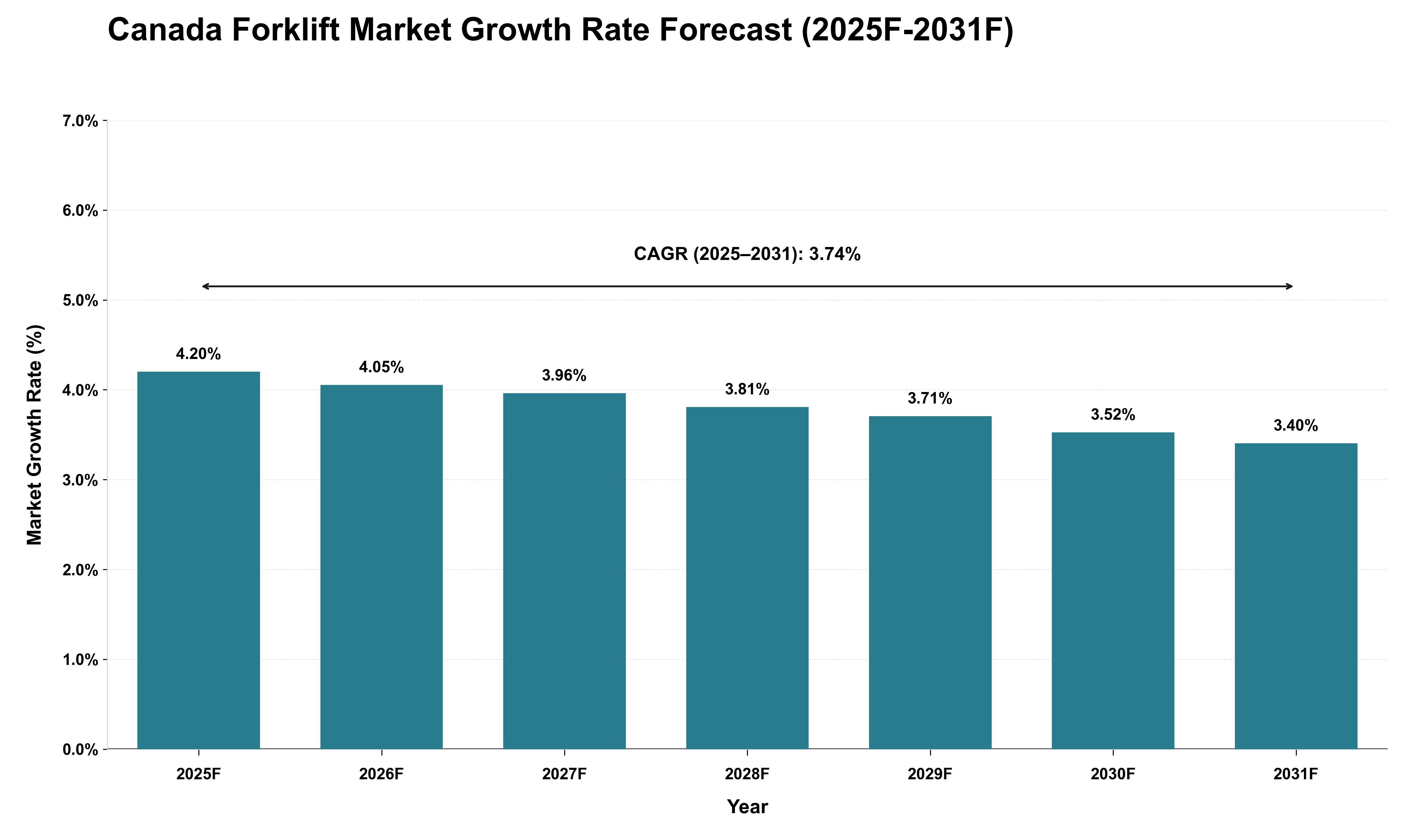
The Canadian forklift market is projected to experience a compound annual growth rate of 3.74% from 2025 to 2031, reflecting a steady demand trajectory influenced by several macroeconomic factors. The initial growth rate of 4.20% in 2025 suggests robust activity in sectors such as logistics and warehousing, which are expected to drive increased investment in material handling equipment. As the forecast progresses, the gradual decline in growth rates indicates potential shifts in import dependencies and cyclical trends, likely influenced by fluctuations in global supply chains and economic conditions. The anticipated decrease from 4.20% to 3.40% by 2031 may also reflect adjustments in production capacities as manufacturers respond to evolving market dynamics and competitive pressures. Overall, this trend underscores a resilient yet adaptive market landscape that will navigate through varying economic cycles while maintaining a focus on efficiency and technological advancements within the forklift sector.
Key Highlights of the Report:
- Canada Forklift Market Outlook
- Market Size of Canada Forklift Market, 2024
- Forecast of Canada Forklift Market, 2031
- Historical Data and Forecast of Canada Forklift Revenues & Volume for the Period 2021-2031
- Canada Forklift Market Trend Evolution
- Canada Forklift Market Drivers and Challenges
- Canada Forklift Price Trends
- Canada Forklift Porter`s Five Forces
- Canada Forklift Industry Life Cycle
- Historical Data and Forecast of Canada Forklift Market Revenues & Volume By Class for the Period 2021-2031
- Historical Data and Forecast of Canada Forklift Market Revenues & Volume By Class 1 for the Period 2021-2031
- Historical Data and Forecast of Canada Forklift Market Revenues & Volume By 2 for the Period 2021-2031
- Historical Data and Forecast of Canada Forklift Market Revenues & Volume By 3 for the Period 2021-2031
- Historical Data and Forecast of Canada Forklift Market Revenues & Volume By 4/5 for the Period 2021-2031
- Historical Data and Forecast of Canada Forklift Market Revenues & Volume By Propulsion for the Period 2021-2031
- Historical Data and Forecast of Canada Forklift Market Revenues & Volume By Electric for the Period 2021-2031
- Historical Data and Forecast of Canada Forklift Market Revenues & Volume By ICE for the Period 2021-2031
- Historical Data and Forecast of Canada Forklift Market Revenues & Volume By Battery Type for the Period 2021-2031
- Historical Data and Forecast of Canada Forklift Market Revenues & Volume By Li-Ion for the Period 2021-2031
- Historical Data and Forecast of Canada Forklift Market Revenues & Volume By Lead Acid for the Period 2021-2031
- Canada Forklift Import Export Trade Statistics
- Market Opportunity Assessment By Class
- Market Opportunity Assessment By Propulsion
- Market Opportunity Assessment By Battery Type
- Canada Forklift Top Companies Market Share
- Canada Forklift Competitive Benchmarking By Technical and Operational Parameters
- Canada Forklift Company Profiles
- Canada Forklift Key Strategic Recommendations






































