Paraguay Forklift Market Growth Rate Analysis (2021 - 2031)
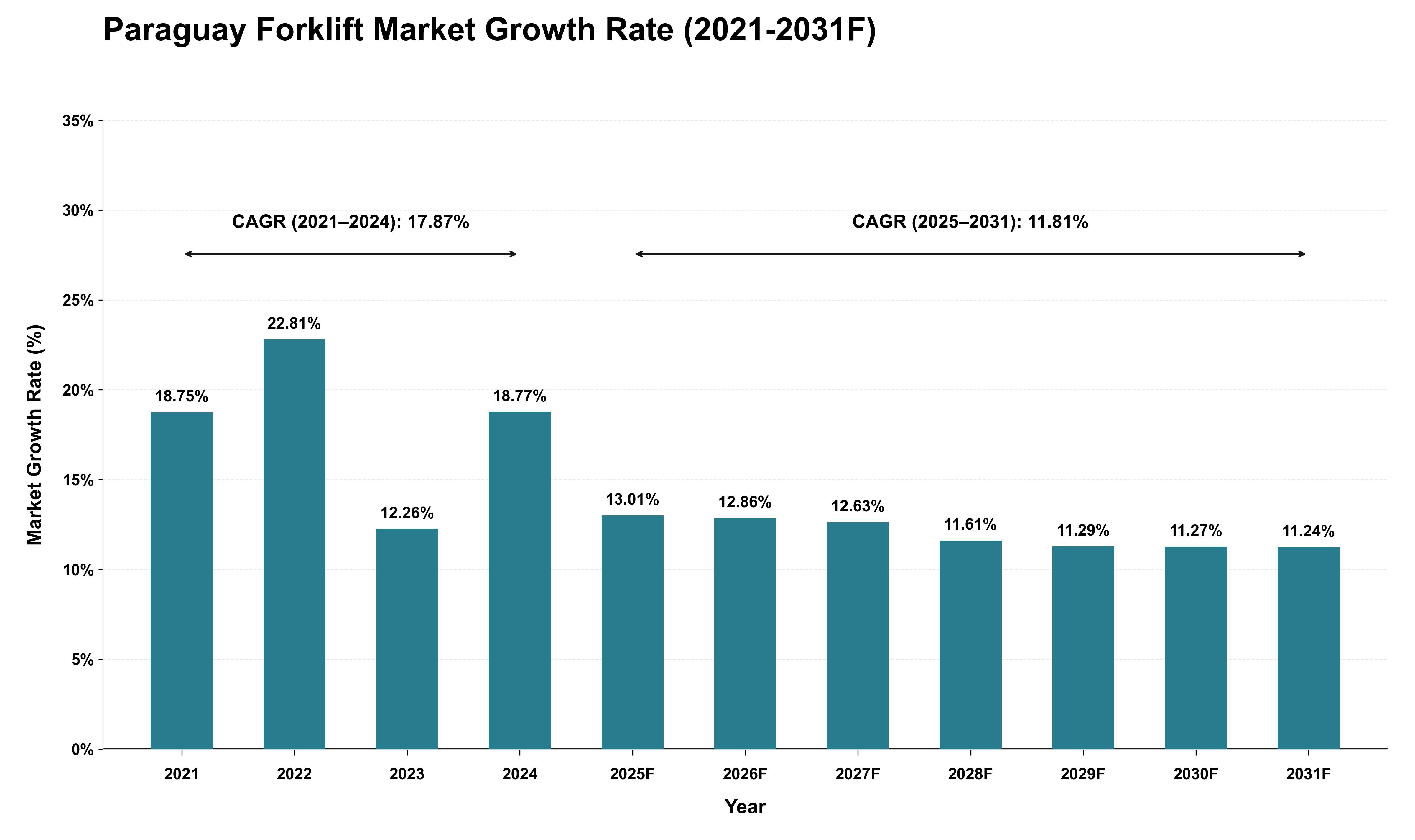
Between 2021 and 2024, the Paraguayan forklift market experienced a robust CAGR of 17.87%, driven by heightened demand in logistics and construction sectors as the economy rebounded post-pandemic. The annual growth rates peaked in 2022 at 22.81%, reflecting a surge in import reliance due to global supply chain disruptions that necessitated increased material handling capabilities. However, as the market transitioned into a more stable phase, growth rates moderated significantly, with a forecast CAGR of 11.81% from 2025 to 2031. This anticipated deceleration can be attributed to evolving competitive dynamics, where local players may enhance capacity through technological advancements and efficiency improvements, while global commodity price fluctuations could impact operational costs. Consequently, while demand remains strong, the competitive landscape will likely shift towards optimizing existing capacities rather than expanding them aggressively in response to changing economic conditions and import dependencies.
Key Highlights of the Report:
- Paraguay Forklift Market Outlook
- Market Size of Paraguay Forklift Market, 2024
- Forecast of Paraguay Forklift Market, 2031
- Historical Data and Forecast of Paraguay Forklift Revenues & Volume for the Period 2021-2031
- Paraguay Forklift Market Trend Evolution
- Paraguay Forklift Market Drivers and Challenges
- Paraguay Forklift Price Trends
- Paraguay Forklift Porter`s Five Forces
- Paraguay Forklift Industry Life Cycle
- Historical Data and Forecast of Paraguay Forklift Market Revenues & Volume By Class for the Period 2021-2031
- Historical Data and Forecast of Paraguay Forklift Market Revenues & Volume By Class 1 for the Period 2021-2031
- Historical Data and Forecast of Paraguay Forklift Market Revenues & Volume By 2 for the Period 2021-2031
- Historical Data and Forecast of Paraguay Forklift Market Revenues & Volume By 3 for the Period 2021-2031
- Historical Data and Forecast of Paraguay Forklift Market Revenues & Volume By 4/5 for the Period 2021-2031
- Historical Data and Forecast of Paraguay Forklift Market Revenues & Volume By Propulsion for the Period 2021-2031
- Historical Data and Forecast of Paraguay Forklift Market Revenues & Volume By Electric for the Period 2021-2031
- Historical Data and Forecast of Paraguay Forklift Market Revenues & Volume By ICE for the Period 2021-2031
- Historical Data and Forecast of Paraguay Forklift Market Revenues & Volume By Battery Type for the Period 2021-2031
- Historical Data and Forecast of Paraguay Forklift Market Revenues & Volume By Li-Ion for the Period 2021-2031
- Historical Data and Forecast of Paraguay Forklift Market Revenues & Volume By Lead Acid for the Period 2021-2031
- Paraguay Forklift Import Export Trade Statistics
- Market Opportunity Assessment By Class
- Market Opportunity Assessment By Propulsion
- Market Opportunity Assessment By Battery Type
- Paraguay Forklift Top Companies Market Share
- Paraguay Forklift Competitive Benchmarking By Technical and Operational Parameters
- Paraguay Forklift Company Profiles
- Paraguay Forklift Key Strategic Recommendations






































