Canada Smokeless Tobacco Products Market: Import Trend Analysis
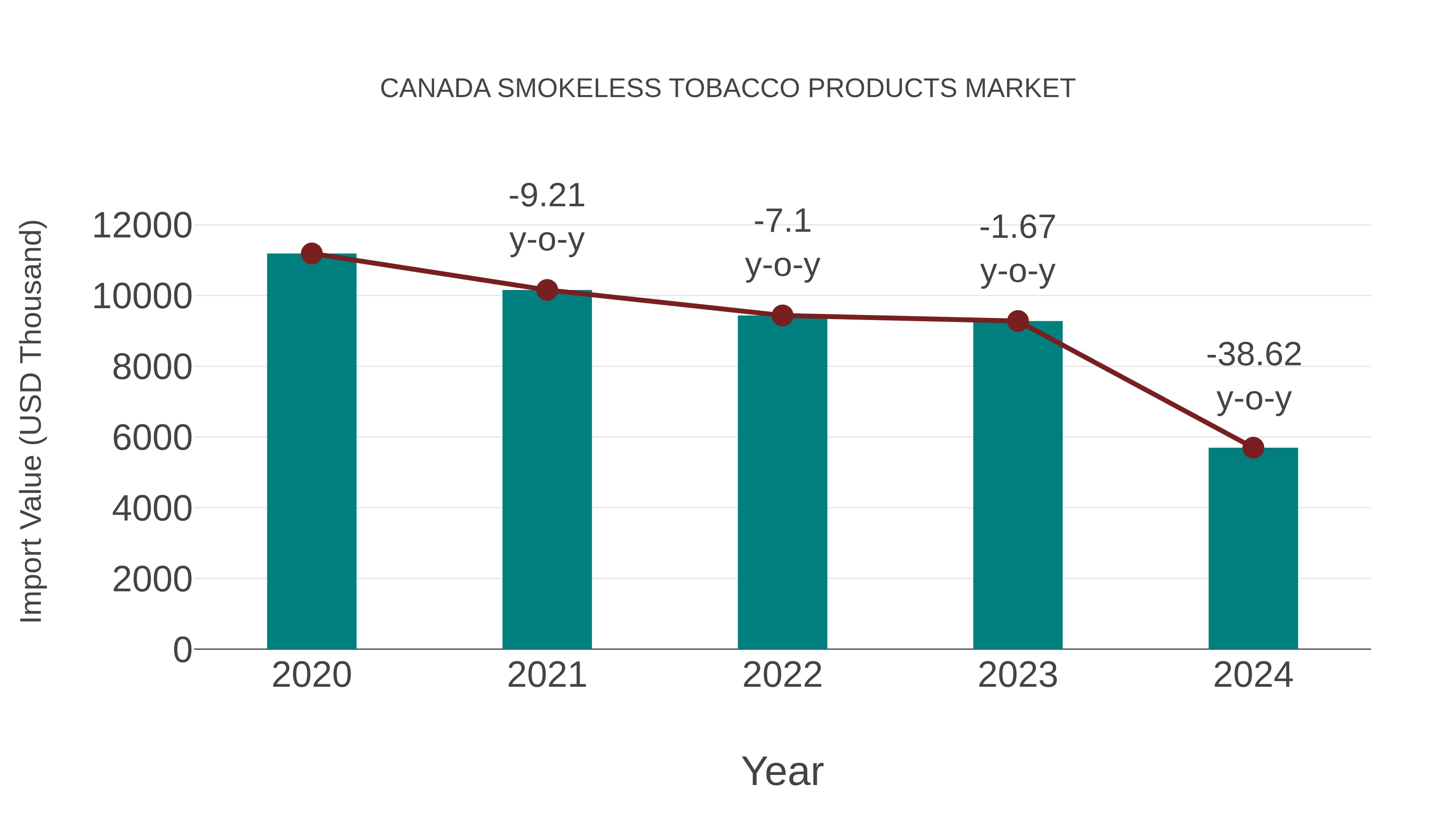
In the Canada smokeless tobacco products market, the import trend experienced a notable decline from 2023 to 2024, with a growth rate of -38.62%. The compound annual growth rate (CAGR) for the period 2020-2024 stood at -15.53%. This significant downturn could be attributed to shifting consumer preferences, regulatory changes, or a decline in overall market demand.
Canada Smokeless Tobacco Products Market Overview
The Canada smokeless tobacco products market is experiencing steady growth driven by factors such as rising consumer awareness about the harmful effects of traditional smoking, increasing government regulations on smoking in public places, and changing consumer preferences towards smokeless alternatives. Products like snus, chewing tobacco, and dissolvable tobacco are gaining popularity among Canadian consumers looking for smoke-free alternatives. Manufacturers are focusing on developing innovative and flavored smokeless tobacco products to attract a wider consumer base. With a growing health-conscious population and increasing disposable income levels, the demand for smokeless tobacco products in Canada is expected to continue on an upward trajectory, presenting opportunities for market expansion and product diversification.
Trends of the Market
The Canada Smokeless Tobacco Products Market is witnessing several key trends. One significant trend is the increasing popularity of smokeless tobacco alternatives such as nicotine pouches and snus, driven by a growing consumer preference for smoke-free options. These products are perceived as less harmful than traditional tobacco products, appealing to health-conscious consumers. Another notable trend is the rise of flavored smokeless tobacco products, targeting younger demographics with a variety of flavors such as mint, citrus, and berry. Additionally, the market is seeing a shift towards innovative packaging and product formats to enhance convenience and user experience. Regulatory changes and increased awareness of the health risks associated with tobacco consumption are also influencing market dynamics, leading to a greater emphasis on harm reduction strategies and product diversification.
Challenges of the Market
In the Canada Smokeless Tobacco Products Market, some of the key challenges include stringent regulations and restrictions on advertising and marketing of tobacco products, increasing awareness about the health risks associated with smokeless tobacco, competition from alternative nicotine delivery products like e-cigarettes, and changing consumer preferences towards healthier lifestyle choices. Additionally, the high taxes imposed on tobacco products in Canada also pose a challenge for companies operating in this market, leading to higher prices for consumers and potential impact on sales. Overall, navigating through the regulatory landscape, addressing health concerns, and adapting to shifting consumer trends are the primary challenges faced in the Canada Smokeless Tobacco Products Market.
Investment Opportunities of the market
The Canada Smokeless Tobacco Products Market presents promising investment opportunities due to the increasing consumer demand for smokeless alternatives to traditional tobacco products. With growing health awareness and stricter tobacco regulations, many consumers are seeking smokeless options as a perceived safer alternative. Key product categories within this market include snus, snuff, chewing tobacco, and dissolvable tobacco products. Companies that offer innovative smokeless tobacco products with appealing flavors and packaging are likely to capture a share of this market. Additionally, the rising popularity of smokeless tobacco among younger demographics presents a significant growth opportunity for investors. However, it is crucial for investors to closely monitor regulatory developments and public health trends to mitigate risks associated with the tobacco industry.
Government Policy of the market
In Canada, the government has implemented strict regulations on smokeless tobacco products to reduce their usage and protect public health. The Tobacco and Vaping Products Act prohibits the sale of flavored tobacco products, restricts advertising and promotion, and mandates health warnings on packaging. Furthermore, smokeless tobacco products are subject to high taxation to deter consumption. The government also enforces age restrictions to prevent youth access to these products. These policies aim to curb the prevalence of smokeless tobacco use, reduce associated health risks, and promote overall public health and well-being in Canada.
Future Outlook of the market
The future outlook for the Canada Smokeless Tobacco Products Market is expected to be influenced by several key factors. The market is anticipated to experience moderate growth due to changing consumer preferences towards smokeless tobacco products as a potentially less harmful alternative to traditional cigarettes. Health concerns related to smoking are likely to drive more individuals to seek smokeless tobacco options. Additionally, innovative product offerings, such as new flavors and packaging formats, are expected to attract a wider consumer base. Regulatory developments and taxation policies aimed at reducing tobacco consumption may pose challenges for the market. Overall, with increasing awareness about the health risks associated with smoking and evolving product offerings, the Canada Smokeless Tobacco Products Market is forecasted to exhibit steady growth in the coming years.
Key Highlights of the Report:
- Canada Smokeless Tobacco Products Market Outlook
- Market Size of Canada Smokeless Tobacco Products Market,2025
- Forecast of Canada Smokeless Tobacco Products Market, 2032
- Historical Data and Forecast of Canada Smokeless Tobacco Products Revenues & Volume for the Period 2022-2032F
- Canada Smokeless Tobacco Products Market Trend Evolution
- Canada Smokeless Tobacco Products Market Drivers and Challenges
- Canada Smokeless Tobacco Products Price Trends
- Canada Smokeless Tobacco Products Porter's Five Forces
- Canada Smokeless Tobacco Products Industry Life Cycle
- Historical Data and Forecast of Canada Smokeless Tobacco Products Market Revenues & Volume By Product Type for the Period 2022-2032F
- Historical Data and Forecast of Canada Smokeless Tobacco Products Market Revenues & Volume By Chewing Tobacco for the Period 2022-2032F
- Historical Data and Forecast of Canada Smokeless Tobacco Products Market Revenues & Volume By Snuff for the Period 2022-2032F
- Historical Data and Forecast of Canada Smokeless Tobacco Products Market Revenues & Volume By Dissolvable Tobacco for the Period 2022-2032F
- Historical Data and Forecast of Canada Smokeless Tobacco Products Market Revenues & Volume By Flavoring for the Period 2022-2032F
- Historical Data and Forecast of Canada Smokeless Tobacco Products Market Revenues & Volume By Menthol for the Period 2022-2032F
- Historical Data and Forecast of Canada Smokeless Tobacco Products Market Revenues & Volume By Mint for the Period 2022-2032F
- Historical Data and Forecast of Canada Smokeless Tobacco Products Market Revenues & Volume By Fruit-Flavored for the Period 2022-2032F
- Historical Data and Forecast of Canada Smokeless Tobacco Products Market Revenues & Volume By Packaging for the Period 2022-2032F
- Historical Data and Forecast of Canada Smokeless Tobacco Products Market Revenues & Volume By Pouch for the Period 2022-2032F
- Historical Data and Forecast of Canada Smokeless Tobacco Products Market Revenues & Volume By Tin Can for the Period 2022-2032F
- Historical Data and Forecast of Canada Smokeless Tobacco Products Market Revenues & Volume By Strips for the Period 2022-2032F
- Historical Data and Forecast of Canada Smokeless Tobacco Products Market Revenues & Volume By Consumer Segment for the Period 2022-2032F
- Historical Data and Forecast of Canada Smokeless Tobacco Products Market Revenues & Volume By Adult Smokers for the Period 2022-2032F
- Historical Data and Forecast of Canada Smokeless Tobacco Products Market Revenues & Volume By Young Adults for the Period 2022-2032F
- Historical Data and Forecast of Canada Smokeless Tobacco Products Market Revenues & Volume By Health-Conscious Consumers for the Period 2022-2032F
- Canada Smokeless Tobacco Products Import Export Trade Statistics
- Market Opportunity Assessment By Product Type
- Market Opportunity Assessment By Flavoring
- Market Opportunity Assessment By Packaging
- Market Opportunity Assessment By Consumer Segment
- Canada Smokeless Tobacco Products Top Companies Market Share
- Canada Smokeless Tobacco Products Competitive Benchmarking By Technical and Operational Parameters
- Canada Smokeless Tobacco Products Company Profiles
- Canada Smokeless Tobacco Products Key Strategic Recommendations






































