Cape Verde Ceiling Tiles Market: Top 5 Importing Countries and Market Competition (HHI) Analysis
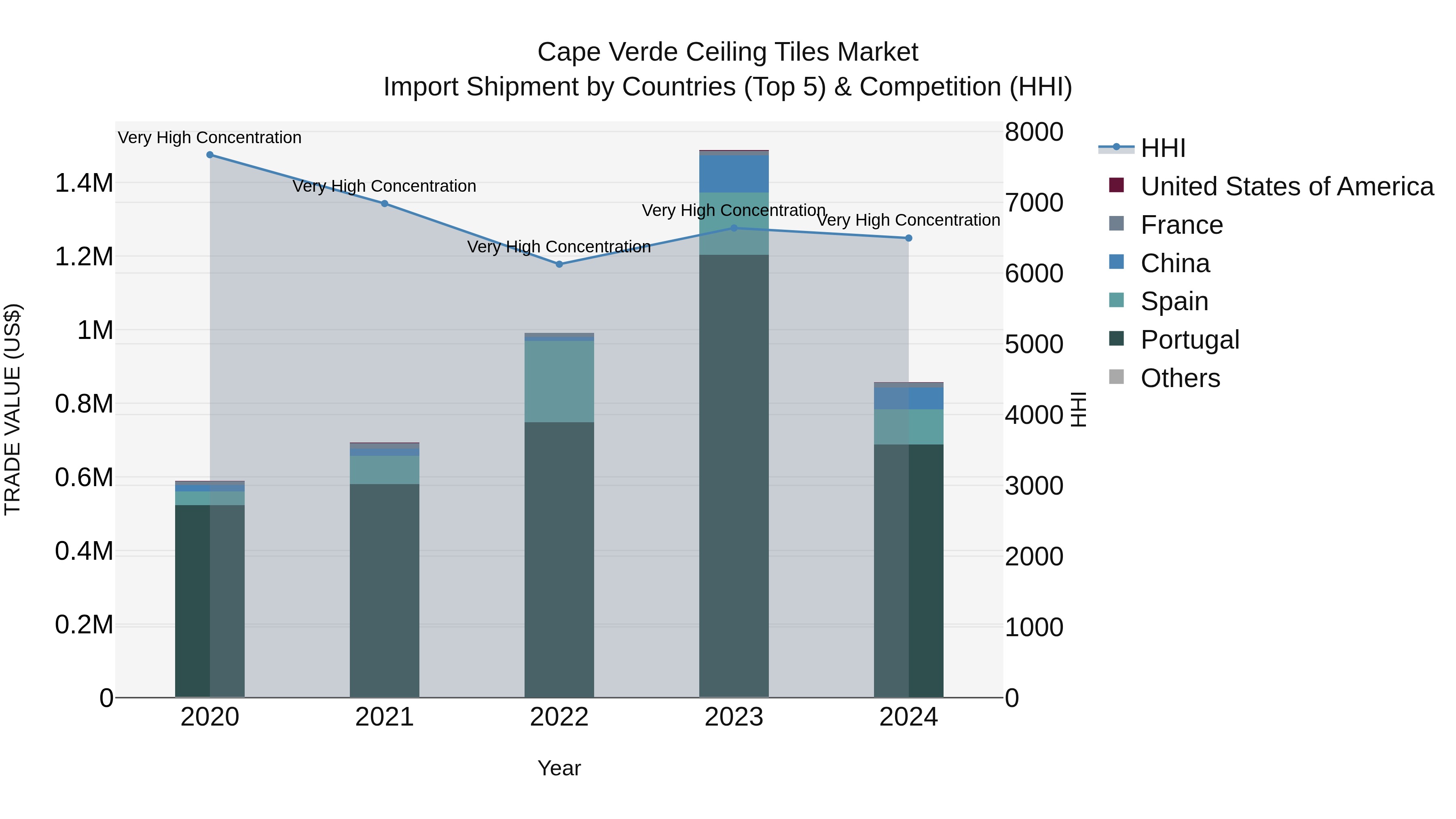
In 2024, Cape Verde continued to see a high concentration of ceiling tile imports, with top exporters being Portugal, Spain, China, France, and the United States. Despite a significant decline in growth rate from 2023 to 2024, the compound annual growth rate (CAGR) over the period of 2020-2024 remained strong at 9.83%. This suggests a steady demand for ceiling tiles in Cape Verde, with key countries maintaining their position as major suppliers in the market.
Cape Verde Ceiling Tiles Market Overview
The ceiling tiles market in Cape Verde is influenced by the construction and renovation sectors. Ceiling tiles are used for aesthetic and functional purposes in residential and commercial buildings. Market growth is supported by increasing construction activities, though challenges include the need for durable and cost-effective products.
Drivers of the market
The ceiling tiles market in Cape Verde benefits from growth in the construction and renovation sectors. As new residential and commercial properties are developed, the demand for ceiling tiles increases. Additionally, the focus on improving building aesthetics and acoustics drives the market for various types of ceiling tiles.
Challenges of the market
The Cape Verde ceiling tiles market faces issues related to high import costs and limited local production. There are also challenges related to logistical and infrastructure constraints, which can affect the availability and distribution of ceiling tiles. Additionally, the market is affected by fluctuating demand and varying standards for construction materials.
Government Policy of the market
Government policies affecting the ceiling tiles market in Cape Verde focus on ensuring product quality and safety. Regulations cover the materials used in ceiling tiles to prevent health hazards and promote sustainability. There are also initiatives to support the use of environmentally friendly and energy-efficient products in construction.
Key Highlights of the Report:
- Cape Verde Ceiling Tiles Market Outlook
- Market Size of Cape Verde Ceiling Tiles Market, 2024
- Forecast of Cape Verde Ceiling Tiles Market, 2031
- Historical Data and Forecast of Cape Verde Ceiling Tiles Revenues & Volume for the Period 2021-2031
- Cape Verde Ceiling Tiles Market Trend Evolution
- Cape Verde Ceiling Tiles Market Drivers and Challenges
- Cape Verde Ceiling Tiles Price Trends
- Cape Verde Ceiling Tiles Porter`s Five Forces
- Cape Verde Ceiling Tiles Industry Life Cycle
- Historical Data and Forecast of Cape Verde Ceiling Tiles Market Revenues & Volume By Material Type for the Period 2021-2031
- Historical Data and Forecast of Cape Verde Ceiling Tiles Market Revenues & Volume By Mineral Wool for the Period 2021-2031
- Historical Data and Forecast of Cape Verde Ceiling Tiles Market Revenues & Volume By Metal for the Period 2021-2031
- Historical Data and Forecast of Cape Verde Ceiling Tiles Market Revenues & Volume By Gypsum for the Period 2021-2031
- Historical Data and Forecast of Cape Verde Ceiling Tiles Market Revenues & Volume By Others for the Period 2021-2031
- Historical Data and Forecast of Cape Verde Ceiling Tiles Market Revenues & Volume By Application for the Period 2021-2031
- Historical Data and Forecast of Cape Verde Ceiling Tiles Market Revenues & Volume By Residential for the Period 2021-2031
- Historical Data and Forecast of Cape Verde Ceiling Tiles Market Revenues & Volume By Non-residential for the Period 2021-2031
- Cape Verde Ceiling Tiles Import Export Trade Statistics
- Market Opportunity Assessment By Material Type
- Market Opportunity Assessment By Application
- Cape Verde Ceiling Tiles Top Companies Market Share
- Cape Verde Ceiling Tiles Competitive Benchmarking By Technical and Operational Parameters
- Cape Verde Ceiling Tiles Company Profiles
- Cape Verde Ceiling Tiles Key Strategic Recommendations






































