Chile Aerosol Market Size, Share & Growth Rate
The Chile Aerosol Market was estimated at USD 496 Million in 2025 and is projected to reach USD 683 Million by 2032, growing at a CAGR of 4.7% from 2026 to 2032. This upward trajectory is driven by increasing disposable incomes and urbanization, which are leading consumers to seek convenient and innovative aerosol solutions in their daily lives. Furthermore, the growing awareness of hygiene and sustainability among consumers is further propelling demand in various segments.
Chile Aerosol Market Year-wise Growth Rate and Key Drivers
This graph highlights how the Chile Aerosol Market has steadily grown over the years, supported by major growth factors.
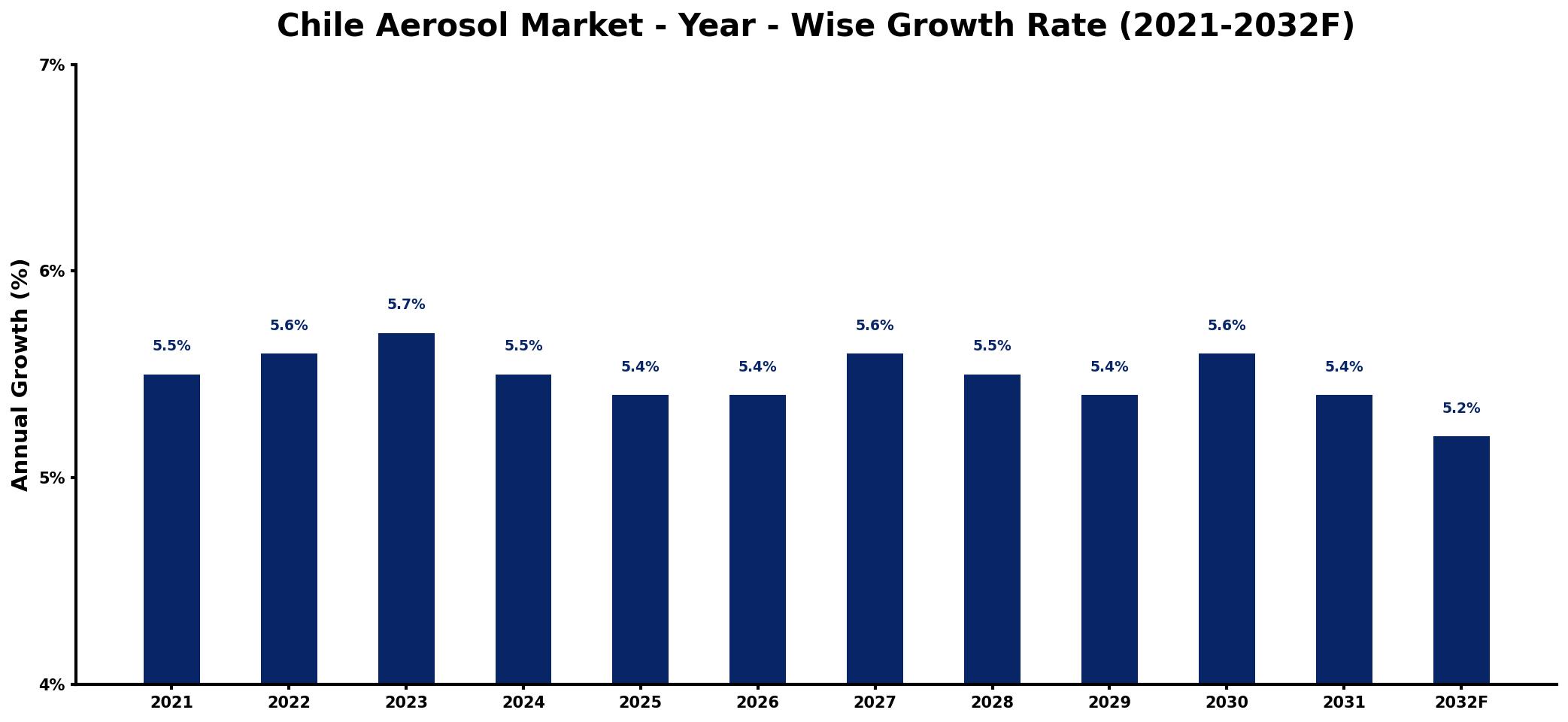
The table below presents the year‑wise growth rates along with the key drivers influencing the market
| Year | Growth Rate | Major Drivers |
| 2021 | 5.5% | Rising demand for homecare products |
| 2022 | 5.6% | Growth in personal care industry |
| 2023 | 5.7% | Increased consumer preference for convenience |
| 2024 | 5.5% | Expansion of retail distribution channels |
| 2025 | 5.4% | Higher investments in product innovation |
| 2026 | 5.4% | increased production capacity utilization |
| 2027 | 5.6% | Surge in outdoor recreational activities |
| 2028 | 5.5% | Increased focus on hygiene standards |
| 2029 | 5.4% | Growing popularity of DIY solutions |
| 2030 | 5.6% | Rise in online shopping trends |
| 2031 | 5.4% | expanding healthcare application demand |
| 2032 | 5.2% | Increased emphasis on health awareness |
Note: Market size estimations and growth projections presented in this report are based on 6Wresearch's proprietary forecasting methodology, utilizing the latest available industry data, government publications, and primary research inputs.
Chile Aerosol Market Synopsis
The Chile Aerosol Market is currently on an upward trend, reflecting a shift in consumer preferences toward convenience and eco-friendliness. This momentum is expected to continue as urbanization accelerates, coupled with an increasing focus on personal care and household hygiene products.
As the market matures, companies are responding to consumer demands by innovating product formulations and packaging. The emphasis on sustainability is reshaping the competitive landscape, ensuring that the market is poised for growth while addressing environmental concerns.
Chile Aerosol Market Key Takeaways
- The market is experiencing steady growth due to rising disposable incomes and urban lifestyles.
- Innovation in product formulations and eco-friendly packaging is driving competitive differentiation.
- Consumers are increasingly favoring aerosol products for their convenience and ease of use.
- Government regulations are pushing the market towards more sustainable aerosol solutions.
- Opportunities exist in the personal care and household segments for investment in eco-conscious products.
Evaluation of Restraints in Chile Aerosol Market
While the Chile Aerosol Market is positioned for growth, there are notable restraints that could impede progress. Chief among these are stringent environmental regulations that demand adherence to eco-friendly practices, forcing manufacturers to innovate continually. The competitive landscape poses additional challenges, as numerous players compete for market share, often leading to price wars that can diminish profitability. Furthermore, fluctuations in raw material costs can impact production expenses, necessitating agility and cost management from manufacturers to maintain their market positions.
Chile Aerosol Market Trends
Several key trends are shaping the Chile Aerosol Market. A marked shift towards eco-friendly and sustainable products is evident, with consumers actively seeking aerosols devoid of harmful chemicals. Additionally, aerosol packaging's convenience and user-friendliness are propelling demand in personal care and household cleaning products. Innovations in packaging designs and formulations are also emerging as manufacturers strive to differentiate themselves in a crowded marketplace.
Chile Aerosol Market Opportunities
Investment opportunities abound in the Chile Aerosol Market, particularly in the personal care and household product segments. The rise in consumer demand for convenience is prompting interest in products such as deodorants and air fresheners. Furthermore, the trend toward eco-friendly solutions presents a lucrative avenue for investors willing to develop sustainable aerosol products. By focusing on innovative formulations and packaging technologies, companies can capitalize on the changing market dynamics.
Government Initiatives in the Chile Aerosol Market
The Chilean government is actively pursuing policies aimed at environmental protection and consumer safety in the aerosol market. Regulations concerning the use of specific propellants are in place to mitigate their impact on the ozone layer, while labeling requirements ensure consumer awareness of product contents. Additionally, initiatives promoting recycling of aerosol containers are fostering sustainable practices within the industry, reflecting a commitment to environmental stewardship.
Future Insights of the Chile Aerosol Market
Looking ahead to 2026-2032, the Chile Aerosol Market is expected to maintain its growth momentum, driven by a continued rise in consumer purchasing power and heightened awareness of hygiene standards. As the market evolves, manufacturers will likely prioritize innovation, focusing on sustainable formulations and packaging to resonate with consumer values. This proactive approach will not only support market expansion but also align with the growing demand for environmentally responsible products.
Chile Aerosol Market Latest Developments (2025 - 2026)
Recent developments in the Chile Aerosol Market have centered around sustainability and product innovation. Companies are increasingly investing in eco-friendly formulations, responding to consumer demand for greener products. New regulations aimed at promoting the recycling of aerosol cans are being implemented, pushing manufacturers to adopt more sustainable practices. Additionally, the introduction of novel product lines in personal care and household cleaning aerosols is becoming a focal point for driving consumer interest and market growth.
Chile Aerosol Market - Key Attractiveness of the Report
- 10 Years of Market Numbers
- Historical Data Starting from 2022 to 2025
- Base Year: 2025
- Forecast Data until 2032
- Key Performance Indicators Impacting the Market
- Major Upcoming Developments and Projects
Key Highlights of the Report:
- Chile Aerosol Market Outlook
- Market Size of Chile Aerosol Market, 2025
- Forecast of Chile Aerosol Market, 2032
- Historical Data and Forecast of Chile Aerosol Revenues & Volume for the Period 2022-2032F
- Chile Aerosol Market Trend Evolution
- Chile Aerosol Market Drivers and Challenges
- Chile Aerosol Price Trends
- Chile Aerosol Porter's Five Forces
- Chile Aerosol Industry Life Cycle
- Historical Data and Forecast of Chile Aerosol Market Revenues & Volume By Material for the Period 2022-2032F
- Historical Data and Forecast of Chile Aerosol Market Revenues & Volume By Steel for the Period 2022-2032F
- Historical Data and Forecast of Chile Aerosol Market Revenues & Volume By Aluminum for the Period 2022-2032F
- Historical Data and Forecast of Chile Aerosol Market Revenues & Volume By Others for the Period 2022-2032F
- Historical Data and Forecast of Chile Aerosol Market Revenues & Volume By Type for the Period 2022-2032F
- Historical Data and Forecast of Chile Aerosol Market Revenues & Volume By Bag-In-Valve for the Period 2022-2032F
- Historical Data and Forecast of Chile Aerosol Market Revenues & Volume By Standard for the Period 2022-2032F
- Historical Data and Forecast of Chile Aerosol Market Revenues & Volume By Application for the Period 2022-2032F
- Historical Data and Forecast of Chile Aerosol Market Revenues & Volume By Personal Care for the Period 2022-2032F
- Historical Data and Forecast of Chile Aerosol Market Revenues & Volume By Household for the Period 2022-2032F
- Historical Data and Forecast of Chile Aerosol Market Revenues & Volume By Automotive & Industrial for the Period 2022-2032F
- Historical Data and Forecast of Chile Aerosol Market Revenues & Volume By Food for the Period 2022-2032F
- Historical Data and Forecast of Chile Aerosol Market Revenues & Volume By Paints for the Period 2022-2032F
- Historical Data and Forecast of Chile Aerosol Market Revenues & Volume By Medical for the Period 2022-2032F
- Historical Data and Forecast of Chile Aerosol Market Revenues & Volume By Others for the Period 2022-2032F
- Chile Aerosol Import Export Trade Statistics
- Market Opportunity Assessment By Material
- Market Opportunity Assessment By Type
- Market Opportunity Assessment By Application
- Chile Aerosol Top Companies Market Share
- Chile Aerosol Competitive Benchmarking By Technical and Operational Parameters
- Chile Aerosol Company Profiles
- Chile Aerosol Key Strategic Recommendations






































