Chile Applicant Tracking System Market Size & Growth Rate (2026-2032)
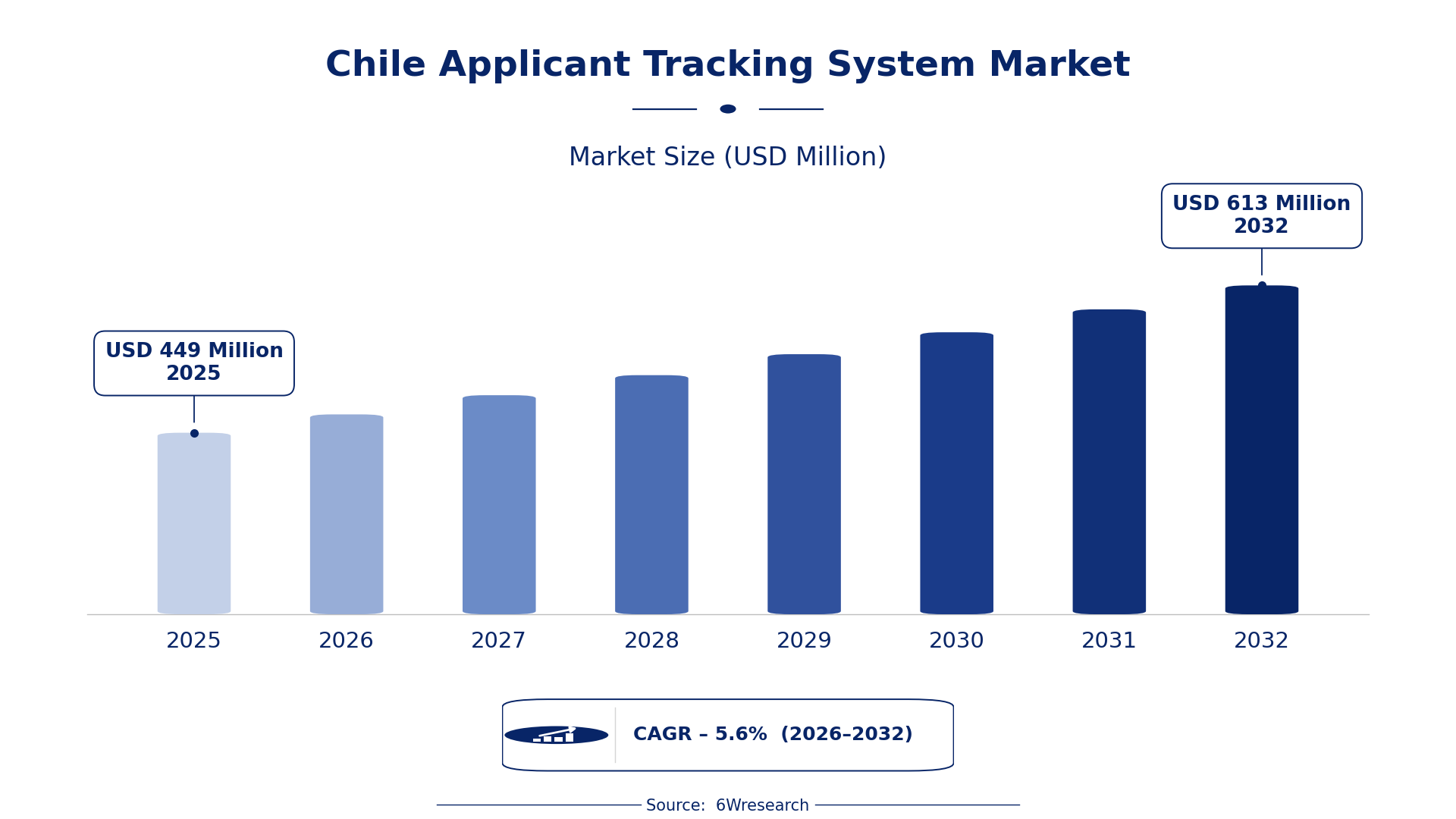
The Chile Applicant Tracking System Market was estimated at USD 449 Million in 2025 and is projected to reach USD 613 Million by 2032, growing at a CAGR of 5.6% from 2026 to 2032.
Chile Applicant Tracking System Market Synopsis
The Chile Applicant Tracking System (ATS) market is currently thriving, driven by a strong emphasis on optimizing recruitment processes across diverse industries. As organizations grapple with the competition for top talent, there is a growing recognition of the need for advanced technology solutions that streamline hiring and enhance the candidate experience.
Cloud-based ATS solutions are gaining traction, offering scalability and flexibility that traditional systems cannot match. This shift is indicative of a broader trend toward digitization in the recruitment space, where automation and data analytics are increasingly essential for attracting and retaining skilled professionals.
Chile Applicant Tracking System Market Year-wise Growth Rate and Key Drivers
This graph illustrates the annual growth rates of the Chile Applicant Tracking System Market from 2021 to 2032, highlighting a steady upward trajectory and projected expansion over the forecast period.
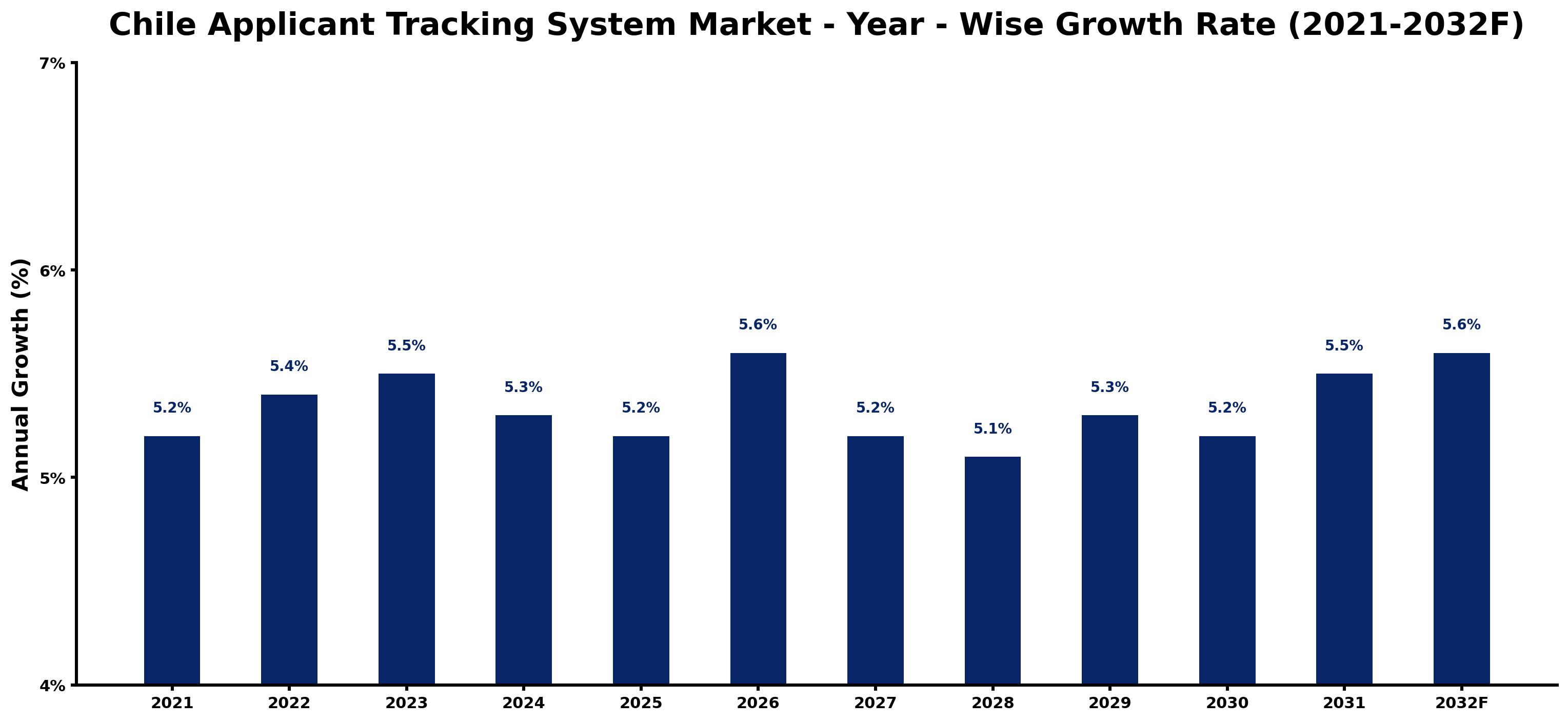
The table below presents the year‑wise growth rates along with the key drivers influencing the market
| Year | Growth Rate | Major Drivers |
| 2021 | 5.2% | Increased demand for digital solutions post-pandemic. |
| 2022 | 5.4% | Government incentives for tech adoption in HR management. |
| 2023 | 5.5% | Rise in startups seeking efficient hiring processes. |
| 2024 | 5.3% | Integration of AI technologies in local recruitment platforms. |
| 2025 | 5.2% | Growing emphasis on diversity hiring practices among companies. |
| 2026 | 5.6% | Technological advancements in candidate screening tools. |
| 2027 | 5.2% | Increased remote job offerings from local businesses. |
| 2028 | 5.1% | Emphasis on employer branding in recruitment strategies. |
| 2029 | 5.3% | Regulatory support for data privacy in hiring processes. |
| 2030 | 5.2% | Growing talent competition driving adoption of ATS solutions. |
| 2031 | 5.5% | Local universities promoting tech-driven workforce development. |
| 2032 | 5.6% | Increased funding for HR tech startups in Chile. |
Note: Market size estimations and growth projections presented in this report are based on 6Wresearch's proprietary forecasting methodology, utilizing the latest available industry data, government publications, and primary research inputs.
Chile Applicant Tracking System Market Key Takeaways
Below are some of the specific key takeaways from the market, including:
- The market is experiencing a notable shift towards cloud-based ATS solutions, enhancing flexibility for businesses.
- Companies are prioritizing advanced features like AI-driven analytics to improve recruitment outcomes.
- Compliance with data protection regulations is becoming a critical factor in ATS implementation.
- The competition for skilled talent is driving organizations to invest in sophisticated ATS technologies.
- Streamlining hiring processes remains a primary focus for businesses looking to optimize their recruitment strategies.
Evaluation of Restraints in Chile Applicant Tracking System Market
Despite the promising growth trajectory, the Chile ATS market faces several constraints that could hinder progress. Customization requirements often complicate the adoption of ATS solutions, as organizations seek systems that align with their specific workflows. This often leads to prolonged implementation times and increased costs.
Integration with existing HR software can also be a hurdle, as companies aim to ensure seamless data flow and accuracy. on top of that, navigating local labor laws and data protection regulations adds another layer of complexity that must be managed carefully by vendors and users alike.
Chile Applicant Tracking System Market Trends
The Chile ATS market is currently influenced by several key trends. Firstly, the demand for AI and machine learning capabilities within ATS platforms is growing, as organizations seek to enhance candidate matching and streamline decision-making processes. Secondly, there is an increasing focus on mobile optimization, enabling candidates to apply via their smartphones.
on top of that, data analytics are becoming integral to recruitment strategies, providing insights that help organizations make informed hiring decisions. Companies are also emphasizing the importance of candidate experience, aiming to create a more engaging and efficient application process.
Chile Applicant Tracking System Market Opportunities
There are significant opportunities for growth in the Chile ATS market, particularly for providers who can offer tailored solutions that meet the unique demands of local businesses. The rise of remote work has created a need for virtual recruitment tools, which presents an avenue for innovation.
Additionally, companies that prioritize data security and compliance with local regulations will find a receptive market among organizations seeking to mitigate risks associated with applicant data management. The increasing emphasis on diversity and inclusion in hiring practices also creates openings for ATS solutions that support these initiatives.
Government Initiatives in the Chile Applicant Tracking System Market
Government policies in Chile significantly influence the ATS market, particularly regarding data protection and labor regulations. As the government implements stricter data privacy laws, companies must adapt their ATS solutions to ensure compliance and safeguard applicant information. This regulatory focus is critical for fostering trust in digital recruitment processes.
- A national data protection regulation introduced in 2023 mandates enhanced security measures for applicant data management.
- Current initiatives are underway to promote fair hiring practices, which directly impact how ATS systems are utilized in recruitment.
- Ongoing public awareness campaigns aim to educate companies about compliance with new labor laws affecting recruitment practices.
- A planned regulatory framework expected to roll out in 2025 will require ATS providers to demonstrate compliance with updated data protection standards.
Future Insights of the Chile Applicant Tracking System Market
Looking ahead to 2026-2032, the Chile ATS market is set to expand as businesses increasingly adopt technology-driven solutions to enhance their recruitment processes. The continuous evolution of candidate expectations, driven by technological advancements, will push organizations to invest in innovative ATS features.
As the competitive landscape intensifies, companies that harness the power of data analytics and automation will likely see improved hiring outcomes. The future is bright for ATS providers who can adapt to these changes and offer solutions that align with market demands.
Chile Applicant Tracking System Market Latest Developments
Recent industry activity in the Chile ATS market reflects a dynamic shift towards advanced technological solutions. Over the past year, companies have increasingly invested in cloud-based systems to improve recruitment efficiency and candidate engagement. The ongoing trend towards digitization is reshaping how organizations approach talent acquisition.
- A major technology vendor launched a new cloud-based ATS platform in early 2025, designed to enhance user experience and integrate seamlessly with existing HR systems.
- An initiative that began in late 2024 focuses on developing AI-driven tools to aid recruitment teams in identifying top candidates based on skill sets and experience.
- A partnership between several local firms was established in Q1 2025 to create a standardized framework for ATS compliance with Chilean labor laws.
- Upcoming plans for a comprehensive training program aimed at HR professionals are set to roll out by mid-2026, focusing on effective ATS utilization and best practices.
Chile Applicant Tracking System Market - Key Attractiveness of the Report
- 10 Years of Market Numbers
- Historical Data Starting from 2022 to 2025
- Base Year: 2025
- Forecast Data until 2032
- Key Performance Indicators Impacting the Market
- Major Upcoming Developments and Projects
Organizations are increasingly adopting ATS solutions that comply with the Ley de Protección de Datos Personales, ensuring applicant data security and confidentiality.
Key Highlights of the Report:
- Chile Applicant Tracking System Market Outlook
- Market Size of Chile Applicant Tracking System Market, 2025
- Forecast of Chile Applicant Tracking System Market, 2032
- Historical Data and Forecast of Chile Applicant Tracking System Revenues & Volume for the Period 2022-2032F
- Chile Applicant Tracking System Market Trend Evolution
- Chile Applicant Tracking System Market Drivers and Challenges
- Chile Applicant Tracking System Price Trends
- Chile Applicant Tracking System Porter's Five Forces
- Chile Applicant Tracking System Industry Life Cycle
- Historical Data and Forecast of Chile Applicant Tracking System Market Revenues & Volume By Component for the Period 2022-2032F
- Historical Data and Forecast of Chile Applicant Tracking System Market Revenues & Volume By Software for the Period 2022-2032F
- Historical Data and Forecast of Chile Applicant Tracking System Market Revenues & Volume By Services for the Period 2022-2032F
- Historical Data and Forecast of Chile Applicant Tracking System Market Revenues & Volume By Organization Size for the Period 2022-2032F
- Historical Data and Forecast of Chile Applicant Tracking System Market Revenues & Volume By SMEs for the Period 2022-2032F
- Historical Data and Forecast of Chile Applicant Tracking System Market Revenues & Volume By Large Enterprises for the Period 2022-2032F
- Historical Data and Forecast of Chile Applicant Tracking System Market Revenues & Volume By Deployment Mode for the Period 2022-2032F
- Historical Data and Forecast of Chile Applicant Tracking System Market Revenues & Volume By On-Premises for the Period 2022-2032F
- Historical Data and Forecast of Chile Applicant Tracking System Market Revenues & Volume By Cloud for the Period 2022-2032F
- Historical Data and Forecast of Chile Applicant Tracking System Market Revenues & Volume By Vertical for the Period 2022-2032F
- Historical Data and Forecast of Chile Applicant Tracking System Market Revenues & Volume By BFSI for the Period 2022-2032F
- Historical Data and Forecast of Chile Applicant Tracking System Market Revenues & Volume By Government for the Period 2022-2032F
- Historical Data and Forecast of Chile Applicant Tracking System Market Revenues & Volume By Manufacturing for the Period 2022-2032F
- Historical Data and Forecast of Chile Applicant Tracking System Market Revenues & Volume By Telecom and IT for the Period 2022-2032F
- Historical Data and Forecast of Chile Applicant Tracking System Market Revenues & Volume By Consumer Goods and Retail for the Period 2022-2032F
- Historical Data and Forecast of Chile Applicant Tracking System Market Revenues & Volume By Healthcare and Lifesciencs for the Period 2022-2032F
- Historical Data and Forecast of Chile Applicant Tracking System Market Revenues & Volume By Energy and Utilities for the Period 2022-2032F
- Historical Data and Forecast of Chile Applicant Tracking System Market Revenues & Volume By Transportation and Logistics for the Period 2022-2032F
- Chile Applicant Tracking System Import Export Trade Statistics
- Market Opportunity Assessment By Component
- Market Opportunity Assessment By Organization Size
- Market Opportunity Assessment By Deployment Mode
- Market Opportunity Assessment By Vertical
- Chile Applicant Tracking System Top Companies Market Share
- Chile Applicant Tracking System Competitive Benchmarking By Technical and Operational Parameters
- Chile Applicant Tracking System Company Profiles
- Chile Applicant Tracking System Key Strategic Recommendations






































