Chile Cameras Market Summary
The chile cameras market was estimated at USD 1076 Million in 2025 and is projected to reach USD 1548 Million by 2032, growing at a CAGR of 6.5% from 2026 to 2032.
Chile Cameras Market Year-wise Growth Rate and Key Drivers
This graph highlights how the Chile Cameras Market has steadily grown over the years, supported by major growth factors.
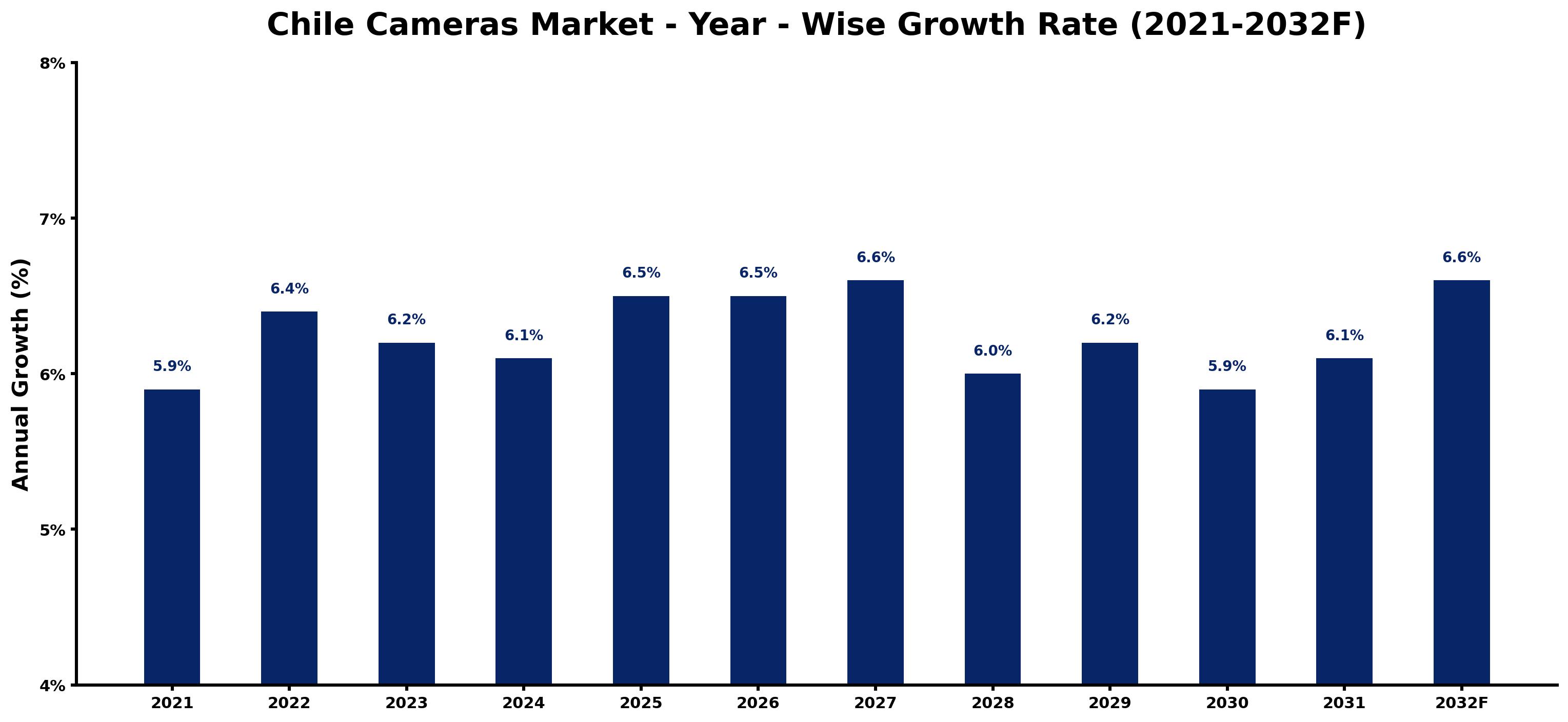
The table below presents the year wise growth rates along with the key drivers influencing the market
| Year | Growth Rate | Major Drivers |
| 2021 | 5.9% | Post-lockdown retail projects emphasize the importance of high-quality camera equipment. |
| 2022 | 6.4% | Photography enthusiasts increasingly seek advanced features in mid-range cameras. |
| 2023 | 6.2% | Consumer interest in outdoor and nature photography boosts camera sales across regions. |
| 2024 | 6.1% | Emergence of new influencers creates demand for content creation tools among youth. |
| 2025 | 6.5% | Technological improvements in image stabilization capture attention of professional photographers. |
| 2026 | 6.5% | Popularity of virtual events encourages investment in live streaming camera technology. |
| 2027 | 6.6% | Emerging trends in travel photography inspire purchases of lightweight camera options. |
| 2028 | 6.0% | Collaboration between brands and travel agencies enhances camera visibility in tourism. |
| 2029 | 6.2% | Online photo-sharing platforms motivate users to upgrade their camera equipment continuously. |
| 2030 | 5.9% | Sustainability efforts lead brands to develop eco-friendly materials for camera production. |
| 2031 | 6.1% | Integration of AI features in cameras simplifies user experience for first-time buyers. |
| 2032 | 6.6% | Global sporting events facilitate partnerships, boosting premium camera sales in Chile. |
Note - Market size estimations and growth projections presented in this report are based on 6Wresearch's advanced forecasting approach, validated with industry datasets as of June 2026.
Chile Cameras Market Synopsis
The Chile Cameras Market is projected to reach 6.5% and witness significant growth during the forecast period (2026-2032). This expansion is primarily supported by technological advancements, an increase in disposable income, and a growing interest in photography and videography among the Chilean population. The market encompasses a diverse range of products, including DSLRs, mirrorless cameras, action cameras, and drones, catering to both casual consumers and professional photographers.
Chile Cameras Market Growth Drivers
Several factors are propelling the growth of the Chile Cameras Market. Firstly, the increasing disposable income of consumers allows for greater spending on high-quality imaging products. Secondly, the rising popularity of social media platforms encourages individuals to invest in superior camera equipment to enhance their visual content. Moreover, technological advancements in camera features, including improved image stabilization, faster autofocus, and enhanced video capabilities, are attracting a wider customer base.
- The proliferation of technological innovations such as AI-driven imaging technologies is enhancing user experience.
- Growing interest in outdoor activities and sports is leading to increased demand for durable action cameras particularly suited for adventure enthusiasts.
- There is a noticeable shift toward compact and lightweight cameras, making them more appealing for vloggers and travel enthusiasts.
- The need for high-quality imaging in professional settings, including marketing and advertising, is fostering an uptick in camera purchases.
- Moreover, educational initiatives promoting photography skills are contributing to a more informed consumer base that seeks quality equipment.
Chile Cameras Market Trends and Opportunities
The trend towards mirrorless cameras is particularly noteworthy, as these devices continue to gain traction among photography enthusiasts and professionals alike. Their compactness and superior technology provide advantages that traditional DSLRs may struggle to match. Additionally, the increasing demand for cameras with enhanced connectivity features, such as Wi-Fi and Bluetooth, reflects the evolving preferences of consumers for seamless sharing and editing of images.
- Social media influencers are driving a significant portion of camera sales, necessitating user-friendly designs that cater to non-professional users.
- As a result of these trends, manufacturers are focusing on developing compact cameras with user-friendly interfaces and advanced functionalities.
- The burgeoning market for content creation is also propelling interest in professional-grade filming equipment, including drones, which can capture high-definition aerial footage.
- Furthermore, with the rise of online tutorials and photography courses, there is a growing segment of consumers eager to invest in quality gear.
- Meanwhile, the demand for surveillance and security cameras is on the rise due to heightened concerns over safety, presenting additional opportunities for market players.
Chile Cameras Market Challenges and Restraints
Despite its growth potential, the Chile Cameras Market faces several challenges. A significant hurdle comes from the fierce competition posed by smartphone cameras, which now boast advanced photographic capabilities at lower price points. This has resulted in a marked decline in sales of traditional digital cameras, particularly among casual users. Additionally, economic factors such as fluctuating exchange rates and import tariffs can lead to inflated prices, consequently affecting consumer purchasing decisions.
- The rapid pace of technological advancements necessitates continuous innovation, compelling manufacturers to invest heavily in research and development.
- The lingering effects of the COVID-19 pandemic have disrupted supply chains, leading to inconsistencies in product availability.
- Market players must navigate shifting consumer preferences, which are increasingly influenced by convenience and multifunctionality in devices.
- Moreover, the market is witnessing a need for robust marketing strategies to combat the prevalent consumer perception that smartphones can fulfill their photography needs.
- Finally, privacy concerns regarding the usage of certain camera technologies can inhibit market growth in specific segments.
Chile Cameras Market Government Investment and Initiatives
The Chilean government has initiated several policies aimed at regulating and promoting the Cameras Market within the country. Notably, import tariffs and taxes on camera equipment have been established to protect local manufacturers and stimulate domestic production. Furthermore, regulations ensure that safety and quality standards are upheld for cameras sold in the market, requiring certification for imported products. The government has also introduced incentives and subsidies for companies engaged in research and development of innovative camera technologies, fostering an environment conducive to growth and competitiveness in the sector. Overall, these government initiatives seek to strike a balance between consumer protection, support for local industry, and the encouragement of technological advancements.
Chile Cameras Market Latest Developments (May 2025 - June 2026)
Recent developments in the Chile Cameras Market indicate a sustained momentum towards innovation and user-centric design. Companies are increasingly focusing on integrating AI features into their products, enhancing the overall user experience while catering to the evolving demands of consumers. Moreover, the market has seen the introduction of models with enhanced durability and versatility suited for extreme outdoor conditions, reflecting the growing interest in adventure sports.
- Marketers are leveraging social media platforms to reach a wider audience, successfully targeting content creators and aspiring photographers.
- There is a marked increase in collaborations between manufacturers and tech companies to develop smarter, more interconnected camera systems.
- Additionally, consumer feedback is being actively solicited to drive product enhancements, leading to rapid iteration cycles in camera design and functionality.
- Supply chain recovery efforts post-pandemic have improved product availability, contributing positively to market dynamics.
- Lastly, the acknowledgment of the importance of security has seen a rise in advanced surveillance camera offerings tailored for both residential and commercial use.
Chile Cameras Market - Key Attractiveness of the Report
- 10 Years of Market Numbers
- Historical Data Starting from 2022 to 2025
- Base Year: 2025
- Forecast Data until 2032
- Key Performance Indicators Impacting the Market
- Major Upcoming Developments and Projects
Key Highlights of the Report:
- Chile Cameras Market Outlook
- Market Size of Chile Cameras Market, 2025
- Forecast of Chile Cameras Market, 2032F
- Historical Data and Forecast of Chile Cameras Revenues & Volume for the Period 2022-2032F
- Chile Cameras Market Trend Evolution
- Chile Cameras Market Drivers and Challenges
- Chile Cameras Price Trends
- Chile Cameras Porter's Five Forces
- Chile Cameras Industry Life Cycle
- Historical Data and Forecast of Chile Cameras Market Revenues & Volume By Product Type for the Period 2022-2032F
- Historical Data and Forecast of Chile Cameras Market Revenues & Volume By Built-in Lens Camera for the Period 2022-2032F
- Historical Data and Forecast of Chile Cameras Market Revenues & Volume By Interchangeable Lens Camera for the Period 2022-2032F
- Historical Data and Forecast of Chile Cameras Market Revenues & Volume By DSLR for the Period 2022-2032F
- Historical Data and Forecast of Chile Cameras Market Revenues & Volume By Non-reflex for the Period 2022-2032F
- Historical Data and Forecast of Chile Cameras Market Revenues & Volume By Application for the Period 2022-2032F
- Historical Data and Forecast of Chile Cameras Market Revenues & Volume By Commercial for the Period 2022-2032F
- Historical Data and Forecast of Chile Cameras Market Revenues & Volume By Residential for the Period 2022-2032F
- Historical Data and Forecast of Chile Cameras Market Revenues & Volume By Distribution Channel for the Period 2022-2032F
- Historical Data and Forecast of Chile Cameras Market Revenues & Volume By Online for the Period 2022-2032F
- Historical Data and Forecast of Chile Cameras Market Revenues & Volume By Offline for the Period 2022-2032F
- Chile Cameras Import Export Trade Statistics
- Market Opportunity Assessment By Product Type
- Market Opportunity Assessment By Application
- Market Opportunity Assessment By Distribution Channel
- Chile Cameras Top Companies Market Share
- Chile Cameras Competitive Benchmarking By Technical and Operational Parameters
- Chile Cameras Company Profiles
- Chile Cameras Key Strategic Recommendations






































