Chile Cloud Managed Services Market Size & Growth Rate (2026-2032)
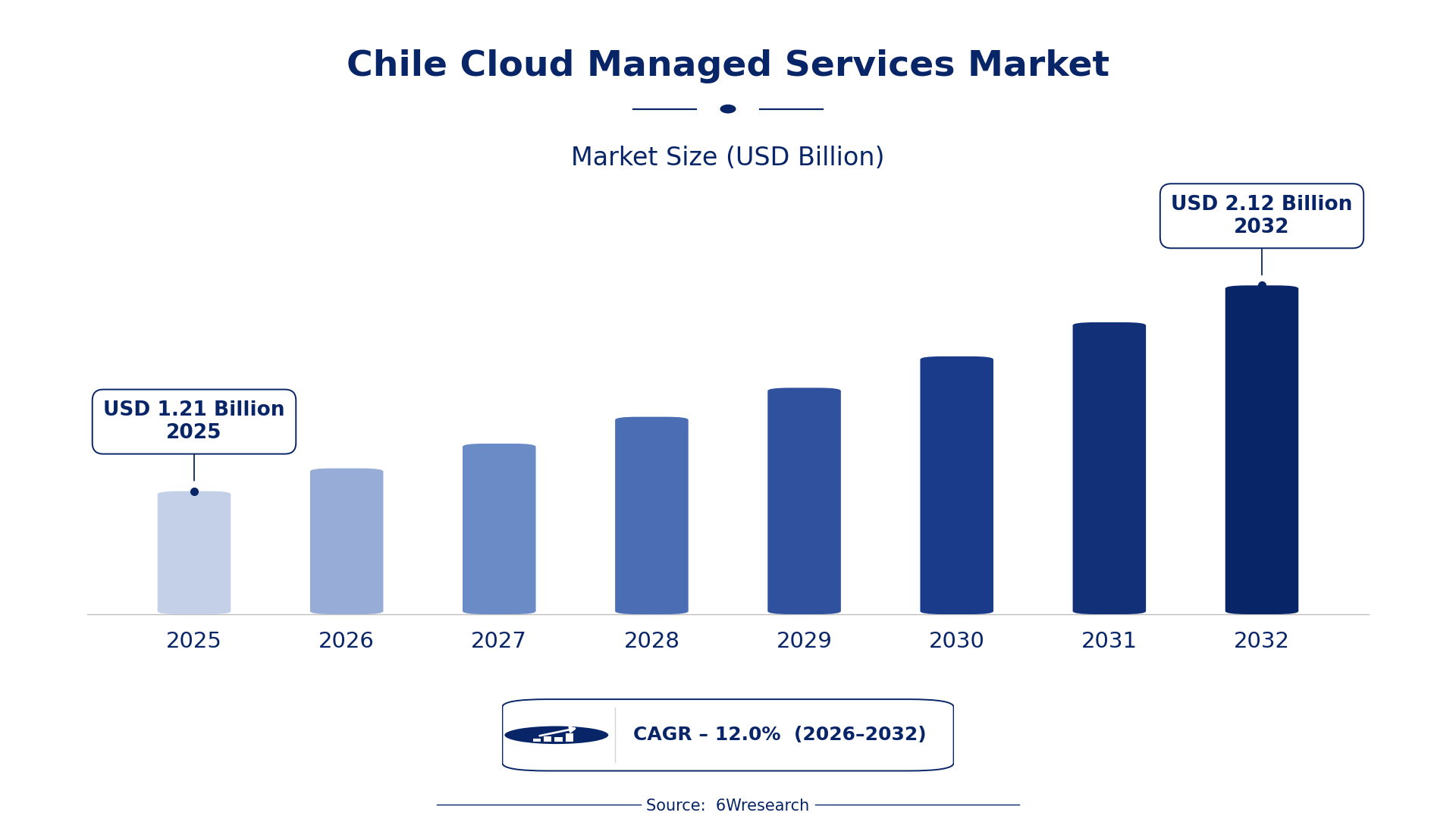
The Chile Cloud Managed Services Market was estimated at USD 1210 Million in 2025 and is projected to reach USD 2120 Million by 2032, growing at a CAGR of 12.0% from 2026 to 2032.
Chile Cloud Managed Services Market Synopsis
In Chile, the surge in demand for cloud managed services is primarily driven by organizations seeking to outsource their IT operations. The increasing complexity of cloud environments compels businesses to rely on managed service providers (MSPs) to ensure the effective management of their cloud infrastructure.
As companies focus on their core competencies, they are turning to MSPs for essential services such as cloud migration, monitoring, and security. This shift is not just about efficiency; it’s also about tapping into specialized knowledge that can navigate the intricacies of cloud technology.
Chile Cloud Managed Services Market Year-wise Growth Rate and Key Drivers
This graph illustrates the annual growth rates of the Chile Cloud Managed Services Market from 2021 to 2032, highlighting a steady upward trajectory and projected expansion over the forecast period.
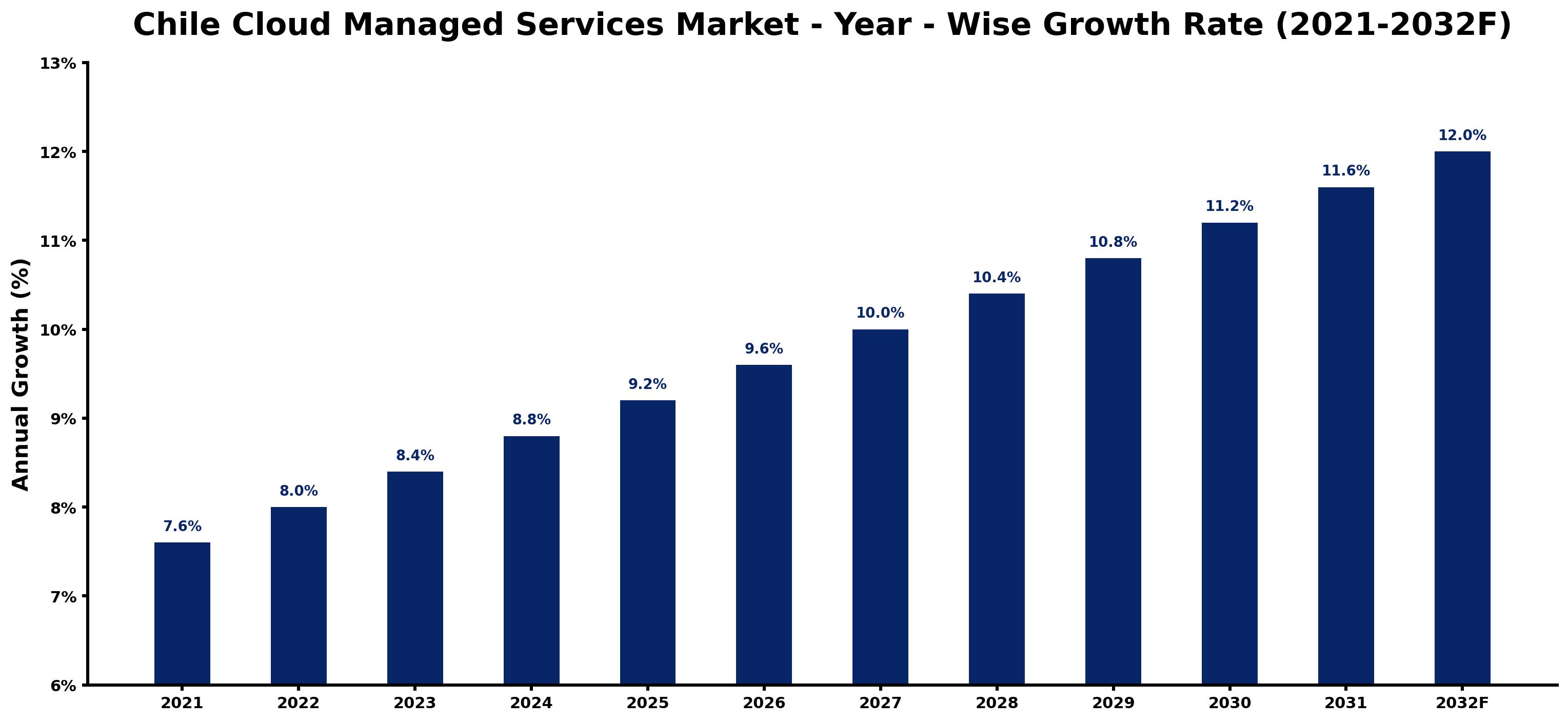
The table below presents the year‑wise growth rates along with the key drivers influencing the market
| Year | Growth Rate | Major Drivers |
| 2021 | 7.6% | Chile's National Cybersecurity Policy enhancing cloud service trust. |
| 2022 | 8.0% | Growth of fintech startups driving cloud adoption in Chile. |
| 2023 | 8.4% | Local universities promoting cloud technology in their curriculum. |
| 2024 | 8.8% | International companies establishing data centers boosting local services. |
| 2025 | 9.2% | Government incentives for SMEs to adopt cloud solutions. |
| 2026 | 9.6% | Surge in e-commerce requiring robust cloud infrastructure. |
| 2027 | 10.0% | Proliferation of IoT devices demanding managed cloud services. |
| 2028 | 10.4% | Increase in telehealth services enhancing cloud service needs. |
| 2029 | 10.8% | Higher investment in digital marketing requires scalable solutions. |
| 2030 | 11.2% | Rise in renewable energy firms leveraging cloud capabilities. |
| 2031 | 11.6% | Agriculture technology advancements pushing cloud service utilization. |
| 2032 | 12.0% | Smart city projects necessitating integrated cloud-managed services. |
Note: Market size estimations and growth projections presented in this report are based on 6Wresearch's proprietary forecasting methodology, utilizing the latest available industry data, government publications, and primary research inputs.
Chile Cloud Managed Services Market Key Takeaways
Below are some of the specific key takeaways from the market, including:
- Rising demand for specialized cloud management services among enterprises.
- The increasing complexity of cloud environments necessitates expert intervention.
- Organizations are prioritizing security and performance in their cloud strategies.
- The shortage of in-house IT skills is pushing firms towards managed services.
- Government initiatives are fostering partnerships between MSPs and local businesses.
Evaluation of Restraints in Chile Cloud Managed Services Market
While the adoption of cloud managed services is gaining momentum, businesses in Chile face significant barriers. One critical issue is the challenge of identifying trustworthy service providers. Companies often grapple with the complexity of negotiating service level agreements (SLAs) that adequately protect their interests. on top of that, maintaining visibility and control over outsourced IT processes remains a concern for many organizations, which can hinder their willingness to fully embrace managed services.
Chile Cloud Managed Services Market Trends
The Chile Cloud Managed Services Market is currently influenced by several key trends. A notable trend is the rising emphasis on cybersecurity, with organizations increasingly prioritizing secure cloud environments to protect sensitive data. Additionally, the integration of artificial intelligence and machine learning into cloud services is enabling more efficient operations and predictive analytics.
Another emerging trend is the movement towards hybrid cloud solutions, allowing companies to balance on-premises and cloud-based resources effectively. This flexibility caters to diverse business needs, paving the way for tailored service offerings from MSPs.
Chile Cloud Managed Services Market Opportunities
The growth trajectory of the Chile Cloud Managed Services Market reveals numerous opportunities for investment and expansion. As organizations continue to undergo digital transformation, the demand for managed services that facilitate cloud migration and optimization will increase. Additionally, sectors such as healthcare and finance are recognizing the need for compliant, secure cloud solutions, driving further growth.
on top of that, as the government fosters partnerships between local enterprises and MSPs, there is a ripe opportunity for service providers to innovate and tailor solutions that address specific industry challenges.
Government Initiatives in the Chile Cloud Managed Services Market
The Chilean government is actively promoting cloud managed services as part of its broader digital transformation agenda. By enhancing public service delivery through partnerships with managed service providers, the government is creating a conducive environment for businesses to adopt these solutions. Regulatory reforms aimed at optimizing IT operations are also playing a crucial role in shaping the market.
- A recently completed initiative focused on public sector digital infrastructure improvement has enhanced service delivery efficiency.
- A current program is underway to establish a regulatory framework that encourages transparency in service level agreements.
- Planned initiatives aim to expand access to cloud infrastructure across rural areas, supporting localized businesses.
- Ongoing collaborations between government agencies and MSPs are designed to streamline public services through cloud solutions.
- Future policies are expected to incentivize businesses to adopt cloud services through tax benefits and grants.
Future Insights of the Chile Cloud Managed Services Market
Looking ahead to 2026-2032, the Chile Cloud Managed Services Market is set to experience substantial growth driven by ongoing digital transformation efforts. As organizations increasingly recognize the strategic value of outsourcing cloud management, the market will expand. The convergence of technological advancements with evolving business needs will create a fertile ground for innovative service offerings. on top of that, the increasing demand for security and compliance in cloud environments will further fuel the adoption of managed services across various sectors.
Chile Cloud Managed Services Market Latest Developments
Over the past 12-14 months, the Chile Cloud Managed Services Market has seen a notable uptick in industry activity. This has included a wave of partnerships between local enterprises and MSPs aimed at enhancing service delivery and operational efficiency. The focus on cybersecurity has intensified, prompting service providers to roll out new security-focused offerings.
- A leading regional operator launched a new suite of cloud security services in Q1 2025, aimed at bolstering data protection for enterprises.
- An initiative that began in late 2025 to upgrade cloud infrastructure for public services is currently underway, targeting improved efficiency and access.
- Plans are in place for a significant partnership between technology vendors and local firms expected to kick off in mid-2026, focusing on AI-driven cloud solutions.
- A major technology vendor completed a comprehensive cloud migration project for a large financial institution by the end of 2025, showcasing successful sector-specific solutions.
- Ongoing discussions are in progress regarding regulatory changes aimed at enhancing data sovereignty for cloud services, expected to conclude by 2026.
Chile Cloud Managed Services Market - Key Attractiveness of the Report
- 10 Years of Market Numbers
- Historical Data Starting from 2022 to 2025
- Base Year: 2025
- Forecast Data until 2032
- Key Performance Indicators Impacting the Market
- Major Upcoming Developments and Projects
Opportunities lie in expanding cloud services for sectors like healthcare and finance, where compliance and security are top priorities, along with the government’s initiatives to boost local cloud infrastructure.
Key Highlights of the Report:
- Chile Cloud Managed Services Market Outlook
- Market Size of Chile Cloud Managed Services Market, 2025
- Forecast of Chile Cloud Managed Services Market, 2032
- Historical Data and Forecast of Chile Cloud Managed Services Revenues & Volume for the Period 2022-2032F
- Chile Cloud Managed Services Market Trend Evolution
- Chile Cloud Managed Services Market Drivers and Challenges
- Chile Cloud Managed Services Price Trends
- Chile Cloud Managed Services Porter's Five Forces
- Chile Cloud Managed Services Industry Life Cycle
- Historical Data and Forecast of Chile Cloud Managed Services Market Revenues & Volume By Service Type for the Period 2022-2032F
- Historical Data and Forecast of Chile Cloud Managed Services Market Revenues & Volume By Managed Security Services for the Period 2022-2032F
- Historical Data and Forecast of Chile Cloud Managed Services Market Revenues & Volume By Managed Network Services for the Period 2022-2032F
- Historical Data and Forecast of Chile Cloud Managed Services Market Revenues & Volume By Managed Infrastructure Services for the Period 2022-2032F
- Historical Data and Forecast of Chile Cloud Managed Services Market Revenues & Volume By Managed Communication & Collaboration Services for the Period 2022-2032F
- Historical Data and Forecast of Chile Cloud Managed Services Market Revenues & Volume By Managed Mobility Services for the Period 2022-2032F
- Historical Data and Forecast of Chile Cloud Managed Services Market Revenues & Volume By Managed Business Services for the Period 2022-2032F
- Historical Data and Forecast of Chile Cloud Managed Services Market Revenues & Volume By Security Services for the Period 2022-2032F
- Historical Data and Forecast of Chile Cloud Managed Services Market Revenues & Volume By Managed Identity & Access Management for the Period 2022-2032F
- Historical Data and Forecast of Chile Cloud Managed Services Market Revenues & Volume By Managed Antivirus/Anti-Malware for the Period 2022-2032F
- Historical Data and Forecast of Chile Cloud Managed Services Market Revenues & Volume By Managed Firewall for the Period 2022-2032F
- Historical Data and Forecast of Chile Cloud Managed Services Market Revenues & Volume By Managed Risk & Compliance Management for the Period 2022-2032F
- Historical Data and Forecast of Chile Cloud Managed Services Market Revenues & Volume By Managed Vulnerability Management for the Period 2022-2032F
- Historical Data and Forecast of Chile Cloud Managed Services Market Revenues & Volume By Managed Security Information & Event Management for the Period 2022-2032F
- Historical Data and Forecast of Chile Cloud Managed Services Market Revenues & Volume By Managed Intrusion Detection System/Intrusion Prevention System for the Period 2022-2032F
- Historical Data and Forecast of Chile Cloud Managed Services Market Revenues & Volume By Managed Data Loss Prevention for the Period 2022-2032F
- Historical Data and Forecast of Chile Cloud Managed Services Market Revenues & Volume By Network Services for the Period 2022-2032F
- Historical Data and Forecast of Chile Cloud Managed Services Market Revenues & Volume By Managed Network Provisioning for the Period 2022-2032F
- Historical Data and Forecast of Chile Cloud Managed Services Market Revenues & Volume By Managed Network Monitoring & Management for the Period 2022-2032F
- Historical Data and Forecast of Chile Cloud Managed Services Market Revenues & Volume By Infrastructure Services for the Period 2022-2032F
- Historical Data and Forecast of Chile Cloud Managed Services Market Revenues & Volume By Storage Management for the Period 2022-2032F
- Historical Data and Forecast of Chile Cloud Managed Services Market Revenues & Volume By Server Management for the Period 2022-2032F
- Historical Data and Forecast of Chile Cloud Managed Services Market Revenues & Volume By Managed Print Services for the Period 2022-2032F
- Historical Data and Forecast of Chile Cloud Managed Services Market Revenues & Volume By Managed Communication & Collaboration Services for the Period 2022-2032F
- Historical Data and Forecast of Chile Cloud Managed Services Market Revenues & Volume By Managed Voice Over Internet Protocol for the Period 2022-2032F
- Historical Data and Forecast of Chile Cloud Managed Services Market Revenues & Volume By Managed Unified Communication as a Service for the Period 2022-2032F
- Historical Data and Forecast of Chile Cloud Managed Services Market Revenues & Volume By Managed Mobility Services for the Period 2022-2032F
- Historical Data and Forecast of Chile Cloud Managed Services Market Revenues & Volume By Device Management Services for the Period 2022-2032F
- Historical Data and Forecast of Chile Cloud Managed Services Market Revenues & Volume By Application Management Services for the Period 2022-2032F
- Historical Data and Forecast of Chile Cloud Managed Services Market Revenues & Volume By Managed Business Services for the Period 2022-2032F
- Historical Data and Forecast of Chile Cloud Managed Services Market Revenues & Volume By Business Process Services for the Period 2022-2032F
- Historical Data and Forecast of Chile Cloud Managed Services Market Revenues & Volume By Continuity & Disaster Recovery Services for the Period 2022-2032F
- Historical Data and Forecast of Chile Cloud Managed Services Market Revenues & Volume By Other Managed Business Services for the Period 2022-2032F
- Historical Data and Forecast of Chile Cloud Managed Services Market Revenues & Volume By Organization Size for the Period 2022-2032F
- Historical Data and Forecast of Chile Cloud Managed Services Market Revenues & Volume By SMEs for the Period 2022-2032F
- Historical Data and Forecast of Chile Cloud Managed Services Market Revenues & Volume By Large Enterprises for the Period 2022-2032F
- Chile Cloud Managed Services Import Export Trade Statistics
- Market Opportunity Assessment By Service Type
- Market Opportunity Assessment By Security Services
- Market Opportunity Assessment By Network Services
- Market Opportunity Assessment By Infrastructure Services
- Market Opportunity Assessment By Managed Communication & Collaboration Services
- Market Opportunity Assessment By Managed Mobility Services
- Market Opportunity Assessment By Managed Business Services
- Market Opportunity Assessment By Organization Size
- Chile Cloud Managed Services Top Companies Market Share
- Chile Cloud Managed Services Competitive Benchmarking By Technical and Operational Parameters
- Chile Cloud Managed Services Company Profiles
- Chile Cloud Managed Services Key Strategic Recommendations






































